ADHD Paralysis vs Executive Dysfunction: Same Thing or Not?
Disclaimer: This article is for informational and educational purposes only. It is not a substitute for professional medical advice, diagnosis, or treatment. If you suspect you have ADHD, please consult a qualified healthcare provider.
ADHD paralysis and executive dysfunction are related but distinct: executive dysfunction is the chronic underlying impairment (broken bridge between intention and action), while ADHD paralysis is the acute freeze state that results when that impairment exceeds your compensatory capacity. Understanding which one you are experiencing matters because the solutions differ — executive dysfunction responds to structural scaffolding and habits, while acute paralysis requires immediate physical interrupts and micro-step interventions.
You're frozen at your desk. Again. The cursor blinks. The task list stares. Your body refuses to move and your brain feels like it's been unplugged from your limbs.
So you Google it. And now you're more confused, because half the internet says you have "ADHD paralysis" and the other half says it's "executive dysfunction." Some articles use these terms interchangeably. Others treat them as completely separate conditions.
Which one is it? Does it even matter?
Yeah. It actually does. Because the fix for each one is different — and using the wrong strategy on the wrong problem is like putting a cast on a headache.
I've spent the last two years untangling these two concepts, first as someone who experiences both regularly, and then as the founder of Thawly, where I watch hundreds of users describe their freezing patterns in real time. The difference became painfully clear to me around the 500th time I read someone say "I just can't start" — because that sentence can mean two fundamentally different things.
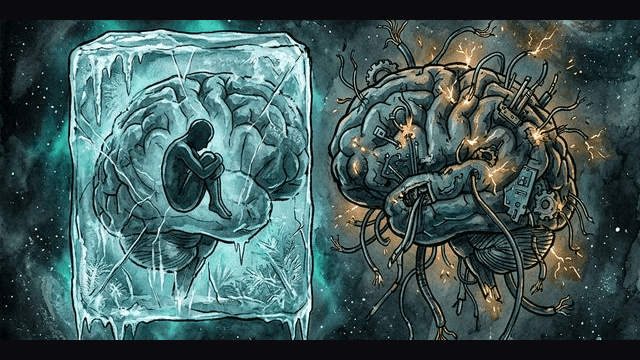
The Quick Answer: Paralysis Is a Symptom, Dysfunction Is the System Failure
Here's the simplest way to think about it:
Executive dysfunction is the broken engine. It's a chronic, persistent impairment in the brain systems that handle planning, organizing, initiating, and completing tasks. It's always there, humming (or not humming) in the background. Think of it as the underlying condition.
ADHD paralysis is what happens when that broken engine meets a specific situation — stress, overwhelm, emotional weight, or too many choices — and the whole system seizes up. It's the acute, visible freeze. The moment you physically cannot move.
Executive dysfunction is the cracked foundation. ADHD paralysis is the earthquake.
One is always present. The other hits in episodes.
The Neuroscience: Two Different Failure Modes
Let's go deeper, because the brain mechanics are actually quite different.
Executive Dysfunction: The Chronic Bridge Gap
The prefrontal cortex (PFC) is your brain's CEO. It handles working memory, task initiation, planning, time perception, and emotional regulation — collectively called "executive functions."
In ADHD brains, the PFC is chronically under-fueled. Volkow et al. (2009) used PET scans to show that adults with ADHD have significantly lower dopamine transporter availability in the brain's reward and motivation circuits. Arnsten (2006) demonstrated that the PFC requires precise levels of dopamine and norepinephrine to function — and ADHD brains sit below that threshold most of the time.
The result? The bridge between "I want to do this" and "I am doing this" has structural gaps. Not sometimes. Always. You can see the other side, but crossing requires extraordinary effort every single time.
ADHD Paralysis: The Emergency Freeze
ADHD paralysis is a different beast. It's what happens when the already-compromised system gets overwhelmed and the amygdala — your brain's threat detection center — hijacks the whole operation.
Barkley (2015) describes this as the point where emotional dysregulation and executive impairment collide. The amygdala registers the looming task, the shame of past failures, or the sheer volume of choices not as a to-do list, but as a threat. And the survival response kicks in: freeze.
A 2021 study in Frontiers in Psychiatry found that adults with ADHD show significantly heightened amygdala reactivity compared to neurotypical controls during emotionally charged tasks. Your brain isn't choosing to freeze. It's deploying a survival mechanism.
The key difference? Executive dysfunction means the system is always impaired. ADHD paralysis means the system has crashed entirely, right now, in this moment.
Stuck on something right now?
Stop reading about it — try it. Thawly breaks your task into one tiny step you can do right now.
Free · No signup · 3 secondsSide-by-Side: How to Tell Which One You're Experiencing
| Executive Dysfunction | ADHD Paralysis | |
|---|---|---|
| Duration | Persistent, daily | Episodic (minutes to hours) |
| Trigger | Doesn't need one — it's baseline | Specific trigger (overwhelm, emotion, decision) |
| Feeling | "I can't figure out how to start" | "I physically cannot move" |
| Awareness | You might not even notice it | You're acutely, painfully aware |
| Emotional state | Low-grade frustration | Acute distress, panic, or numbness |
| Analogy | A car with a weak engine | A car that stalled at an intersection |
| Best intervention | Systems and structure | Nervous system reset |
Here's a real example from my own life. Last Tuesday:
-
Morning: I spent 45 minutes trying to decide what to work on first. I had three tasks, all roughly equal priority. I kept switching between tabs, making no progress. That was executive dysfunction — my PFC couldn't prioritize.
-
Afternoon: My manager pinged me asking for a status update on a project I'd barely started. Instant freeze. Couldn't reply. Couldn't look at the project. Couldn't move from my chair for two hours. That was ADHD paralysis — the shame and urgency triggered a full amygdala hijack.
Same person. Same day. Two completely different problems.

Why It Matters: Different Problems Need Different Solutions
This is the part most articles get wrong. They give you one list of tips for both conditions. But treating paralysis like dysfunction — or dysfunction like paralysis — doesn't just fail. It can make things worse.
When It's Executive Dysfunction → Build External Structure
If your problem is the chronic bridge gap — you can't plan, can't sequence, can't hold steps in your head — you need external scaffolding to replace the internal executive function your brain can't consistently provide.
What works:
-
Externalize your plan. Don't keep it in your head. Write it down, use sticky notes, or let Thawly break it into micro-steps. Gollwitzer (1999) showed that ultra-specific "implementation intentions" increase follow-through by 20-30% in people with executive functioning deficits.
-
Reduce decisions. Every decision burns the limited executive fuel you have. Pre-decide your first task of the day the night before. Eat the same breakfast. Remove the "what should I do next" question entirely.
-
Use if-then triggers. Instead of "I'll work on the report today," try: "When I sit down with my coffee at 9 AM, I will open the report and type the first sentence." The trigger removes the initiation barrier.
-
Body-doubling. Work alongside someone — physically or virtually. The social presence creates gentle external accountability that substitutes for the internal drive your PFC can't generate reliably.
When It's ADHD Paralysis → Reset Your Nervous System First
If you're in a full freeze — concrete body, racing heart, can't-breathe-can't-move — no amount of planning will help. You need to de-escalate the survival response before you can think clearly enough to act.
What works:
-
TIPP technique (DBT). Splash ice-cold water on your face. This triggers the mammalian dive reflex, which forces your parasympathetic nervous system to slow your heart rate within 15 seconds (Khurana et al., 2019). Your body overrides the freeze.
-
Physical opposite action. Lying down? Sit up. Sitting? Stand. Your body posture reinforces the emotion — change the posture, interrupt the loop.
-
The absurdly small step. Don't think about the task. Think about one microscopic physical action: "pick up the pen." That's it. The Zeigarnik Effect (your brain's itch to complete unfinished actions) will pull you forward once you start.
-
Name the feeling out loud. "I am frozen because I'm afraid of failing." Lieberman et al. (2007) showed that affect labeling — simply naming the emotion — reduces amygdala activation. Naming breaks the spell.
The Overlap Zone (And Why People Get Confused)
Here's the messy truth: ADHD paralysis and executive dysfunction aren't completely separate. They exist on a spectrum, and they feed each other.
Executive Dysfunction (chronic) → task piles up → guilt and overwhelm build →
→ triggers ADHD Paralysis (acute) → nothing gets done →
→ more tasks pile up → deeper executive dysfunction spiral
This is why so many people — and so many articles — treat them as the same thing. In practice, they often show up together. The chronic bridge gap makes you fall behind, which builds the emotional Wall of Awful — a concept coined by ADHD educator Brendan Mahan, which makes the next task more likely to trigger a full freeze.
Breaking the cycle means intervening at the right level. If you're currently frozen: reset the nervous system first. If you're functional but struggling: build the external systems. (Not sure which mode you're in? Start with our Task Paralysis Engine — it works for both.)
In Thawly, we designed the micro-step engine to work at both levels. When you tell it what you're stuck on, it bypasses the executive function gap (by doing the planning for you) and the paralysis trigger (by making the first step so small your amygdala doesn't even notice it). It's not one or the other — it's a bridge that works regardless of which failure mode you're in.
Frequently Asked Questions
Is ADHD paralysis a real medical term? "ADHD paralysis" is not a formal clinical diagnosis in the DSM-5. However, the underlying mechanisms — executive dysfunction, emotional dysregulation, and the freeze response — are extensively documented in ADHD literature (Barkley, 2015; Brown, 2013). The term is useful because it describes a specific, recognizable experience that millions of people share.
Can you have executive dysfunction without ADHD? Yes. Executive dysfunction can occur with depression, anxiety, autism spectrum conditions, traumatic brain injuries, and even chronic sleep deprivation. ADHD is one of the most common causes, but it's not the only one.
Which one should I treat first? If you're currently frozen — treat the paralysis first with a nervous system reset (cold water, movement, one micro-step). You can't build systems while your amygdala is in control. Once you're unfrozen, invest in the external structures that prevent executive dysfunction from piling up again.
Does medication help both? Stimulant medication primarily addresses executive dysfunction by increasing dopamine availability in the prefrontal cortex (Volkow et al., 2009). This raises the baseline, reducing the frequency and severity of both chronic dysfunction and acute paralysis episodes. But medication alone doesn't eliminate either — behavioral strategies remain essential.
How do I explain the difference to someone without ADHD? "Executive dysfunction is like having a GPS that constantly recalculates and never gives you a clear route. ADHD paralysis is like the GPS crashing completely — the screen goes black and you're stuck at the intersection, unable to move in any direction."
Sources
- Arnsten, A.F. (2006). Stimulants: Therapeutic actions in ADHD. Neuropsychopharmacology, 31(11), 2376-2383.
- Barkley, R.A. (2015). Attention-Deficit Hyperactivity Disorder: A Handbook for Diagnosis and Treatment. 4th ed. Guilford Press.
- Brown, T.E. (2013). A New Understanding of ADHD in Children and Adults: Executive Function Impairments. Routledge.
- Gollwitzer, P.M. (1999). Implementation intentions: Strong effects of simple plans. American Psychologist, 54(7), 493-503.
- Khurana, R.K. et al. (2019). The diving reflex in clinical autonomic testing. Clinical Autonomic Research, 29(1), 31-39.
- Lieberman, M.D. et al. (2007). Putting feelings into words: Affect labeling disrupts amygdala activity in response to affective stimuli. Psychological Science, 18(5), 421-428.
- Surman, C.B. et al. (2021). Emotional dysregulation and amygdala reactivity in adults with ADHD. Frontiers in Psychiatry, 12, 651160.
- Volkow, N.D. et al. (2009). Evaluating dopamine reward pathway in ADHD. JAMA, 302(10), 1084-1091.

Sean Z. holds a Master's degree in Cognitive Psychology. He spent 7 years in academic research focused on human cognition, followed by 10+ years designing products and services in the applied psychology space. He built Thawly after years of firsthand experience with ADHD task paralysis — combining academic understanding of executive function with the daily reality of living with it. About the Author → LinkedIn
Looking for more specific strategies?
Explore 115+ targeted tools for specific ADHD scenarios.
Browse the ADHD Toolkit →