ADHD Executive Dysfunction: What It Really Is (Not Laziness)
Disclaimer: This article is for informational and educational purposes only. It is not a substitute for professional medical advice, diagnosis, or treatment. If you suspect you have ADHD, please consult a qualified healthcare provider.
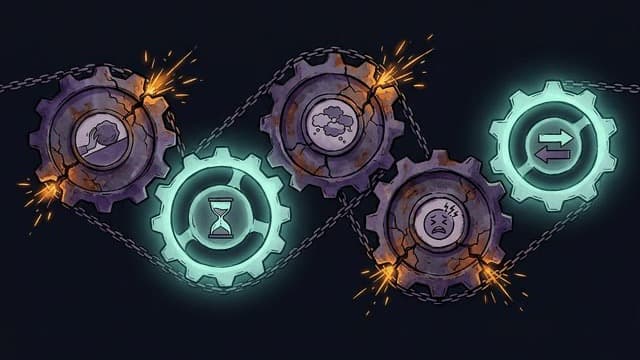
Executive dysfunction in ADHD is the inability to plan, initiate, organize, or follow through on tasks — even when you know exactly what needs to be done. It is the core impairment in ADHD (Barkley, 2012), caused by dopamine and norepinephrine deficits in the prefrontal cortex. Five systems break: task initiation, working memory, emotional regulation, time perception, and task switching. The solution isn't willpower — it's building external scaffolding that bypasses the broken internal systems.
Have you ever found yourself sitting on the couch, staring at the laundry basket or the open laptop, screaming at yourself internally to just get up and do it — but your body simply refuses to move?
You understand the task. You know how to do it. You even want to do it. But the signal from "want" to "do" seems lost in transit.
Welcome to the most maddening symptom of ADHD: Executive Dysfunction.
I deal with this every single day. Some days it's mild — I stare at my inbox for 10 minutes before opening the first email. Other days it's debilitating — I lose entire afternoons to the gap between "I should start" and actually starting. Understanding the neuroscience behind it didn't cure it, but it stopped me from hating myself for it.
What Is ADHD Executive Dysfunction?
Executive dysfunction is the inability to plan, initiate, organize, or follow through on tasks — even when you intellectually know what needs to be done. It's like being the CEO of a company where the intercom system is broken. You, the CEO (your prefrontal cortex), are shouting orders, but the workers on the factory floor (your motor system) can't hear you.
For the ADHD brain, this is not a character flaw.
It is a neurological reality. Research by Barkley (2012) established that executive functioning deficits are the core impairment in ADHD — more fundamental than attention issues or hyperactivity. His work showed that the prefrontal cortex in ADHD brains is chronically under-stimulated due to dopamine and norepinephrine dysregulation, making task initiation, working memory, and emotional regulation all unreliable.
The Broken Bridge Metaphor

Imagine a bridge between Intention (knowing you need to send an email) and Action (opening your inbox and typing).
For a neurotypical brain, this bridge is solid concrete. When they want to cross, they just cross.
For the ADHD brain, the bridge is out. You can clearly see the other side, but you can't get there without waiting for a ferry. That "ferry" is external pressure, urgency, or a massive spike in adrenaline — which is why you can suddenly write a whole 10-page paper at 3 AM the night before it's due.
This isn't a willpower problem. It's a dopamine problem. Volkow et al. (2009) used PET imaging to demonstrate that adults with ADHD have significantly lower dopamine receptor availability in the brain's reward and motivation pathways. The bridge is literally made of different material.
Stuck on something right now?
Stop reading about it — try it. Thawly breaks your task into one tiny step you can do right now.
Free · No signup · 3 secondsWhat Are the Five Executive Functions That Fail in ADHD?
Executive dysfunction doesn't hit one area — it hits at least five, often simultaneously. Understanding which ones are failing you right now helps you choose the right bypass strategy.
1. Task Initiation
The big one. You can't start. The task sits there, staring at you, and you stare back. In our data from Thawly users, task initiation is the #1 reported barrier — over 70% of users describe their primary struggle as "I know what to do but I can't begin." This freeze state is better known as ADHD paralysis, and it comes in three distinct forms.
2. Working Memory
You walk into the kitchen to get water and suddenly have no idea why you're there. You read the same paragraph four times. You forget what you were saying mid-sentence. Klingberg (2010) showed that ADHD brains have reduced working memory capacity, which means holding multi-step plans in your head is like trying to juggle while riding a unicycle.
3. Emotional Regulation
Your boss gives you mildly critical feedback and you emotionally spiral for 3 hours. Or you get a parking ticket and it ruins your entire week. This isn't being "too sensitive" — Shaw et al. (2014) found that emotional dysregulation in ADHD is driven by the same prefrontal cortex deficits that cause cognitive symptoms. Your emotional thermostat is broken.
4. Time Blindness
You genuinely believed you had "plenty of time" and then suddenly it's 11 PM and the deadline is in 30 minutes. Barkley calls this "time blindness" — the ADHD brain's inability to perceive time as a manageable, divisible resource. You live in an eternal "now" with a vague, distant "not now."
5. Task Switching
Once you finally get into a flow state on one thing, switching to another task feels physically painful. Your brain clings to whatever it managed to start, making flexibility almost impossible. This is why you can hyperfocus on organizing your bookshelf for 4 hours but can't pivot to the report that's actually due.
Why Is "Just Do It" Terrible Advice for ADHD?
"If you know what to do, just do it."
This sentence has caused more shame and trauma in the neurodivergent community than perhaps any other. It wrongly assumes that the bridge is perfectly intact and you are simply choosing not to walk across it.
Laziness implies a lack of caring. Executive dysfunction means you care deeply but are neurologically unable to bridge the gap between wanting and doing. The crushing guilt and self-loathing that follows proves you are the absolute opposite of lazy.
I've had people tell me this my entire life. Teachers, managers, even therapists. "You clearly understand the material, you just need to apply yourself." That's like telling someone with a broken leg to "just walk it off." The intention-action gap in ADHD is not a motivational problem — it's a neurological one.
How Do You Bypass ADHD Executive Dysfunction?
Since your internal executive functions (the bridge) are unreliable, you have to build temporary external bridges. Here's what actually works, based on clinical research and our observations with Thawly users (or if you just want pure tactics without the science, jump to our practical guide on how to deal with executive dysfunction):
1. Externalize Everything
If your brain can't break down a task, outsource the breakdown. If the task is "Clean my room," your brain sees an Everest-sized monolith of undefined effort. If the task is "Pick up three blue items from the floor," your brain sees a clear, achievable micro-action.
Gollwitzer's (1999) research on "implementation intentions" — ultra-specific if-then plans — showed a 20-30% increase in task completion rates. The more specific and small the instruction, the less your broken bridge matters.
Write your steps on sticky notes. Use voice memos. Or let Thawly generate the breakdown.
2. Create Artificial Urgency
Since your brain only builds the bridge when adrenaline spikes, create fake deadlines. Body-doubling (working alongside someone else, even virtually) creates social accountability. Pomodoro timers create micro-deadlines every 25 minutes. (Need to break the urgency cycle? Try our Task Paralysis Engine.)
But here's the key: the urgency has to feel real. Telling yourself "I'll do it by 3 PM" doesn't work because your ADHD brain knows you set the deadline and you can move it. External accountability — a friend checking in, a co-working call, or a visible countdown timer — works far better.
3. Use the Micro-Step Bypass
This technique changed my life and it's why I built Thawly.
Don't think about the whole task. Shrink it to something so absurdly small that your brain's resistance system doesn't even activate.
- Don't do your taxes. Open the tax software and log in. That's it.
- Don't write the email. Type "Hi" in the subject line.
- Don't exercise. Put on one shoe.
The magic is the Zeigarnik Effect — your brain hates unfinished tasks. Once you type "Hi," the itch to finish the email becomes almost irresistible. You tricked your brain into crossing the bridge by telling it you weren't even going to try.
4. Reduce Decision Load
Every decision burns executive function fuel. The fewer decisions you need to make before starting, the more likely you'll start.
Lay out your clothes the night before. Eat the same breakfast every day. Pre-decide your first task of the morning. Steve Jobs wore the same outfit daily for this exact reason — and he was describing decision fatigue before the term was popular.
5. Use Thawly as Your External Executive Function
When you're stuck and can't think of a first step — and the shame spiral is starting — stop trying to use willpower. Open Thawly. Tell it what you're avoiding. It replaces the internal executive your brain can't consistently provide, feeding you one microscopic step at a time until you unfreeze.
We don't give you a 10-step plan. We give you one step. Then the next one. Then the next. That's how real unfreezing works.
Frequently Asked Questions
Is executive dysfunction only caused by ADHD? No. Executive dysfunction can also occur with depression, anxiety, autism, traumatic brain injuries, and certain neurological conditions. However, in ADHD it is considered a core feature rather than a secondary symptom (Barkley, 2012).
Can executive dysfunction be cured? It can be managed, not cured. ADHD medication (stimulants and non-stimulants) can improve executive functioning by increasing dopamine availability. Behavioral strategies like external structure, body-doubling, and micro-stepping provide ongoing support. Most experts recommend a combination of both.
How do I explain executive dysfunction to someone who doesn't have ADHD? The "broken bridge" metaphor works well: "Imagine you can see exactly where you need to go, but the bridge is out. You're not choosing not to cross — you physically can't, and you need to build a temporary rope bridge every single time."
Is executive dysfunction the same as procrastination? Not exactly. Procrastination is choosing to delay. Executive dysfunction is being unable to start despite wanting to. The distinction matters because the solutions are different — procrastination responds to motivation techniques, while executive dysfunction requires structural bypasses.
Sources
- Barkley, R.A. (2012). Executive functions: What they are, how they work, and why they evolved. Guilford Press.
- Gollwitzer, P.M. (1999). Implementation intentions: Strong effects of simple plans. American Psychologist, 54(7), 493-503.
- Klingberg, T. (2010). Training and plasticity of working memory. Trends in Cognitive Sciences, 14(7), 317-324.
- Shaw, P. et al. (2014). Emotion dysregulation in attention deficit hyperactivity disorder. American Journal of Psychiatry, 171(3), 276-293.
- Volkow, N.D. et al. (2009). Evaluating dopamine reward pathway in ADHD. JAMA, 302(10), 1084-1091.

Sean Z. holds a Master's degree in Cognitive Psychology. He spent 7 years in academic research focused on human cognition, followed by 10+ years designing products and services in the applied psychology space. He built Thawly after years of firsthand experience with ADHD task paralysis — combining academic understanding of executive function with the daily reality of living with it. About the Author → LinkedIn
Looking for more specific strategies?
Explore 115+ targeted tools for specific ADHD scenarios.
Browse the ADHD Toolkit →