Does ADHD Make You Forget Things? 3 Memory Systems Explained
Disclaimer: This article is for informational and educational purposes only. It is not a substitute for professional medical advice, diagnosis, or treatment. If you suspect you have ADHD, please consult a qualified healthcare provider.
Yes, ADHD makes you forget things — but not because your memory is broken. ADHD impairs three specific memory systems: working memory (information evaporates before you can use it), prospective memory (you forget to remember future actions), and context-dependent retrieval (out of sight, literally out of mind). Research by Kofler et al. (2020) found that ADHD adults operate with 30-40% reduced working memory capacity. The fix isn't "try harder to remember" — it's building external systems that remember for you.
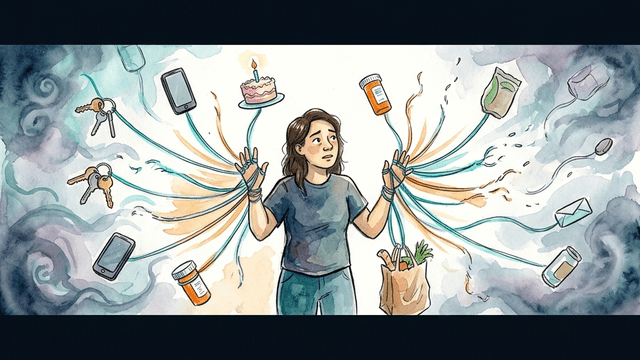
You were supposed to call your mom. It was her birthday. You knew it was her birthday — it was in your calendar, you thought about it at 9 AM, you even picked up a card last week. And yet, at 11 PM, lying in bed, it hits you like a truck: you never called.
It's not that you don't care. You care deeply. That's what makes it so excruciating — the depth of your caring doesn't protect you from the forgetting. The important things slip through with the same ease as the trivial ones. Your brain doesn't rank memories by emotional importance. It drops them at random, indiscriminately, without warning.
If this pattern describes your life, the answer is yes: ADHD does make you forget things. But not in the way most people think.
What Does ADHD Forgetting Actually Mean?
ADHD doesn't damage your long-term memory storage. You're not losing memories. You're failing to file them properly, retrieve them on time, or hold them long enough to act on them.
Think of it this way: your brain's library has all the books. But the librarian is asleep, the card catalog is on fire, and the return-by dates are written in invisible ink.
Research by Kofler et al. (2020) and Barkley (2012) has identified three distinct memory systems that ADHD impairs:
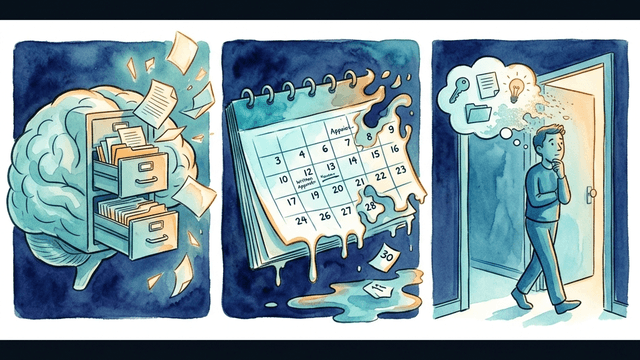
What Are the 3 Memory Systems ADHD Breaks?
1. Working Memory Failure — "I Just Had It"
What breaks: Your brain can't hold information long enough to use it.
Working memory is the mental whiteboard where you temporarily hold information while doing something with it. Neurotypical adults can hold approximately 7 items (±2) in working memory. ADHD adults operate with a working memory capacity approximately 30-40% below average (Kofler et al., 2020).
What this looks like:
- Walking into a room and forgetting why you came
- Opening your phone to check the time and somehow ending up on Instagram without ever seeing the clock
- Someone tells you a phone number and it's gone before you can write it down
- Starting a sentence and losing your point halfway through
This isn't carelessness. The information genuinely evaporates from your mental whiteboard before you can act on it. The prefrontal cortex, which maintains working memory, operates with reduced dopamine and norepinephrine in ADHD brains (Arnsten, 2009) — meaning the whiteboard doesn't just have less space, it also erases faster.
2. Prospective Memory Failure — "I'll Do It Later"
What breaks: Your brain can't remember to remember.
Prospective memory is the ability to remember to do something in the future. It's the system that should fire the reminder "call Mom at 5 PM" or "take medication after breakfast" or "bring the signed form to school tomorrow."
ADHD devastates prospective memory. Research by Kliegel et al. (2013) found that ADHD adults show significant deficits in both time-based prospective memory ("do X at 3 PM") and event-based prospective memory ("do X when Y happens"). The internal alarm system that neurotypical brains use to trigger future actions is unreliable in ADHD.
What this looks like:
- Forgetting birthdays and important dates — even ones you genuinely care about
- Missing appointments that aren't in your calendar
- Forgetting to eat — your body sends hunger signals but the "act on this" system fails
- Forgetting to drink water all day
- Taking medication inconsistently despite knowing it helps
- Telling someone "I'll send you that link" and never doing it
The cruelest aspect of prospective memory failure is that you made the intention. You genuinely planned to do the thing. The plan existed. The system that was supposed to trigger it at the right moment simply... didn't.
3. Context-Dependent Retrieval Failure — "Out of Sight, Out of Mind"
What breaks: Your brain can't retrieve information outside the context where it was encoded.
This is the ADHD version of object permanence. Once something leaves your immediate environment — a friend moves away, a bill goes in a drawer, a coat gets hung in a closet — your brain stops actively holding it in awareness. It's not deleted. It's just... inaccessible until something in your current environment triggers the retrieval.
What this looks like:
- Losing keys and wallet — they exist, you just can't generate the retrieval cue
- Forgetting about friends who aren't in your daily routine — not because you don't love them, but because your brain doesn't spontaneously generate the thought "I should reach out to Alex"
- That pile of unopened mail you forget exists the moment it's out of view
- Groceries rotting in the back of the fridge because closing the door erased their existence from your awareness
- Subscriptions you forgot you're paying for
This is why ADHD adults are disproportionately affected by the phrase "out of sight, out of mind." For neurotypical brains, it's a metaphor. For ADHD brains, it's a neurological description.
Stuck on something right now?
Stop reading about it — try it. Thawly breaks your task into one tiny step you can do right now.
Free · No signup · 3 secondsWhy Does "Just Set a Reminder" Fail for ADHD?
"Just set a reminder." "Write it down." "Make a list."
These solutions assume the problem is capturing the information. It's not. You've captured it dozens of times. The problem is that the retrieval and execution system is unreliable. You set the reminder — and then dismiss it without acting on it. You write the list — and then forget where you put the list. You know the appointment is tomorrow — and tomorrow arrives and the knowledge never surfaces.
The failure isn't in the input. It's in the output.
What External Memory Systems Actually Work for ADHD?
Since your internal memory systems are unreliable, the solution is to externalize memory entirely. Don't try to remember better — create systems that remember for you.
1. The Launch Pad (Working Memory Fix)
Designate one physical spot by your door as the "launch pad." Keys, wallet, phone, badge, medication — everything you need when you leave goes here. Always. No exceptions.
Why it works: It eliminates retrieval. You don't need to remember where your keys are because they're always in the same place. You've replaced a memory task with a habit task — and habits are stored in the basal ganglia, which ADHD doesn't impair.
2. The Kitchen Timer Rule (Prospective Memory Fix)
When you think "I need to do X later," don't trust your brain. Set a timer immediately — not a silent notification (you'll dismiss it), but a physical timer that goes off with an unavoidable sound.
Why it works: External timers bypass the prospective memory system entirely. The reminder comes from the environment, not from your brain. Your brain doesn't need to "remember to remember" — the timer does that for it.
3. The Visual Inventory (Context-Dependent Retrieval Fix)
Use clear containers instead of opaque ones. Mount a clear shoe organizer on the back of a door. Put frequently needed items on open shelves, not in drawers. Make as many objects as possible visually accessible.
Why it works: If the retrieval cue is seeing the object, then making objects visible eliminates the need for self-generated retrieval cues. You see the vitamins → you remember to take them. No internal reminder needed.
4. The Body Double System (Execution Fix)
When you need to remember and complete something important, tell another human. Not "I'll try to remember" — actively say "can you remind me at 5 PM to call my mom?" or "please ask me about the report before you leave today."
Why it works: You're outsourcing your prospective memory to another person's brain. Their brain fires the reminder, and the social pressure of the interaction creates enough activation energy to actually do the thing.
5. The "Do It Now" 2-Minute Rule (Bypass Fix)
If something will take less than 2 minutes, do it the instant you think of it. Reply to that text now. Put the dish in the dishwasher now. Sign the form now.
Why it works: It bypasses all three memory failure points. No working memory needed (you're acting immediately). No prospective memory needed (there's no "later"). No retrieval needed (you haven't left the context yet).
(Need help breaking a bigger task into 2-minute chunks? Thawly can decompose any task into micro-steps small enough to clear the activation barrier.)
What Is the Emotional Cost of ADHD Forgetting?
ADHD forgetting isn't just inconvenient. It's devastating to relationships and self-image.
When you forget someone's birthday, they feel unloved. When you forget a promise, they feel unimportant. When you forget to pick up the kids, they feel unsafe. And no amount of explaining "my brain doesn't work like that" fully repairs the damage, because to the other person, it looks like you don't care enough to remember.
The internal toll is equally heavy. Decades of forgetting — and decades of being told you're "careless," "unreliable," "spacey," or "selfish" — create a shame narrative that's deeply embedded: I can't be trusted. I always let people down. Something is fundamentally wrong with me.
Nothing is wrong with you. Something is wrong with your brain's filing and retrieval system. Those are different things. You can't fix the system through effort or caring more. You can build external scaffolding that catches what the system drops.
FAQ
Does ADHD affect long-term memory?
Not directly. ADHD primarily affects working memory (holding information in the moment) and prospective memory (remembering to do future actions). Long-term memory storage itself is generally intact — the issue is that information often doesn't get properly encoded into long-term memory because working memory dropped it before the encoding process completed. So you don't "forget" — you never fully stored it in the first place.
Why do I remember useless things but forget important ones?
Because ADHD memory is interest-based, not importance-based. Your brain encodes information that is novel, emotionally charged, or personally fascinating — regardless of its practical importance. This is why you can recite every Pokémon but can't remember your dentist appointment. The dentist appointment lacks novelty and emotional engagement, so it doesn't generate enough dopamine to strengthen the memory trace.
Is ADHD forgetting the same as early dementia?
No, and this is a common fear. ADHD forgetting is primarily a retrieval and attention problem — the information exists but can't be accessed reliably. Dementia involves actual degradation of stored memories — the information itself is lost. If you forget where you put your keys, that's ADHD. If you forget what keys are for, that's a different concern. If you're worried, a neuropsychological evaluation can clearly distinguish between the two.
Does medication help with ADHD forgetting?
Yes — particularly with working memory. Stimulant medications increase dopamine and norepinephrine in the prefrontal cortex, which directly supports working memory function. Many adults report that medication makes them feel like they can "hold more things in their head at once." Prospective memory may also improve indirectly, as better working memory allows intentions to be maintained longer. Medication won't fix context-dependent retrieval — you'll still need external systems for that.
How do I stop forgetting to take my ADHD medication?
Pair it with an existing habit that you never skip (brushing teeth, making coffee). Place the medication bottle next to that habit's trigger object. Use a weekly pill organizer so you can visually confirm whether you took it. Some people set a daily phone alarm with a custom label: not "Take meds" (too easy to dismiss) but "DID you take your meds? Check the pill box." The visual confirmation eliminates the "did I already take it?" loop.
Sources
- Kofler, M.J. et al. (2020). "Working Memory and Organizational Skills Problems in ADHD." Journal of Child Psychology and Psychiatry, 61(4), 458-468.
- Barkley, R.A. (2012). Executive Functions: What They Are, How They Work, and Why They Evolved. Guilford Press.
- Arnsten, A.F.T. (2009). "Stress signalling pathways that impair prefrontal cortex structure and function." Nature Reviews Neuroscience, 10(6), 410-422.
- Kliegel, M. et al. (2013). "Prospective memory in adults with ADHD." Journal of Attention Disorders, 17(8), 650-658.
- Faraone, S.V. et al. (2021). "The World Federation of ADHD International Consensus Statement." Neuroscience & Biobehavioral Reviews, 128, 789-818.

Sean Z. holds a Master's degree in Cognitive Psychology. He spent 7 years in academic research focused on human cognition, followed by 10+ years designing products and services in the applied psychology space. He built Thawly after years of firsthand experience with ADHD task paralysis — combining academic understanding of executive function with the daily reality of living with it. About the Author → LinkedIn
Looking for more specific strategies?
Explore 115+ targeted tools for specific ADHD scenarios.
Browse the ADHD Toolkit →