How to Deal with Executive Dysfunction: A No-BS Practical Guide
Disclaimer: This article is for informational and educational purposes only. It is not a substitute for professional medical advice, diagnosis, or treatment. If you suspect you have ADHD, please consult a qualified healthcare provider.
The most effective approach to executive dysfunction is building external systems that bypass your unreliable internal executive function. Key strategies include: externalize everything (write steps down, use timers, put reminders in the physical space where action happens), reduce decision load (pre-decide routines, limit choices), create artificial urgency (body doubling, micro-deadlines), and shrink tasks to absurdly small micro-steps that bypass the dopamine activation threshold.
I'm going to skip the part where I explain what executive dysfunction is. If you're Googling "how to deal with executive dysfunction," you already know. You've probably read six articles about dopamine and the prefrontal cortex. You can explain the science to other people. You could give a TED talk about it.
You just can't do your laundry.
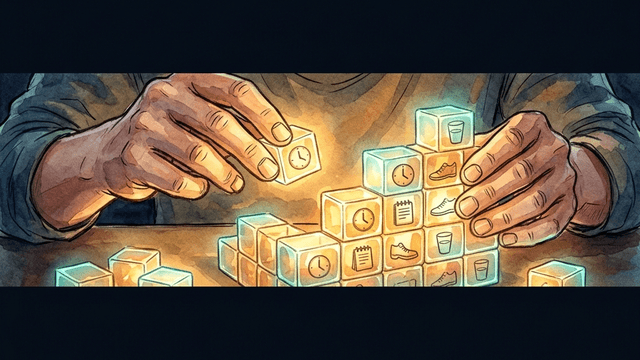
So this article is different. No neuroscience primer. No "what is executive dysfunction" section. Just the strategies — the ones I use daily, the ones backed by research, the ones that work when your brain is actively not cooperating.
(If you do want the neuroscience deep-dive, I wrote that separately: ADHD and Executive Dysfunction: The Complete Guide.)
Strategy 1: Make Starting Stupid Easy
The biggest mistake: trying to "do the task." Don't do the task. Do the pre-task.
- "Write the report" → Open Google Docs
- "Clean the apartment" → Pick up one item and put it anywhere that's not the floor
- "Cook dinner" → Take one ingredient out of the fridge
- "Exercise" → Put on shoes (you don't have to go anywhere)
You're not committing to the task. You're committing to the smallest physical motion that moves you toward the task. Once motion starts, momentum often takes over — not because of willpower, but because of behavioral activation: the neurological principle that action generates its own motivation (Martell et al., 2010).
(Can't even figure out the pre-task? Type what you're avoiding into Thawly and it'll generate the first micro-step for you.)
Strategy 2: Use External Brains
Your internal task management system is broken. Stop relying on it.
For memory: Put everything external. Don't try to remember — record. Use whatever capture tool you'll actually use: phone notes, voice memos, sticky notes on the fridge, a single notebook you carry everywhere. The specific tool doesn't matter. Using something matters.
For planning: Don't plan in your head. Plan on paper. Literally. Not digitally — physically. Research shows that handwriting activates different cognitive pathways than typing and improves memory encoding. Write tomorrow's three most important tasks on an index card and put it where you'll see it first thing.
For decisions: Outsource them. Set rules that eliminate choice: "I eat the same breakfast every weekday." "I always wear the outfit I laid out the night before." "If I can't decide in 5 minutes, I flip a coin." Every decision you eliminate saves dopamine for the decisions that actually matter.
For time: Use analog clocks. Seriously. Digital clocks show you a number (3:47). Analog clocks show you a shape — a visual representation of how much time has passed and how much remains. Many adults with ADHD report that analog clocks make time feel "real" in a way that digital displays don't. The Time Timer brand makes clocks with a colored disk that shrinks as time passes. It's not a gimmick — it's an external representation of something your brain can't internally track.
Strategy 3: Engineer Your Environment
Your environment is either working for your executive dysfunction or against it. Most environments are designed for neurotypical brains, which means they're working against you by default.
The "Launch Pad": Designate one spot near your front door for keys, wallet, phone, and anything you need tomorrow. This eliminates the morning scavenger hunt that burns 20 minutes of executive function before you've even left the house.
Transparent everything: Use clear containers in the kitchen, clear bins in the closet, open shelving instead of closed cabinets. For ADHD brains, out of sight is literally out of existence. If you can't see it, your brain forgets it exists.
The anti-doom-pile system: Put a basket or box in every room where doom piles tend to accumulate. When stuff starts piling, it piles in the container. Once a week, deal with whatever's in the containers. This isn't organizing — it's containing the chaos until you have executive bandwidth to address it.
Friction architecture: Make good habits frictionless and bad habits difficult.
| Want more | Remove friction |
|---|---|
| Water intake | Fill 3 bottles each morning, place in rooms you frequent |
| Reading | Leave book open on your pillow |
| Vitamins | Put bottle next to toothbrush |
| Want less | Add friction |
|---|---|
| Social media | Delete apps; use only browser versions (slower, less satisfying) |
| Impulse buying | Remove saved payment methods |
| Late nights | Set WiFi router on timer to shut off at 11 PM |
Stuck on something right now?
Stop reading about it — try it. Thawly breaks your task into one tiny step you can do right now.
Free · No signup · 3 secondsStrategy 4: Body Double Everything
Working in the presence of another person — physically or virtually — is one of the most consistently effective executive dysfunction strategies available.
A 2023 systematic review found that body doubling improved task initiation by up to 65% in adults with ADHD. The mechanism isn't willpower or shame — it's nervous system co-regulation. Another person's presence activates your ventral vagal system, which tells your brain "you're safe, you can engage with the world."
Options, ranked by effort:
- A friend sitting nearby (zero effort, maximum effect)
- FaceTime/Zoom call where you both work silently (low effort)
- Virtual coworking platform like Focusmate (medium effort)
- "Study with me" YouTube livestream (minimal effort, still effective)
- Working at a coffee shop (the OG body double)
Strategy 5: Time Box, Don't Task List
Task lists are shame lists. Every unchecked box is evidence of failure. For ADHD brains, a long list doesn't motivate — it overwhelms.
Replace task lists with time boxes: blocks of time assigned to a category of activity, not a specific task.
Instead of:
☐ Write report
☐ Reply to emails
☐ Call dentist
☐ Clean kitchen
☐ Buy groceries
Try:
9:00-10:00  Work block (whatever work task feels most accessible)
10:00-10:15 Admin (emails, messages, quick replies)
10:15-10:30 One household thing
The difference: task lists require you to choose what to do (executive function). Time boxes tell you when to do categories of things. Within the block, you tackle whatever feels most accessible — no guilt about the order. Even if you only do 50% of what you planned, you're operating within a structure that reduces decision fatigue.
Strategy 6: The Reset Ritual
Executive dysfunction gets worse throughout the day as dopamine depletes. By 3 PM, your tank is often empty. Instead of pushing through (which produces diminishing returns), do a deliberate reset:
- Move your body for 5 minutes — walk, stretch, jumping jacks
- Eat something with protein (dopamine is synthesized from amino acids)
- Change your location — even moving to a different room helps
- Pick ONE thing for the next 30 minutes. Not two things. One.
This resets the neurochemical landscape enough for one more productive push. It's not infinite — you'll deplete again — but it extends your functional window by 2-3 hours.
Strategy 7: Build "When-Then" Rules
Open-ended decisions murder executive function. "I should probably exercise sometime today" will never happen. "When I get home from work, then I put on running shoes" has a fighting chance.
The research calls these "implementation intentions" (Gollwitzer, 1999), and they're surprisingly powerful. A meta-analysis found that implementation intentions had a medium-to-large effect on goal attainment — because they offload the decision from the moment of action (when your PFC might be depleted) to a planning phase (when it's online).
Build rules for your most common failure points:
- When my alarm goes off, then I immediately stand up (no snooze)
- When I sit at my desk, then I open the document I need to work on (before email, before Slack)
- When I eat dinner, then I wash the plate immediately (not later, not tomorrow)
- When I feel the paralysis starting, then I do 3 physiological sighs and splash cold water on my face
The key: the "then" must be a single physical action, not a plan. "Then I clean the kitchen" is too abstract. "Then I pick up one thing from the counter" is concrete enough for a depleted brain to execute.
Strategy 8: Know Your "Golden Hours" and Guard Them
Most adults with ADHD have specific hours when their executive function is best — usually mid-morning (9-11 AM) or after medication peaks. These are your golden hours.
Protect them ruthlessly:
- No meetings during golden hours (if possible)
- No email checking during golden hours
- No "quick tasks" that scatter your attention
- The hardest, most important task goes here — and only here
Everything else — admin, emails, calls, errands — goes in the afternoon when your executive function is depleting anyway and lower-demand tasks are all you can manage.
If you don't know your golden hours yet: track your productivity for one week. Note when starting feels easiest and when paralysis hits hardest. The pattern will emerge.
The Non-Negotiable: Self-Compassion
I'm going to end with something that sounds soft but is actually strategic.
Shame makes executive dysfunction worse. Not a little worse — significantly worse. Shame increases cortisol. Cortisol shuts down the prefrontal cortex. A shut-down PFC deepens the executive dysfunction. You're punishing yourself into incompetence.
Self-compassion isn't about lowering your standards. It's about recognizing that you have a neurological condition that makes certain tasks harder, and responding to failures with problem-solving instead of self-attack.
"I didn't do my taxes" + shame = paralysis spiral. "I didn't do my taxes" + self-compassion = "Okay, what's one micro-step I can do right now?"
The second approach actually leads to the taxes getting done. The first one doesn't.
FAQ
Can executive dysfunction be cured?
No — the underlying neurology doesn't change. But it can be managed to the point of minimal life impact. The right combination of medication, behavioral strategies, environmental design, and therapy can reduce executive dysfunction from a daily crisis to an occasional inconvenience.
How is executive dysfunction different from laziness?
Laziness is a choice; executive dysfunction is a deficit. Lazy people don't want to do the task. People with executive dysfunction desperately want to do the task and can't initiate, sequence, or sustain the action needed to complete it. If you consistently want to do things and can't make yourself start, that's not a character flaw — it's a neurological pattern.
Does exercise help executive dysfunction?
Yes, and the evidence is strong. A 2019 meta-analysis found that acute aerobic exercise improved executive function performance for 30-60 minutes post-exercise. The mechanism: exercise increases dopamine and norepinephrine availability in the prefrontal cortex — the exact neurotransmitters ADHD brains are deficient in. Even a 10-minute walk can noticeably improve task initiation capacity.
What's the difference between executive dysfunction and ADHD?
Executive dysfunction is the mechanism. ADHD is the condition. ADHD causes executive dysfunction because of dopamine and norepinephrine deficits in the prefrontal cortex. But executive dysfunction also occurs in depression, autism, TBI, and aging. The ADHD-specific version has particular features: inconsistency (good days vs. bad days), novelty-dependence (new things are easier), and emotional intensity.
Sources
- Martell, C.R. et al. (2010). Behavioral Activation for Depression: A Clinician's Guide. Guilford Press.
- Gollwitzer, P.M. (1999). Implementation intentions: Strong effects of simple plans. American Psychologist, 54(7), 493-503.
- Barkley, R.A. (2012). Executive Functions: What They Are, How They Work, and Why They Evolved. Guilford Press.
- ADHD Research Collaborative (2023). Body doubling and task initiation in adults with ADHD. Journal of Attention Disorders.
- Chang, Y.K. et al. (2019). Effect of acute exercise on executive function: A meta-analysis. Brain Research, 1662, 34-46.
- Safren, S.A. (2010). CBT for adult ADHD. JAMA, 304(8), 875-880.

Sean Z. holds a Master's degree in Cognitive Psychology. He spent 7 years in academic research focused on human cognition, followed by 10+ years designing products and services in the applied psychology space. He built Thawly after years of firsthand experience with ADHD task paralysis — combining academic understanding of executive function with the daily reality of living with it. About the Author → LinkedIn
Looking for more specific strategies?
Explore 115+ targeted tools for specific ADHD scenarios.
Browse the ADHD Toolkit →