ADHD Overwhelm: Why Everything Feels Like Too Much at Once
Disclaimer: This article is for informational and educational purposes only. It is not a substitute for professional medical advice, diagnosis, or treatment. If you suspect you have ADHD, please consult a qualified healthcare provider.
ADHD overwhelm is the acute, often paralyzing experience of having more cognitive demands than your brain can process. It occurs when working memory overflow, amygdala hijack, and dopamine depletion happen simultaneously — causing executive function to collapse under load. ADHD brains manage only 3-4 working memory "slots" vs. the neurotypical 5-7 (Klingberg, 2010), so even a normal inbox can trigger full system shutdown. The fix isn't "just relax" — it's actively reducing cognitive load.
Last Thursday I opened my email and saw 47 unread messages.
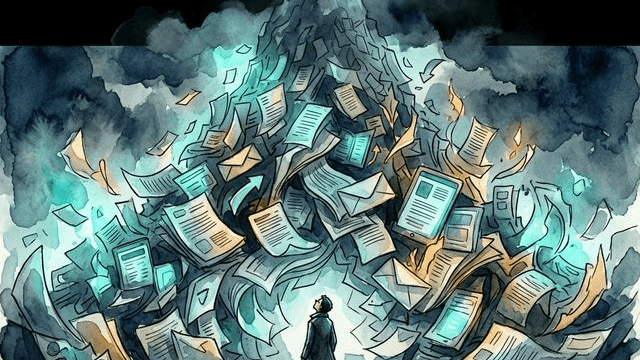
Not a crisis by most standards. But my brain didn't see 47 emails. It saw 47 decisions, each requiring me to read, evaluate, decide, and act. Within seconds, my chest tightened, my thoughts blurred, and I closed the laptop and stared at the wall for twenty minutes.
This is ADHD overwhelm — and if you're reading this, you almost certainly know the feeling. Not just "stressed" or "busy." Something deeper. A full-body shutdown triggered by inputs your brain simply cannot process at the rate they arrive.
What Is ADHD Overwhelm?
ADHD overwhelm is the acute, often paralyzing experience of having more demands on your cognitive system than it can handle. It's not the same as being busy. Plenty of busy people feel stressed but still function. ADHD overwhelm is the point where functioning stops.
The distinction matters clinically. Brown (2013) identified a phenomenon he called "overwhelm shutdown" — a state where the ADHD brain's working memory, emotional regulation, and task initiation systems all fail simultaneously. It's not one thing going wrong. It's every executive function collapsing at once under load.
How It Differs from Normal Stress
| Normal Stress | ADHD Overwhelm | |
|---|---|---|
| Trigger | Proportional to actual workload | Often disproportionate (small trigger, massive response) |
| Duration | Resolves when workload decreases | Can persist long after the trigger is gone |
| Function | Reduced but present | Can stop completely (freeze) |
| Self-talk | "This is a lot" | "I literally cannot" |
| Recovery | Rest and completion | Requires active intervention |
What Causes ADHD Overwhelm in the Brain?
Working Memory Overload
The core issue is bandwidth. Your working memory — the brain's RAM — has a limited number of "slots" for holding and manipulating information.
Klingberg (2010) demonstrated that ADHD brains have significantly reduced working memory capacity compared to neurotypical brains. Where a neurotypical person might hold 5-7 active items, an ADHD brain might manage 3-4 on a good day.
Now imagine opening your inbox with 47 emails. Each email becomes a potential item vying for one of your precious working memory slots. Your brain doesn't queue them neatly — it tries to hold them all at once. Within seconds, you've exceeded capacity, and the whole system crashes.
The Amygdala Hijack
The overflow doesn't just create confusion — it creates fear.
When working memory overflows, the prefrontal cortex (your rational planning center) loses control to the amygdala (your threat detector). Arnsten (2009) showed that even moderate stress causes the PFC to go "offline" in ADHD brains, handing control to more primitive emotional systems.
Your amygdala doesn't see an inbox. It sees a threat. And its response options are simple: fight, flight, or freeze. For most people with ADHD overwhelm, the answer is freeze.
The Dopamine Drain
Every decision, every evaluation, every "should I do this now or later" drains from the same limited dopamine pool your brain needs for executive function. When you're overwhelmed, you've already burned through your dopamine budget on the emotional reaction alone — leaving nothing for actually doing the work.
This is why overwhelm often hits hardest before you start working, not during. The anticipation of everything that needs doing is more cognitively expensive than doing any single task.
Stuck on something right now?
Stop reading about it — try it. Thawly breaks your task into one tiny step you can do right now.
Free · No signup · 3 secondsWhat Are the 5 Types of ADHD Overwhelm?
Not all overwhelm feels the same. Recognizing which type you're experiencing helps you choose the right intervention.
1. Task Volume Overwhelm
Trigger: Too many things to do. Feels like: "I have so much to do that I can't do anything." What's happening: Working memory overflow — your brain can't sequence or prioritize because it's trying to hold everything simultaneously.
2. Decision Overwhelm
Trigger: Too many choices, no clear "right" answer. Feels like: "I can't decide, so I'll decide nothing." What's happening: The prefrontal cortex requires dopamine to evaluate options. Multiple options drain it faster than it can replenish.
3. Emotional Overwhelm
Trigger: Task carries emotional weight (shame, fear of failure, past trauma). Feels like: "I can't even think about this without wanting to cry." What's happening: The amygdala hijacks the PFC. Barkley (2015) emphasizes that emotional dysregulation is a core feature of ADHD, not a side effect.
4. Sensory Overwhelm
Trigger: Environmental inputs — noise, visual clutter, notifications, people. Feels like: "Everything is too loud, too bright, too much." What's happening: The brain's sensory gating system (normally managed by the thalamus) is less efficient in ADHD, allowing more unfiltered stimulation through. (When sensory overload hits, our Brain Fog Bypass tool can help you find the one thing to focus on.)
5. Transition Overwhelm
Trigger: Switching between tasks, contexts, or modes (work→home, morning→afternoon). Feels like: "I just finished one thing and now I can't even look at the next thing." What's happening: Task-switching requires executive function resources that are already depleted in ADHD brains. Each transition is like a cold reboot.
What Actually Works to Manage ADHD Overwhelm?
Strategy 1: The Brain Dump
The principle: Get everything out of your head and onto paper. All of it. Right now.
This works because it frees working memory. David Allen's Getting Things Done (2001) principle is based on the same idea: your brain is for having ideas, not holding them. When you externalize the list, your working memory no longer needs to maintain it, freeing slots for actual processing.
How to do it:
- Set a timer for 5 minutes
- Write every single thing that's on your mind — tasks, worries, ideas, appointments, things you forgot
- Don't organize. Don't prioritize. Just dump.
- When the timer stops, look at the list. You'll feel lighter immediately.
Strategy 2: The 3-Item Rule
The principle: From your brain dump, choose only 3 things for today. Cross everything else off (not forever — just for today).
Research by Baumeister & Tierney (2011) on decision fatigue shows that the act of choosing what to do depletes the same cognitive resources needed to do it. By pre-deciding on only 3 items, you eliminate the continuous "what should I do next" question that drains your dopamine.
Why 3? Because your working memory can reliably hold 3 items without overflow. It's not about productivity — it's about staying within your cognitive bandwidth.
Strategy 3: One Physical Action
When you're actively overwhelmed — chest tight, thoughts racing, body frozen — don't try to think your way out. Use your body.
Options:
- Splash cold water on your face (triggers the mammalian dive reflex, calming the nervous system in ~15 seconds)
- Stand up and stretch for 60 seconds
- Walk to a different room
This works because the amygdala hijack is a physical state, not just a mental one. Physical movement sends counter-signals to the nervous system, breaking the freeze response. (Still stuck after moving? Our Task Paralysis Engine can give you the specific first micro-step to take.)
Strategy 4: Environment Reduction
When everything feels like too much, make there be less.
- Close all browser tabs except the one you're working on
- Put your phone in another room
- Turn off all notifications
- Clear your desk to one piece of paper
- Put on noise-canceling headphones (even without music)
You can't control your brain's sensory gating, but you can control how much sensory input reaches it.
Strategy 5: The Permission Pause
Give yourself explicit permission to do nothing for 10 minutes.
This sounds counterproductive, but it's strategic. When your nervous system is in overwhelm mode, adding "I need to calm down and be productive" creates more pressure. The permission pause removes the pressure of needing to "fix" the overwhelm immediately.
Set a timer. Do nothing. Stare at the ceiling. When the timer goes off, you'll often find your nervous system has self-regulated enough to tackle one small thing.

Why Doesn't "Just Relax" Work for ADHD Overwhelm?
If you've ever been told to "just relax" during overwhelm, you know how infuriating it is. Here's why it fails:
Overwhelm is not a choice. It's a neurological state. Telling an overwhelmed ADHD brain to relax is like telling a computer with 100% CPU usage to "just run faster." The hardware is the constraint, not the software.
What works instead is reducing the load (fewer inputs, fewer decisions, fewer open loops) or resetting the hardware (physical movement, cold water, breathing techniques). The strategies above do exactly that.
When Does ADHD Overwhelm Become a Bigger Problem?
If you're overwhelmed every day, not just occasionally, that's a signal that something structural needs to change — not just your coping strategies.
Chronic overwhelm often indicates:
- Unmedicated or under-medicated ADHD — medication can raise the baseline working memory capacity
- Unsustainable lifestyle demands — too many commitments relative to your executive function capacity
- Learned helplessness — CBT techniques can address the thought patterns that amplify overwhelm
- ADHD Burnout — sustained overwhelm depletes neurochemical reserves and can collapse your entire coping system
Professional support (ADHD-specialized therapy, medication review, coaching) isn't a sign of failure. It's the rational response to a hardware limitation.
Thawly was designed as one piece of this support structure — when you're overwhelmed by a task, it breaks it down into steps small enough that your working memory can handle. It doesn't fix the overwhelm, but it removes one of the biggest triggers: the "I don't know where to start" paralysis.
FAQ
Is ADHD overwhelm the same as anxiety?
They overlap but aren't identical. Anxiety is future-focused worry ("what if something bad happens"). ADHD overwhelm is present-focused overload ("too much is happening right now"). Many people with ADHD also have anxiety, and overwhelm can trigger anxiety — but the interventions are different. Anxiety responds to cognitive reappraisal; overwhelm responds to load reduction.
Can you be overwhelmed by positive things?
Absolutely. Planning a vacation, organizing a birthday party, starting an exciting new project — these can all trigger overwhelm because they still require decisions, sequencing, and working memory. The emotional valence doesn't matter; the cognitive load does.
How do I explain ADHD overwhelm to someone who doesn't have ADHD?
"Imagine your phone has 47 apps running simultaneously, the battery is at 8%, and someone keeps asking you to open new apps. You can't close the old ones and you can't open the new ones. Everything just freezes. That's what my brain does with tasks."
Does medication help with overwhelm?
Yes, significantly. Stimulant medication increases dopamine availability, which directly improves working memory capacity, emotional regulation, and task-switching ability — the three systems that fail during overwhelm. However, medication doesn't eliminate overwhelm entirely; it raises the threshold. You'll still need practical strategies for when the load exceeds even the medicated threshold.
What's the difference between ADHD overwhelm and ADHD paralysis?
ADHD paralysis is one possible outcome of overwhelm. Overwhelm is the state (too much input, system overloaded). Paralysis is the freeze response (can't move, can't act). Not all overwhelm leads to paralysis — sometimes it leads to frantic, unproductive busyness instead. But paralysis is the most common and most distressing result. For a deeper dive into the distinction, see our comparison article.
Sources
- Allen, D. (2001). Getting Things Done: The Art of Stress-Free Productivity. Viking Press.
- Arnsten, A.F. (2009). Stress signaling pathways that impair prefrontal cortex structure and function. Nature Reviews Neuroscience, 10(6), 410-422.
- Barkley, R.A. (2015). Attention-Deficit Hyperactivity Disorder: A Handbook for Diagnosis and Treatment. 4th ed. Guilford Press.
- Baumeister, R.F. & Tierney, J. (2011). Willpower: Rediscovering the Greatest Human Strength. Penguin Press.
- Brown, T.E. (2013). A New Understanding of ADHD in Children and Adults: Executive Function Impairments. Routledge.
- Klingberg, T. (2010). Training and plasticity of working memory. Trends in Cognitive Sciences, 14(7), 317-324.

Sean Z. holds a Master's degree in Cognitive Psychology. He spent 7 years in academic research focused on human cognition, followed by 10+ years designing products and services in the applied psychology space. He built Thawly after years of firsthand experience with ADHD task paralysis — combining academic understanding of executive function with the daily reality of living with it. About the Author → LinkedIn
Looking for more specific strategies?
Explore 115+ targeted tools for specific ADHD scenarios.
Browse the ADHD Toolkit →