Signs of ADHD in Women: What Doctors Often Miss
Disclaimer: This article is for informational and educational purposes only. It is not a substitute for professional medical advice, diagnosis, or treatment. If you suspect you have ADHD, please consult a qualified healthcare provider.
Women with ADHD are dramatically underdiagnosed — 61% of undiagnosed ADHD cases are women (Holzapfel et al., 2025). The diagnostic criteria were built on hyperactive boys; women's ADHD typically presents as internal hyperactivity (racing thoughts, not physical restlessness), emotional dysregulation, perfectionism-driven paralysis, and exhaustion from chronic masking. Women are diagnosed an average of 5-10 years later than men, often after being misdiagnosed with anxiety or depression first. Hormonal fluctuations (menstrual cycle, perimenopause) directly worsen ADHD symptoms by reducing dopamine-supporting estrogen.
She got straight A's in high school. Made it through college. Held down a job. From the outside, everything looked fine.
From the inside, she was drowning.
Every morning was a war to get out the door. Every conversation required intense effort to stay present. Every deadline was met through punishing last-minute panic — not because she was lazy, but because her brain physically couldn't start until the pressure made it impossible not to. She cried in her car more days than she didn't. She wrote "reply to Sarah's text" on three different to-do lists and still forgot.
She got diagnosed with anxiety at 24. Depression at 27. Was prescribed SSRIs that helped with the crying but did nothing for the fog, the paralysis, the constant sensation that her brain was a browser with 47 tabs open and none of them loading.
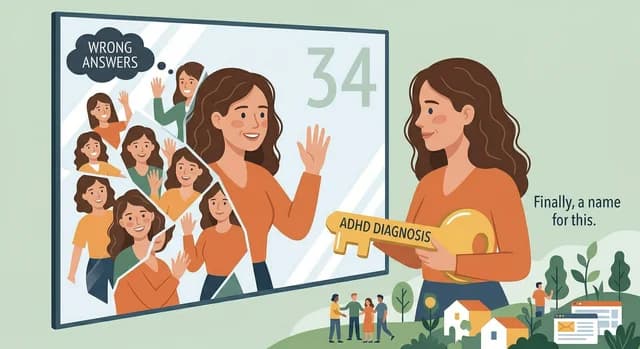
She got her ADHD diagnosis at 34.
Ten years of wrong answers. Ten years of treating symptoms while the cause sat there, unnamed, in the room.
This isn't one woman's story. This is thousands of women's stories. It might be yours.

Why Are Women with ADHD So Often Misdiagnosed?
Here's a number that should make you angry: 61% of undiagnosed ADHD cases are women (Holzapfel et al., 2025).
Not because women are more likely to have ADHD. Because women are more likely to have it missed.
The diagnostic criteria for ADHD were built on studies of hyperactive boys in the 1970s and 1980s. The image in every textbook was the same: a disruptive kid who couldn't sit still, blurted out answers, and drove teachers crazy. If your ADHD didn't look like that — if it looked like a quiet girl staring out the window, losing her homework, and apologizing for existing — nobody flagged it.
Girls are typically diagnosed between ages 16 and 28. Boys between 11 and 22 (Kristen-McClure, 2024). That's up to a decade of extra undiagnosed suffering because the people trained to catch it were trained to catch something else.
And here's the really devastating part: between 2020 and 2022, the number of adult women newly diagnosed with ADHD doubled (Charlie Health, 2025). Not because there's suddenly more ADHD. Because women finally started recognizing themselves in TikTok videos and Reddit threads that described their lived experience — the experience no clinician had ever asked about.
A generation of women diagnosed themselves on the internet because the medical system failed to do its job.
What Are the Hidden Signs of ADHD in Women?
These aren't the "classic" ADHD symptoms. These are the ones that women live with for years — sometimes decades — before anyone connects the dots.
1. The Exhaustion That Sleep Doesn't Fix
You sleep 9 hours and wake up feeling like you ran a marathon in your dreams. That's not laziness. That's the cost of a brain that manually runs processes most people's brains handle automatically — filtering noise, managing time, inhibiting impulses, maintaining working memory. Your prefrontal cortex never actually rests because it never stops compensating (Volkow et al., 2009).
One woman on r/adhdwomen put it this way: "I'm tired in a way that's not about sleep. It's being tired of trying so hard just to function at the level everyone else seems to reach without effort."
2. You're Called "Sensitive" — But It's Rejection Sensitive Dysphoria
Your friend didn't text back for 6 hours and you've already mentally replayed every interaction from the past two weeks, concluded she hates you, and composed three different apology texts for things you're not sure you did wrong.
This isn't being "too sensitive." It's RSD — Rejection Sensitive Dysphoria — and it's one of the most emotionally devastating and least-recognized features of ADHD. It's an intensity of emotional pain in response to perceived rejection that's neurologically driven, not a character flaw.
Doctors don't screen for it. They see the crying and prescribe antidepressants.
3. You Have Systems for Everything (And They're Barely Holding)
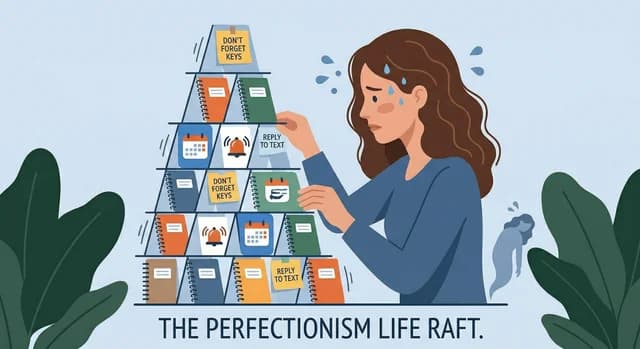
Five different calendar apps. Color-coded notebooks. Alarms set 15 minutes apart. A "launch pad" by the front door with everything you need so you don't forget your keys for the seventh time this month.
Neurotypical people don't need any of this. You need all of it — and when you describe these elaborate systems to friends, they say "wow, you're so organized." They don't see that the systems exist because without them, you can't function. The organization isn't a personality trait. It's a life raft.
4. The Inner Monologue Never Shuts Up
Not hyperactive on the outside. Hyperactive on the inside.
Constant mental chatter. Replaying conversations. Planning three hypothetical futures while trying to read a paragraph you've now read four times without absorbing a word. Jumping between songs in your head, things you said in 2019 that might have been weird, whether you turned off the stove, and what you're going to eat later — all simultaneously, all the time.
Women with ADHD are significantly more likely to present with the inattentive subtype — the kind that doesn't look "ADHD-ish" from the outside (Ramtekkar et al., 2010). No one sees the hurricane. They just see that you seem "spacey."
5. Perfectionism That Paralyzes
This one's counterintuitive. How can someone with ADHD be a perfectionist?
Because perfectionism is a coping mechanism. If you can't trust your brain to work reliably, you compensate by refusing to produce anything that isn't flawless. The essay has to be perfect before you submit it. The email has to be perfect before you send it. The plan has to be perfect before you start.
Which means you often don't start. (Stuck in this loop right now? Our Task Initiation Engine can bypass the perfectionism trap by giving you a single, imperfect-but-doable first step.)
A woman on Reddit described it perfectly: "My perfectionism isn't about high standards. It's about terror. If I do it wrong, everyone will finally see that I've been faking being competent my whole life."
6. The Period Makes Everything Worse
This is the symptom nobody talks about in mixed-gender ADHD spaces.
Estrogen modulates dopamine activity in the prefrontal cortex (Shanmugan & Epperson, 2014). During the luteal phase — the week or two before your period — estrogen drops sharply. For a brain that's already dopamine-deficient, this hormonal dip is like pulling the plug on a system running at minimum power.
The result: ADHD symptoms intensify premenstrually. Executive function tanks. Emotional regulation evaporates. Tasks that were manageable last week become impossible. And when you bring this up to your doctor, they call it PMS.
It's not PMS. It's your ADHD responding to a hormonal environment your clinician never factored in.
The same pattern amplifies during perimenopause, when estrogen levels become erratic and eventually decline permanently. Many women experience their most severe ADHD symptoms — or get their first diagnosis — between ages 40 and 55.
7. You're the Queen of "Almost"
Almost finished the degree. Almost kept the friendship. Almost stayed on top of the bills. Almost made it through the week without a meltdown.
The pattern of starting strong and fading — not from lack of caring, but from the neurological cost of sustained effort without adequate dopamine reward — is one of the defining and most painful experiences of ADHD in women. You know you're capable. You've proven you're capable in short bursts. But consistency requires executive function resources you simply don't have access to consistently.
This is where the self-blame becomes toxic: "I know I can do it because I've done it before. So why can't I do it now?" Because your brain doesn't work on a level playing field. Some days the dopamine is there. Some days it isn't. And you have no control over which day is which.
8. Social Exhaustion Disguised as Introversion
You leave every social event feeling like you ran a cognitive marathon. The masking — making eye contact, tracking the conversation, suppressing the urge to interrupt, pretending you weren't mentally composing a grocery list while someone told you about their weekend — drains everything.
Many women with ADHD identify as introverts for years before realizing: they don't dislike people. They dislike the performance required to be around people.
When you've been masking your whole life, you sometimes don't know where the mask ends and you begin.
9. Your House Is Either Spotless or a Disaster
There's no middle ground. When the dopamine cooperates — hyperfocus cleaning mode. Everything sparkles. You reorganize the pantry alphabetically. Four hours vanish.
When the dopamine doesn't cooperate — doom piles. Laundry on the chair. Dishes in the sink. The mail from three weeks ago sitting unopened because opening it requires three micro-decisions your brain cannot process right now.
People think it's a discipline problem. It's an executive function problem. Specifically, it's a task initiation problem. The desire to clean is there. The ability to translate that desire into physical action is not.
Stuck on something right now?
Stop reading about it — try it. Thawly breaks your task into one tiny step you can do right now.
Free · No signup · 3 secondsWhy Do Women Get Diagnosed with Anxiety Instead of ADHD?
Women with ADHD are twice as likely as men to receive a prior diagnosis of depression or anxiety before anyone considers ADHD (ADDitude, 2024).
The symptom overlap is real:
| Symptom | ADHD | Anxiety | Depression |
|---|---|---|---|
| Difficulty concentrating | ✓ | ✓ | ✓ |
| Restlessness | ✓ | ✓ | |
| Irritability | ✓ | ✓ | ✓ |
| Low self-esteem | ✓ | ✓ | |
| Sleep problems | ✓ | ✓ | ✓ |
| Fatigue | ✓ | ✓ |
But here's the critical difference: with ADHD, the anxiety and depression are usually downstream effects of living undiagnosed. You're anxious because you've spent your whole life barely keeping up and waiting for the day everyone realizes you're a fraud. You're depressed because decades of invisible effort with no recognition breaks a person down.
Treating the anxiety and depression without addressing the ADHD is like mopping the floor while the faucet is still running.
The antidepressants take the edge off the sadness. But you still can't start things. You still can't organize. You still lose time. You still feel broken in a way the medication can't reach — because the thing that's actually broken was never identified.
What Does Thawly's Data Show About Women with ADHD?
Among the task breakdowns in Thawly, we've noticed a pattern: users who identify as women are significantly more likely to enter tasks with high emotional loading — tasks that aren't objectively difficult but carry invisible weight.
The #1 task women struggle to initiate isn't filing taxes or writing a report. It's replying to a text message. Not because the text is hard. Because the text requires emotional processing — figuring out tone, worrying about being misunderstood, ruminating on whether the response is "right" — that depletes an already strained executive function system.
When the AI breaks that task into micro-steps, the first step is never "write the reply." It's something like "open the message thread." Just open it. That's it. (Need that micro-step right now? Try our Executive Dysfunction Tool.)
The barrier to starting isn't the task. It's the invisible emotional processing the task demands. And that burden falls disproportionately on women — because women are socialized to weigh every word, anticipate every reaction, and take responsibility for every misunderstanding.
What Should You Do If You Think You Have ADHD?
You might be sitting here with tears running down your face because this is the first time you've seen your internal experience described accurately. That reaction is common. That reaction is valid. That reaction itself is data.
Here's what to do with it:
1. Get Evaluated — By Someone Who Gets It
Not every clinician understands how ADHD presents in women. Look for a provider who:
- Specifically mentions experience with adult ADHD, particularly in women
- Uses multiple assessment tools (not just a quick questionnaire)
- Asks about your childhood — not just current symptoms
- Takes hormonal factors into account
Organizations like CHADD maintain directories of ADHD-specialized providers.
2. Stop Blaming Yourself — Seriously
Every "why can't I just..." and "if I just tried harder..." and "everyone else manages this" thought loop is wrong. Not wrong because you need encouragement. Wrong because it's factually incorrect.
You have a neurodevelopmental condition that affects the most fundamental cognitive operations: starting, sustaining, shifting, and stopping. The fact that you've compensated this long isn't evidence of failure. It's evidence of extraordinary, invisible labor.
3. Find Your Community
The r/adhdwomen subreddit has over 400,000 members. Many of them were diagnosed after 30. Many of them spent years being treated for the wrong thing. Many of them are living proof that late diagnosis doesn't mean lost cause.
You're not alone. You were never alone. You were just surrounded by people who couldn't see the thing you were drowning in.
4. Reduce the Masking Load
You've been performing neurotypicality your entire life. That performance has a price — and eventually, the bill comes due in the form of ADHD burnout.
Start identifying spaces where you can stop pretending. Where you can let the mask slip. Where you can say "I need to do this differently" without apologizing. Every unit of masking energy you reclaim goes directly back into your ability to actually function.
5. Build Systems That Work for Your Brain
Not systems that look impressive. Not systems that would work for someone without ADHD. Systems designed for a brain that forgets, loses time, can't self-start, and runs on inconsistent neurochemistry.
Keep it brutally simple. One task at a time. One next step at a time. External reminders for everything. And when the system fails — because it will, some days — start again without punishment.
Is Grief After a Late ADHD Diagnosis Normal?
Getting diagnosed late is complicated. There's relief — finally, a name for this. And there's grief — for every year I spent blaming myself for something that wasn't my fault.
That grief is valid. Sit with it. Let it move through you. You did lose something. You lost years of understanding. You lost the chance to learn coping strategies at 14 instead of 34. You lost the self-compassion that comes with knowing there's a reason.
But here's what you didn't lose: the capacity to build a life that works with your brain instead of against it.
The diagnosis doesn't change who you are. It changes how you understand who you've always been.
And that understanding? It changes everything.
FAQ
Can you have ADHD and still be successful?
Yes — and this is one of the biggest reasons women get missed. Academic and professional success doesn't rule out ADHD. Many women with ADHD achieve at very high levels through sheer compensatory effort: last-minute panic-driven performance, perfectionism, people-pleasing, and exhausting self-monitoring. The success is real. But it's built on an unsustainable foundation. The question isn't "can she do it?" It's "what is it costing her?"
Does ADHD get worse with age in women?
ADHD symptoms can intensify at key hormonal transition points — puberty, pregnancy, postpartum, perimenopause, and menopause. Estrogen modulates dopamine signaling in the prefrontal cortex, so when estrogen drops, executive function can decline noticeably. Many women report their worst ADHD symptoms during perimenopause, and some receive their first diagnosis in their 40s or 50s as a result.
What's the difference between inattentive ADHD and being a "daydreamer"?
Everyone daydreams occasionally. Inattentive ADHD involves persistent, pervasive difficulty sustaining attention, following through on tasks, organizing activities, and managing time — to a degree that significantly impairs daily functioning. The difference is frequency, severity, and functional impact. Daydreaming in class occasionally is normal. Losing hours of your life to mental fog while your responsibilities pile up is not.
Can ADHD masking cause physical symptoms?
Yes. Chronic masking activates the stress response system, leading to elevated cortisol levels. Over time, this can manifest as persistent fatigue, insomnia, muscle tension (especially jaw clenching and shoulder pain), headaches, digestive issues, and increased susceptibility to illness. The body keeps the score — and years of performing neurotypicality leave marks.
Does having ADHD mean I'll pass it to my children?
ADHD has a strong genetic component — heritability estimates range from 70-80% (Faraone et al., 2021). If you have ADHD, your children have an elevated probability of having it too. The upside: your lived experience means you're uniquely positioned to recognize the signs early and advocate for support that you never had.
Sources
- Faraone, S.V. et al. (2021). The World Federation of ADHD International Consensus Statement. Neuroscience & Biobehavioral Reviews, 128, 789-818.
- Holzapfel, A. et al. (2025). Gender Differences in Self-Reported ADHD Symptoms and Diagnostic Status. Journal of Attention Disorders.
- Ramtekkar, U.P. et al. (2010). Sex and Age Differences in Attention-Deficit/Hyperactivity Disorder Symptoms and Diagnoses. Journal of the American Academy of Child & Adolescent Psychiatry, 49(3), 217-228.
- Shanmugan, S. & Epperson, C.N. (2014). Estrogen and the Prefrontal Cortex: Towards a New Understanding of Estrogen's Effects on Executive Functions in the Menopause Transition. Human Brain Mapping, 35(3), 847-865.
- Volkow, N.D. et al. (2009). Evaluating Dopamine Reward Pathway in ADHD. JAMA, 302(10), 1084-1091.

Sean Z. holds a Master's degree in Cognitive Psychology. He spent 7 years in academic research focused on human cognition, followed by 10+ years designing products and services in the applied psychology space. He built Thawly after years of firsthand experience with ADHD task paralysis — combining academic understanding of executive function with the daily reality of living with it. About the Author → LinkedIn
Looking for more specific strategies?
Explore 115+ targeted tools for specific ADHD scenarios.
Browse the ADHD Toolkit →