Executive Dysfunction and Task Initiation: The Missing Link Nobody Explains
Disclaimer: This article is for informational and educational purposes only. It is not a substitute for professional medical advice, diagnosis, or treatment. If you suspect you have ADHD, please consult a qualified healthcare provider.
There's a thing that happens in ADHD forums that breaks my heart a little. Someone posts: "I sat on my bed for three hours wanting to shower but couldn't make myself stand up." And the replies flood in — not sympathy, but recognition. "Same." "This is me every morning." "I thought I was the only one."
They're not describing laziness. They're not describing depression (though it can look identical from the outside). They're describing executive dysfunction — specifically, the task initiation component — and it's the single most misunderstood aspect of ADHD in adults.
Most articles about executive dysfunction give you a list: planning, organization, working memory, emotional regulation, blah blah blah. Those are real. But they bury the one that matters most: the inability to begin. Because if you can't start, nothing else on that list is relevant.
Executive Dysfunction Is Not One Thing
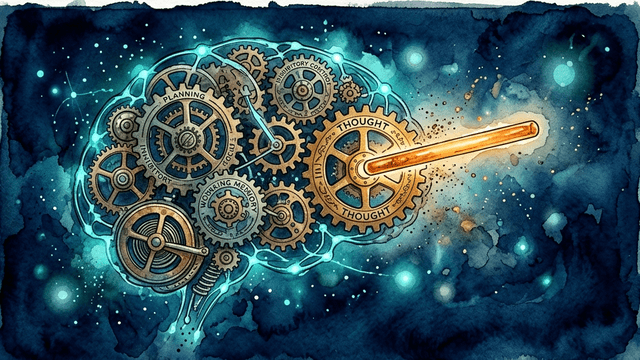
This is where most explanations go wrong. They treat executive dysfunction like a single switch — "on" or "off." It's actually a constellation of at least six interrelated cognitive processes (Brown, 2013):
- Activation — organizing, prioritizing, and starting tasks
- Focus — sustaining, shifting, and dividing attention
- Effort — regulating alertness, sustaining effort, and processing speed
- Emotion — managing frustration and modulating emotions
- Memory — utilizing working memory and accessing recall
- Action — monitoring and self-regulating action
Task initiation lives under Activation — the very first step in the chain. When activation fails, the other five processes never get the chance to engage.
This is why it's so frustrating. You might have adequate focus, decent memory, and functional emotional regulation — but if the activation system doesn't fire, none of those intact functions matter. It's like having a perfectly running car engine that you can't start.
The Barkley Model: It's About Self-Regulation
Barkley (1997) reframed ADHD as fundamentally a disorder of self-regulation, not attention. In his model, the core deficit is behavioral inhibition — the ability to pause, evaluate, and then execute planned behavior.
Task initiation requires all three steps:
- Pause the current activity (scrolling, staring, worrying)
- Evaluate what needs to happen (identify the first action)
- Execute the planned behavior (begin)
For neurotypical brains, this happens automatically — often below conscious awareness. You decide to write an email and your hands are on the keyboard before you've consciously planned the sequence.
For ADHD brains, each step requires effortful, deliberate executive processing. And each step can fail independently. You might successfully pause but fail to evaluate. You might evaluate correctly but fail to execute. The "gap" between intention and action can open at any point in the chain.
Why Task Initiation Is Executive Dysfunction's Weakest Link
It Has the Highest Dopamine Demand
Initiation requires the prefrontal cortex to generate a "go" signal — essentially a prediction that the upcoming task will produce enough reward to justify the effort. This prediction depends on dopamine signaling in the mesocortical pathway (Volkow et al., 2009).
The problem: ADHD brains have reduced dopamine transporter density in exactly these circuits. The "go" signal is chronically weak — especially for tasks with delayed or uncertain rewards (which is most adult responsibilities: emails, bills, chores, reports).
Tasks with immediate, certain rewards — video games, social media, novel projects — produce enough dopamine to initiate easily. That's why you can hyperfocus on your hobby but can't start your expense report. Same brain, different dopamine economics.
It's the Only Executive Function with No Workaround
Here's a brutal asymmetry: most executive functions have external compensations. Poor working memory? Use lists. Poor organization? Use folders. Poor time management? Use alarms.
But poor task initiation? There's no tool that can make you start. A to-do list tells you what to do — it can't generate the neural signal to begin doing it. A calendar tells you when — it can't produce the activation energy to comply. (This is exactly the problem that Thawly was designed to address — not just telling you what to do, but walking you through the first micro-step when your brain's activation system won't fire.)
This is why task initiation dysfunction is so devastating. It's the bottleneck that every other executive function depends on, and it's the one with the fewest natural compensations.
Stuck on something right now?
Stop reading about it — try it. Thawly breaks your task into one tiny step you can do right now.
Free · No signup · 3 secondsThe Emotional Tax
Executive dysfunction and task initiation failure don't exist in an emotional vacuum. Every failed initiation attempt leaves a residue:
- Shame: "Why can't I just do this? Everyone else can."
- Anxiety: "It's been three hours. The deadline is tomorrow."
- Self-doubt: "Maybe I'm not capable of this job/relationship/life."
- Avoidance: "If I don't try, I can't fail again."
These emotions don't just result from initiation failure — they actively make the next initiation attempt harder. The emotional loading raises the activation threshold, requiring even more dopamine to overcome.
Ramsay and Rostain (2008) identified this as the "coping tax" of adult ADHD: the cognitive and emotional energy spent managing executive dysfunction reduces the resources available for actual task performance. You're spending so much energy feeling bad about not starting that you have even less energy to start.
Breaking this cycle requires addressing both the neurological deficit and the emotional layer simultaneously. Strategies alone don't fix the shame. Medication alone doesn't fix the learned helplessness. You need both — plus, often, a therapeutic relationship that validates the experience. (For immediate, practical support, our Executive Dysfunction Bypass tool can help you break through in the moment.)
5 Task Initiation Approaches Specifically for Executive Dysfunction
These aren't generic tips. They're designed to work when your executive system is degraded.
1. The "Already Started" Method
Don't start cold. Start warm.
Before you leave your desk, set up tomorrow's first task in an already-started state:
- Document open, cursor blinking after the first sentence you already typed
- Email draft with the recipient and subject line filled in
- Spreadsheet open to the exact cell you need to edit
Tomorrow, you're not initiating. You're continuing. Neurologically, continuation requires less prefrontal activation than initiation (Zeigarnik, 1927). The task is already "loaded" in your working memory's background processes.
2. The Sensory Trigger Chain
Executive dysfunction often disconnects cognitive intention from motor output. Bridge the gap with sensory cues that bypass the cognitive system:
- Tactile: Pick up the pen. Open the laptop lid. Touch the keyboard.
- Auditory: Play a specific song that's only associated with work. Three bars in, your brain starts context-switching.
- Olfactory: Light a specific candle or use a specific essential oil only during work. Scent is processed through the amygdala, bypassing prefrontal cortex entirely.
You're creating conditioned sensory triggers that initiate the behavioral sequence without requiring executive processing. Pavlov, but make it productivity.
3. The Minimum Viable Action
This is more specific than "break it into smaller steps" — because "breaking it into steps" is itself an executive function task that requires the system you're trying to compensate for.
Instead: What is the single smallest physical action that moves you one inch closer to the task?
- Not "plan the presentation" → "open PowerPoint"
- Not "clean the apartment" → "pick up one thing off the floor"
- Not "do your taxes" → "find last year's W-2"
The action must be:
- Physical (not cognitive — no planning, deciding, or evaluating)
- Under 2 minutes
- Impossible to fail at (you literally cannot pick up one thing wrong)
Fogg (2019) calls this "making it tiny." I call it "making it impossible to not do." The result is the same: the initiation barrier drops below the activation threshold, and the task begins.
4. External Initiation Partners
If your internal activation system is unreliable, borrow someone else's.
- Body doubling: Another person working nearby provides ambient social activation. You're not "supervised" — their presence simply raises your baseline arousal enough to cross the initiation threshold (Zajonc, 1965).
- Accountability texts: "I'm starting X at 2 PM. Will report at 2:15." The social commitment creates external urgency.
- AI coaching: Tools like Thawly that ask "What do you need to do?" and then give you the first micro-step function as an external activation agent when humans aren't available.
5. The Energy Audit
Executive dysfunction severity fluctuates throughout the day. Track it.
For one week, rate your "ability to start things" at 9 AM, 1 PM, and 6 PM on a 1-5 scale. You'll discover your personal initiation windows — the hours where your prefrontal cortex is most responsive.
Then protect those windows ruthlessly. No meetings. No email. No "quick favors." Those peak hours are for your hardest initiation tasks. Everything else goes in maintenance windows.
This isn't time management. It's executive function management — and it's far more important.
When to Seek Professional Help
Executive dysfunction with task initiation impairment crosses from "annoying" to "clinically significant" when it:
- Consistently prevents you from meeting work deadlines
- Damages relationships (missing commitments, appearing unreliable)
- Causes significant distress or shame
- Persists despite environmental modifications and behavioral strategies
- Affects multiple life domains (not just work — also hygiene, finances, household tasks)
If this describes your experience, seek evaluation from a clinician who specializes in adult ADHD or executive function disorders. The combination of accurate diagnosis, appropriate medication (if indicated), and evidence-based behavioral therapy (Safren et al., 2005) is the most effective intervention currently available.
FAQ
Is executive dysfunction the same as ADHD?
No, but they're deeply intertwined. Executive dysfunction is a feature of ADHD, but it also occurs in autism, depression, traumatic brain injury, and other conditions. ADHD is the most common cause of persistent executive dysfunction in adults, but it's not the only one. A clinical evaluation can determine which condition is driving the dysfunction.
Can you have task initiation problems without executive dysfunction?
Situationally, yes — stress, sleep deprivation, and illness can temporarily impair task initiation in anyone. But chronic, persistent task initiation failure that occurs across contexts and despite adequate motivation is a hallmark of executive dysfunction. If it's happening regularly, it's not a bad day — it's a pattern worth investigating.
Why is task initiation harder than task completion?
Because initiation requires the highest prefrontal cortex activation. Once a task is underway, momentum, working memory engagement, and real-time feedback loops sustain the activity with progressively less executive demand. Starting is literally the hardest part — which is why the most effective interventions focus specifically on the first 2 minutes, not the entire task.
Does executive dysfunction get worse with age?
Executive functions continue developing into the mid-20s (Giedd, 2004), and some adults report improvement as they develop compensatory strategies over decades. However, the underlying neurological deficit doesn't resolve — and the increasing complexity of adult responsibilities (mortgages, children, career advancement) can make the functional impact worse even if the raw deficit stays stable.
What's the difference between executive dysfunction and being lazy?
Laziness is a choice to avoid effort despite having the capacity to engage. Executive dysfunction is the absence of capacity — you want to start, you intend to start, and you can't generate the neural signal to begin. The subjective experience is completely different: lazy people feel relaxed about not working; people with executive dysfunction feel trapped, ashamed, and desperate to move but unable to.
Sources
- Barkley, R.A. (1997). Behavioral inhibition, sustained attention, and executive functions: Constructing a unifying theory of ADHD. Psychological Bulletin, 121(1), 65-94.
- Brown, T.E. (2013). A New Understanding of ADHD in Children, Adolescents, and Adults: Executive Function Impairments. Routledge.
- Fogg, B.J. (2019). Tiny Habits: The Small Changes That Change Everything. Houghton Mifflin Harcourt.
- Giedd, J.N. (2004). Structural magnetic resonance imaging of the adolescent brain. Annals of the New York Academy of Sciences, 1021(1), 77-85.
- Ramsay, J.R. & Rostain, A.L. (2008). Cognitive-Behavioral Therapy for Adult ADHD. Routledge.
- Safren, S.A. et al. (2005). Cognitive-behavioral therapy for ADHD in medication-treated adults with continued symptoms. Behaviour Research and Therapy, 43(7), 831-842.
- Volkow, N.D. et al. (2009). Evaluating dopamine reward pathway in ADHD. JAMA, 302(10), 1084-1091.
- Zajonc, R.B. (1965). Social facilitation. Science, 149(3681), 269-274.
- Zeigarnik, B. (1927). On finished and unfinished tasks. Psychologische Forschung, 9, 1-85.

Sean Z. holds a Master's degree in Cognitive Psychology. He spent 7 years in academic research focused on human cognition, followed by 10+ years designing products and services in the applied psychology space. He built Thawly after years of firsthand experience with ADHD task paralysis — combining academic understanding of executive function with the daily reality of living with it. About the Author → LinkedIn
Looking for more specific strategies?
Explore 115+ targeted tools for specific ADHD scenarios.
Browse the ADHD Toolkit →