Implementation Intentions for ADHD: If-Then Plans That Actually Work (94 Studies)
Disclaimer: This article is for informational and educational purposes only. It is not a substitute for professional medical advice, diagnosis, or treatment. If you suspect you have ADHD, please consult a qualified healthcare provider.
Implementation intentions are one of the most powerful — and most underused — tools for ADHD task initiation. In a meta-analysis of 94 studies, Gollwitzer & Sheeran (2006) found that implementation intentions improved goal attainment by 65% on average. And crucially, Gawrilow et al. (2011) confirmed they work specifically for ADHD populations — not just neurotypicals.
Yet most ADHD resources mention them as a footnote. One bullet point in a list of 15 tips. "Try If-Then plans!" Cool. Thanks. Very helpful.
Let me tell you how implementation intentions actually saved my mornings — and why I eventually built an AI to generate them for me.
What Are Implementation Intentions?
The concept was developed by psychologist Peter Gollwitzer in 1999. The idea is deceptively simple:
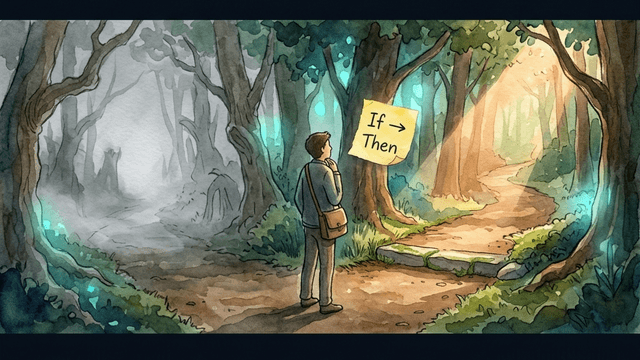
Instead of setting a goal intention ("I will exercise today"), you set an implementation intention — a specific If-Then plan:
"If [situation/cue], then I will [specific action]."
That's it. That's the entire framework.
- Goal intention: "I need to write that report."
- Implementation intention: "If I sit down at my desk after my morning coffee, then I will open the document and type the first sentence."
The difference? The goal intention requires your brain to decide when, where, and how to act — all in real time. The implementation intention pre-decides everything. You've already committed to the action, the trigger, and the first move. Your brain just has to recognize the cue and execute.
Why They're Especially Powerful for ADHD
1. They Bypass the Dopamine Deficit
ADHD brains have reduced dopamine availability in the prefrontal cortex (Volkow et al., 2009). This means your executive system can't reliably generate the "go signal" — the neurochemical push needed to convert intention into action.
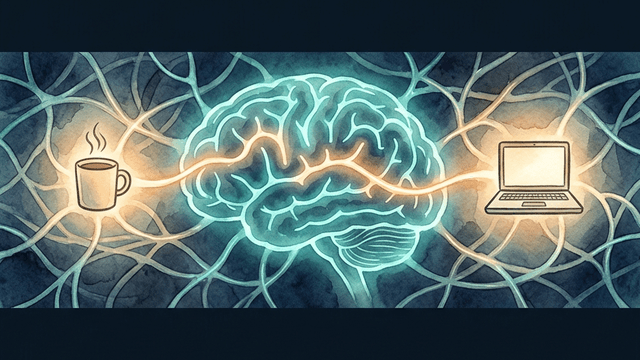
Implementation intentions bypass this entirely. Instead of waiting for your prefrontal cortex to initiate action, you've pre-programmed an environmental cue to do the job. The coffee mug in your hand becomes the trigger. The alarm on your phone becomes the trigger. The task initiation barrier gets sidestepped.
Gollwitzer's research (1999) calls this "strategic automaticity" — you're essentially creating a habit-like response without the weeks of repetition normally required.
2. They Kill Decision Fatigue
Every unstructured moment is a decision point for an ADHD brain. "Should I start now? What should I start with? Where's my laptop? Maybe I should eat first..." Each micro-decision drains the same limited executive resources needed for initiation.
Implementation intentions collapse all those decisions into one upfront commitment. When the cue appears, there's nothing left to decide. You've already decided.
3. They Externalize Executive Function
Dr. Russell Barkley (2012) argues that the most effective ADHD interventions externalize the executive functions the brain can't perform internally. Implementation intentions do exactly this — they move the "when/where/how" processing from your (unreliable) internal system to an (reliable) external plan.
Think of it as outsourcing your prefrontal cortex to a sticky note. (Struggling with this right now? Try our Task Initiation Engine — it externalizes the entire process for you.)
The Science: What the Research Actually Shows
Gollwitzer's Original Study (1999)
In a landmark study, Gollwitzer demonstrated that people who formed implementation intentions were 2-3x more likely to follow through on difficult goals compared to those who only set goal intentions. The effect held across health behaviors, academic tasks, and personal goals.
Gawrilow et al. (2011) — ADHD-Specific Evidence
This is the study that matters most for us. Gawrilow and colleagues tested implementation intentions specifically with children who had ADHD. The results:
- Children using If-Then plans showed significant improvement in response inhibition (a core ADHD deficit)
- The effect was comparable in magnitude to some behavioral interventions
- Critically, the improvement didn't require sustained effort — the plans worked through automatic cue-response activation
Gollwitzer & Sheeran (2006) — The Meta-Analysis
Across 94 independent studies with over 8,000 participants, implementation intentions produced a medium-to-large effect size (d = 0.65) on goal attainment. This is one of the most replicated findings in behavioral science. For context, this effect size is larger than many medication effects.
Stuck on something right now?
Stop reading about it — try it. Thawly breaks your task into one tiny step you can do right now.
Free · No signup · 3 seconds10 Ready-to-Use Templates for ADHD
Stop trying to write these from scratch. Here are templates for the most common ADHD paralysis scenarios:
Morning Routine
| Trigger | Implementation Intention |
|---|---|
| Alarm goes off | "If my alarm goes off, then I will put both feet on the floor before touching my phone." |
| Standing in bathroom | "If I'm standing at the sink, then I will squeeze toothpaste onto the brush." |
Work Tasks
| Trigger | Implementation Intention |
|---|---|
| Sitting at desk with coffee | "If I sit down with coffee, then I will open [specific document] and read the first paragraph." |
| Email notification | "If I see a work email, then I will reply with one sentence within 2 minutes." |
| After lunch | "If I finish lunch, then I will set a 15-minute timer and start the hardest task." |
Household Chores
| Trigger | Implementation Intention |
|---|---|
| Walking past laundry basket | "If the laundry basket is full, then I will carry it to the machine and press start." |
| After dinner | "If I put my plate down, then I will rinse it and put it in the dishwasher." |
Exercise
| Trigger | Implementation Intention |
|---|---|
| 6:00 PM alarm | "If my 6 PM alarm sounds, then I will put on my running shoes. Nothing else — just the shoes." |
Emotional Overwhelm
| Trigger | Implementation Intention |
|---|---|
| Feeling paralyzed | "If I notice I've been staring at my screen for 5 minutes, then I will stand up, take 3 breaths, and pick the smallest task on my list." |
| Feeling dread about a task | "If I feel dread, then I will set a 2-minute timer and commit to only 2 minutes." |
The Key Mistakes (And How to Avoid Them)
❌ Mistake 1: Making the "Then" Too Big
- Bad: "If it's Monday morning, then I will clean the entire kitchen."
- Good: "If it's Monday morning, then I will put one dish in the dishwasher."
The action must be so small that it feels absurd. If you feel any resistance, shrink it further. The goal isn't to finish — it's to start. Momentum handles the rest. (This is the same principle behind our Executive Dysfunction Bypass tool.)
❌ Mistake 2: Vague Triggers
- Bad: "If I have free time, then I will exercise."
- Good: "If I close my laptop at 5:30 PM, then I will put on my running shoes."
"Free time" isn't a trigger. It's a concept. Your brain needs a specific, observable cue — a time, a location, or an event that already happens in your routine.
❌ Mistake 3: Too Many at Once
Start with one. Not five. Not ten. One.
Master it for a week. Feel the automatic response form. Then add a second. ADHD brains are particularly susceptible to the enthusiasm trap — creating 20 implementation intentions on day one, feeling overwhelmed by day three, and abandoning everything by day five.
How Thawly Automates Implementation Intentions
Here's the part I find fascinating as both a researcher and a builder:
Every micro-step that Thawly generates is essentially an implementation intention.
When you type "Do my taxes" into Thawly's Action Mode, the AI doesn't just break it into steps. It generates a sequence of specific, observable, tiny actions — each one designed to be the "Then" in an If-Then plan:
- "Open your browser and go to turbotax.com" ← specific, observable
- "Click 'Start my return'" ← one click, no decision
- "Enter your name and Social Security number" ← one field at a time
The timer provides the "If" — when the current step completes, the next one appears. You never have to decide what comes next. The system externalizes every single decision point.
And in Coach Mode, when you dump your mental chaos, the AI builds the entire implementation intention chain — from the emotional trigger ("I feel overwhelmed about this project") to the first physical action ("Open Figma and draw one rectangle").
This is what Gollwitzer's research has been pointing toward for 25 years: what if implementation intentions didn't require manual creation? What if an AI could observe your task, understand your bottleneck, and generate the If-Then plan for you?
That's what we're building.
Try it free — no signup needed →
FAQ
Do implementation intentions work for everyone with ADHD?
They work for most, but the magnitude varies. Gawrilow et al. (2011) found significant effects in children with ADHD, but individual differences in working memory capacity affected the results. If you have severe working memory deficits, you may need the implementation intentions written down or externalized (which is exactly what tools like Thawly do).
How are implementation intentions different from regular habits?
Habits form through repetition over time (average 66 days per Lally et al., 2010). Implementation intentions create habit-like automatic responses immediately — without the repetition phase. They're essentially a shortcut to automaticity.
Can I use implementation intentions alongside ADHD medication?
Absolutely. Medication raises your baseline dopamine availability, making it easier for the If-Then triggers to activate. Safren et al. (2005) demonstrated that combining medication with cognitive behavioral strategies produces better outcomes than either alone.
What if I forget my implementation intention?
Write it down. Seriously. On a sticky note, on your phone, or set it as your screen wallpaper. The whole point is externalization — keeping the plan in your head defeats the purpose.
How many implementation intentions should I have at once?
Start with one. When it becomes automatic (you don't have to think about it), add a second. Most people can actively maintain 3-5 at any given time.
Sources
- Barkley, R.A. (2012). Executive functions: What they are, how they work, and why they evolved. Guilford Press.
- Gawrilow, C. et al. (2011). If-then plans benefit executive functions in children with ADHD. Journal of Social and Clinical Psychology, 30(6), 616-646.
- Gollwitzer, P.M. (1999). Implementation intentions: Strong effects of simple plans. American Psychologist, 54(7), 493-503.
- Gollwitzer, P.M. & Sheeran, P. (2006). Implementation intentions and goal achievement: A meta-analysis. Advances in Experimental Social Psychology, 38, 69-119.
- Lally, P. et al. (2010). How are habits formed: Modelling habit formation in the real world. European Journal of Social Psychology, 40(6), 998-1009.
- Safren, S.A. et al. (2005). Cognitive-behavioral therapy for ADHD in medication-treated adults. Behaviour Research and Therapy, 43(7), 831-842.
- Volkow, N.D. et al. (2009). Evaluating dopamine reward pathway in ADHD. JAMA, 302(10), 1084-1091.
Related Reading
- Task Initiation: Why Starting Is the Hardest Part — The neuroscience behind why your brain won't start
- Goblin Tools ADHD Task Breakdown: 7 Better Alternatives — Tools that go beyond lists
- ADHD Paralysis vs Executive Dysfunction — Understanding the difference
- How to Deal with Executive Dysfunction — A practical guide

Sean Z. holds a Master's degree in Cognitive Psychology. He spent 7 years in academic research focused on human cognition, followed by 10+ years designing products and services in the applied psychology space. He built Thawly after years of firsthand experience with ADHD task paralysis — combining academic understanding of executive function with the daily reality of living with it. About the Author → LinkedIn
Looking for more specific strategies?
Explore 115+ targeted tools for specific ADHD scenarios.
Browse the ADHD Toolkit →