Paralyzing Anxiety: When Fear Freezes You in Place
Disclaimer: This article is for informational and educational purposes only. It is not a substitute for professional medical advice, diagnosis, or treatment. If you suspect you have ADHD, please consult a qualified healthcare provider.
Paralyzing anxiety is the state where fear and dread become so intense that they overwhelm the prefrontal cortex, triggering a freeze response instead of productive action. It commonly co-occurs with ADHD because executive dysfunction creates repeated failure experiences, which build anticipatory dread about future tasks. The anxiety itself then becomes an additional barrier to starting — creating a vicious cycle where worrying about not doing the thing prevents you from doing the thing.
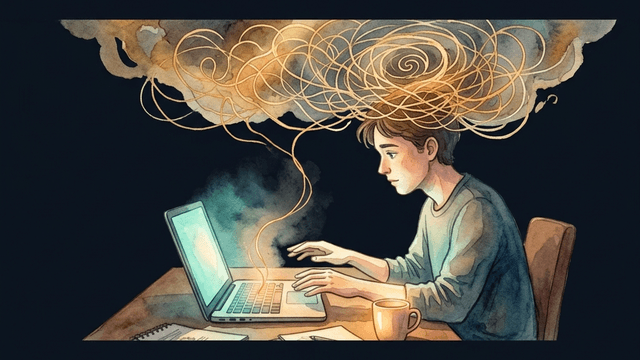
The email has been sitting in my inbox for eleven days. I've opened it six times. Read it once. Started to reply twice. Closed it both times.
It's not a scary email. It's not bad news or a legal threat or anything objectively difficult. It's a vendor asking me to confirm a date. The answer is yes. One word. Three letters. Y-E-S.
Eleven days.
If you've been here — staring at something simple while your chest tightens and your brain produces seventeen catastrophic scenarios about what happens if you respond wrong — you're not experiencing "normal" anxiety. You're in what clinicians call an anxiety-driven freeze state. The popular shorthand is paralyzing anxiety, and it's one of the most common reasons people can't function even when nothing is technically wrong.
What Paralyzing Anxiety Actually Is (The Neuroscience)
Regular anxiety is forward-looking dread — worry about what might happen. Paralyzing anxiety is what happens when that dread crosses a neurological threshold and your brain stops processing future actions entirely.
The mechanism involves two structures having a very bad argument:
The amygdala — your brain's threat detector — is screaming that the task in front of you is dangerous. Not physically dangerous. Socially, emotionally, reputationally dangerous. "If you reply to that email wrong, they'll think you're incompetent. If you call the doctor, they might find something. If you start that project, you might fail."
The prefrontal cortex — your rational planning center — knows these fears are disproportionate. It's trying to calculate that the email is fine, the doctor is routine, the project is manageable. But here's the physiological reality: the amygdala processes threats 10x faster than the PFC processes logic (LeDoux, 1996). By the time your rational brain catches up, your body is already in freeze mode.
This isn't metaphorical. A 2022 study published in Biological Psychiatry used functional MRI to show that individuals with anxiety disorders exhibit hyperconnectivity between the amygdala and the brainstem's periaqueductal gray — the same circuit that triggers freeze responses in animals confronted by predators. Your brain is genuinely treating the email like a predator.
The ADHD + Anxiety Double Bind
If you have ADHD, paralyzing anxiety hits different. And by "different" I mean "worse."
Here's why: an estimated 50% of adults with ADHD have comorbid anxiety (Kessler et al., 2006). That's not a coincidence — and the overlap extends to depression too (see our deep dive: Can ADHD Cause Depression and Anxiety?). ADHD creates anxiety through a brutally logical chain:
- Executive dysfunction → you miss deadlines, forget commitments, lose things
- Consequences accumulate → damaged relationships, poor performance reviews, financial mistakes
- Your brain learns that action leads to failure
- The amygdala starts flagging every action as potentially dangerous
- Paralysis becomes the default "safe" response
This is how the Wall of Awful gets built. Each negative experience adds a brick. After enough bricks, even opening your laptop triggers anticipatory dread — not because the laptop is dangerous, but because what's inside it has hurt you before.
(Recognize this spiral? The Task Avoidance Anxiety Tool was designed for this exact moment — when the fear is bigger than the task.)
The cruelest irony: the very coping strategies that help "normal" anxiety — planning, organizing, making a schedule — require executive function. Which is exactly what ADHD impairs. So you can't plan your way out of the anxiety, and the anxiety prevents you from doing the things that would prove it wrong. It's a neurological Catch-22.
Stuck on something right now?
Stop reading about it — try it. Thawly breaks your task into one tiny step you can do right now.
Free · No signup · 3 secondsWhat Paralyzing Anxiety Looks Like (Beyond the Obvious)
Most people picture paralyzing anxiety as a dramatic panic attack — hyperventilating, heart pounding, visibly distressed. That's one version. But the more common version is eerily quiet:
- The Unopened Notification: You see the red badge on your email/text and immediately look away. Not later. Not in five minutes. Not ever, until someone asks you about it.
- The Draft Graveyard: Half-written texts, unsent emails, unpublished posts. You started, the anxiety hit, and closing the tab felt like oxygen.
- The Phantom Phone Call: You need to call someone. You've rehearsed the conversation in your head fourteen times. You've dialed six digits, then hung up. The phone has become a weapon.
- The Decision Stalemate: Which groceries to buy, which doctor to pick, which route to drive. Each option feels like a one-way door to an irreversible mistake. (This relentless circling often bleeds into generalized rumination — if you find your brain doing this obsessively, check our breakdown: Is Overthinking a Sign of ADHD?)
- The Silent Day: You wake up and the anxiety is already there — not attached to anything specific, just a low-frequency hum that makes initiating any action feel like pushing through wet concrete.
That last one is the hardest to explain to people who don't experience it. "What are you anxious about?" "Nothing." "Then why can't you get up?" "I don't know." And they look at you like you're being difficult.
6 Strategies That Actually Cut Through the Freeze
These aren't the "take deep breaths" suggestions you've seen in every wellness article. These are designed for the specific neurological state of anxiety-induced paralysis.
1. Name the Fear Out Loud (Externalization)
Your amygdala thrives on vagueness. "Something bad will happen" is its favorite fuel — because unspecified threats can't be disproven. Cut through it by forcing specificity.
Say it out loud: "I'm afraid that if I reply to this email, they'll think I took too long and judge me." Now your PFC has something concrete to work with. Is that fear realistic? Maybe. But now it's a specific maybe, not an amorphous doom cloud. Pennebaker's research on expressive writing (1997) showed that narrating fears reduces amygdala activation by up to 30% — and speaking works the same way.
2. The 5-4-3-2-1 Sensory Ground
When anxiety puts you in freeze, your brain has partially disconnected from your body. Reconnect it:
- 5 things you can see
- 4 things you can touch
- 3 things you can hear
- 2 things you can smell
- 1 thing you can taste
This isn't woo. It's a clinical grounding technique that forces your hippocampus to process spatial/sensory data, which competes for the same neural bandwidth the amygdala is using for threat processing. You can't be fully present in your body and fully dissociated at the same time.
3. Set a "Scared but Moving" Timer
Tell yourself: "I will feel this anxiety AND press send in 90 seconds." Not after the anxiety goes away. With it.
This is Acceptance and Commitment Therapy (ACT) applied to a micro-moment. The insight of ACT is that you don't need to wait until the anxiety passes to act — because with ADHD, it might never pass. You can feel terrified and press send simultaneously. The 90-second window creates urgency without trying to fix the emotion.
4. Body-First Discharge
Anxiety is stored as physical tension. Before trying to think or act, discharge the physical energy:
- Shake your hands hard for 20 seconds (bilateral stimulation — same principle as EMDR)
- Push your palms against a wall as hard as you can for 15 seconds, then release
- Breathe out longer than you breathe in (exhale 6 counts, inhale 4) — this activates the parasympathetic nervous system
You're hacking the vagus nerve. A 2021 study in Frontiers in Psychiatry found that vagal nerve stimulation reduced anxiety severity scores by 31% in treatment-resistant populations. You don't need a device — you have a diaphragm.
5. Micro-Action with Zero Stakes
The anxiety says "if you do this, something bad will happen." Prove it wrong with something so tiny that even the worst outcome is trivial.
Don't reply to the email. Just open it. That's the only commitment.
Don't call the doctor. Just Google the phone number.
Don't start the project. Just write one sentence. A bad one. About anything.
You're creating corrective experiences — moments where action didn't lead to catastrophe. Each one slightly weakens the amygdala's case that movement is dangerous. Over time, these accumulate into what researchers call inhibitory learning (Craske et al., 2014) — your brain literally rewiring its threat associations.
(If generating that micro-action feels impossible on your own, Thawly does it for you — one absurdly small physical step at a time. No list. No overwhelm. Just the next thing.)
6. Borrow Someone Else's Nervous System
Call someone. Doesn't matter who. Your mom, a friend, a coworker. Not to talk about the anxiety — just to talk. About anything.
Co-regulation — the process of one calm nervous system calming another — is one of the most powerful anti-freeze tools available. Porges' Polyvagal Theory (2011) shows that the human voice, especially familiar voices, is one of the strongest cues for the ventral vagal system (the "you are safe" network) to activate. You literally borrow their calm.
This is also why body doubling works. It's not about accountability. It's about nervous system co-regulation.
When Paralyzing Anxiety Needs Professional Help
Self-help has limits. You should talk to a mental health professional if:
- Anxiety-driven freeze is happening daily and lasting 30+ minutes
- You're avoiding entire categories of life (phone calls, email, medical care, social events)
- The physical symptoms are escalating — chest pain, nausea, dissociation, depersonalization
- You've started making major life decisions based on anxiety avoidance (turning down jobs, ending relationships, not seeking medical care)
- You have thoughts like "I'm fundamentally broken" or "I'll never be normal"
Effective treatments exist. CBT (specifically exposure-based CBT) has strong evidence for anxiety-driven avoidance. If ADHD is in the mix, stimulant medication can raise the PFC's ability to regulate the amygdala's alarm signals. Some clinicians combine stimulants with low-dose SSRIs for the ADHD-anxiety comorbidity — this isn't unusual and often produces the best outcomes.
FAQ
Is paralyzing anxiety the same as a panic attack?
No. Panic attacks are acute sympathetic nervous system activations — rapid heartbeat, hyperventilation, a sense of impending doom. Paralyzing anxiety is a dorsal vagal shutdown — the opposite end of the spectrum. Panic attacks are your body going to 100; paralyzing anxiety is your body going to zero. They can alternate in the same person, but they require different interventions. Panic responds well to breathing techniques; paralysis responds better to physical activation and sensory grounding.
Can you have paralyzing anxiety without an anxiety disorder?
Yes. Situational anxiety — a job interview, a medical procedure, a confrontation — can produce temporary freeze responses in anyone. It becomes a "disorder" when the freeze is disproportionate to the trigger, happens frequently, and impairs your functioning. The dividing line isn't the existence of the freeze but its frequency, intensity, and impact on daily life.
Why does anxiety make me unable to do simple things?
Because your amygdala doesn't differentiate between "simple" and "complex" — it evaluates tasks based on their emotional charge, not their objective difficulty. Replying to a text from someone you let down is emotionally loaded regardless of how "simple" the task is. Research shows that for people with a history of negative outcomes (especially common in ADHD), even low-stakes tasks can trigger high-stakes emotional responses. The brain is protecting you from pain it expects, not evaluating the actual risk.
Does medication help with paralyzing anxiety?
For many people, yes. SSRIs and SNRIs can lower baseline amygdala reactivity, making it harder for anxiety to reach the paralysis threshold. For the ADHD-anxiety overlap, stimulant medication can strengthen the PFC's ability to override amygdala alarms. Some people benefit from both. Beta-blockers (like propranolol) can specifically reduce the physical symptoms of anxiety without affecting cognition. The right approach depends on whether your anxiety is primarily cognitive, somatic, or both — which is worth discussing with a psychiatrist rather than guessing.
Sources
- LeDoux, J.E. (1996). The Emotional Brain: The Mysterious Underpinnings of Emotional Life. Simon & Schuster.
- Porges, S.W. (2011). The Polyvagal Theory. W.W. Norton.
- Kessler, R.C. et al. (2006). The prevalence and correlates of adult ADHD in the United States. American Journal of Psychiatry, 163(4), 716-723.
- Pennebaker, J.W. (1997). Writing about emotional experiences as a therapeutic process. Psychological Science, 8(3), 162-166.
- Craske, M.G. et al. (2014). Maximizing exposure therapy: An inhibitory learning approach. Behaviour Research and Therapy, 58, 10-23.
- Arnsten, A.F. (2009). Stress signalling pathways that impair prefrontal cortex structure and function. Nature Reviews Neuroscience, 10(6), 410-422.
- Bruin, E.I. et al. (2021). Vagal nerve stimulation for treatment-resistant anxiety. Frontiers in Psychiatry, 12, 684378.

Sean Z. holds a Master's degree in Cognitive Psychology. He spent 7 years in academic research focused on human cognition, followed by 10+ years designing products and services in the applied psychology space. He built Thawly after years of firsthand experience with ADHD task paralysis — combining academic understanding of executive function with the daily reality of living with it. About the Author → LinkedIn
Looking for more specific strategies?
Explore 115+ targeted tools for specific ADHD scenarios.
Browse the ADHD Toolkit →