ADHD Cleaning Planner: Why Schedules Fail and What Actually Gets You Moving
Disclaimer: This article is for informational and educational purposes only. It is not a substitute for professional medical advice, diagnosis, or treatment. If you suspect you have ADHD, please consult a qualified healthcare provider.
Traditional cleaning planners fail ADHD brains because cleaning is not one task — it is a chain of 50+ micro-decisions (what to pick up, where it goes, what order) that each drain executive function. Research shows that ADHD adults have significantly impaired performance on tasks requiring sustained attention and cognitive flexibility (Barkley, 2015), both critical for multi-step cleaning routines. The most effective ADHD cleaning approach bypasses planning entirely: instead of schedules, use single-action prompts that require zero sequencing, zero prioritization, and zero willpower to start.
The 3 AM Shame Spiral
It's 3 AM. You can't sleep because your bedroom looks like a crime scene. There are clothes on every surface. The doom pile on your desk has achieved structural integrity. You can see the floor in approximately 40% of the room, and that percentage is shrinking.
You've been meaning to clean for three weeks. Every morning you think "today I'll do it." Every evening you haven't. The mess isn't getting worse because you're lazy — it's getting worse because every time you look at it, your brain tries to process the entire room as one undifferentiated catastrophe, triggers an amygdala-driven overwhelm response, and you walk right back out.
I've been there. Literally standing in my doorway, looking at my own room, feeling my brain short-circuit as it tried to compute "clean the room" into actual physical actions. It's not that I didn't want to clean. It's that my prefrontal cortex couldn't generate the 47 sequential micro-decisions required to turn "messy room" into "clean room." So I'd close the door and feel terrible about it for another 72 hours.
If this sounds familiar, you don't need another cleaning schedule. You need to understand why your brain does this — and then use a completely different approach.
Why Do Cleaning Schedules Fail ADHD Brains?
The Executive Function Tax
A neurotypical brain looks at a dirty kitchen and automatically chunks it: dishes first, then wipe counters, then sweep floor. This automatic sequencing happens without conscious effort — it's handled by the prefrontal cortex's planning circuitry.
An ADHD brain looks at the same kitchen and sees one giant, overwhelming thing. The prefrontal cortex, chronically under-fueled due to dopamine transporter dysregulation (Volkow et al., 2009), cannot perform the automatic decomposition. Instead of seeing "3 manageable steps," you see "infinite impossible chaos."
This isn't a motivation problem. It's a hardware limitation.
Dr. Russell Barkley's research on executive function deficits (2015) identifies five specific cognitive demands that cleaning places on the brain:
- Task initiation — starting the first action without external pressure
- Sequencing — deciding what comes first, second, third
- Sustained attention — not getting distracted mid-task (you start cleaning the desk, find a old photo, spend 45 minutes reminiscing)
- Working memory — remembering where things go while holding the overall plan
- Emotional regulation — not getting overwhelmed when you see the full scope
That's five ADHD-impaired executive functions firing simultaneously. For a brain running on a dopamine deficit, it's like asking a phone at 2% battery to run five apps at once. It doesn't crash because it's a bad phone — it crashes because the power supply can't support the demand.
(Feeling that overwhelm right now? Our ADHD Cleaning Planner tool breaks "clean my room" into single physical actions you can start in 10 seconds.)
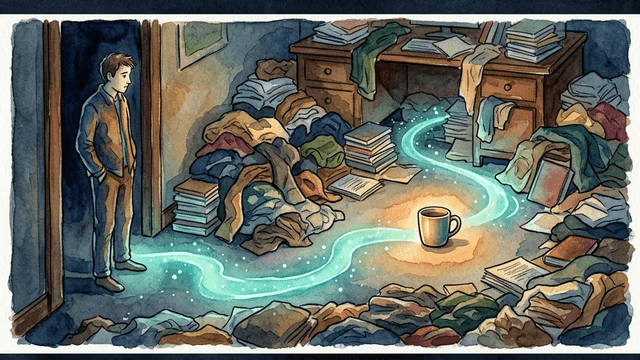
The Doom Pile Problem
Here's something most cleaning advice ignores: the reason your stuff piles up is neurological, not behavioral.
Neurotypical brains have an automatic "filing system." Keys land → brain says "hook by the door." Mail arrives → brain says "tray on the counter." This categorization happens unconsciously, powered by the basal ganglia's habit loops.
ADHD brains lack this automatic categorization. Objects enter your space and simply... stay where they land. Over time, this creates what the ADHD community calls "doom piles" — amorphous mountains of miscellaneous items that become too cognitively expensive to sort.
A cleaning schedule doesn't fix doom piles. You know what fixes doom piles? Removing the need to decide. Instead of "sort this pile," the instruction needs to be "pick up the red cup and put it in the sink." One object. One destination. Zero decisions.
Stuck on something right now?
Stop reading about it — try it. Thawly breaks your task into one tiny step you can do right now.
Free · No signup · 3 secondsWhat Actually Works: 5 Strategies That Bypass Executive Dysfunction
1. The "One Object" Rule
Forget "clean the kitchen." That's not an instruction your ADHD brain can execute. Instead:
Pick up ONE object. Move it to where it belongs. Stop.
That's it. You're done. You cleaned. If you feel like picking up another object, great. If not, you still moved the needle. The trick is that once you pick up the first object, the Zeigarnik Effect kicks in — your brain develops a mild compulsion to continue an incomplete task. Most people end up picking up 5-10 objects before they realize they've been cleaning for 10 minutes.
But the permission to stop after one object is what makes it possible to start.
2. The "Trash Bag Walk" Method
This one is beautifully stupid in how well it works:
- Get a trash bag (or any bag)
- Walk through one room
- Put anything that is obviously trash into the bag
- Done
You're not cleaning. You're not organizing. You're not making decisions about what goes where. You're playing a simple game: "Is this trash? Yes → bag. No → leave it." Binary decision. Minimal cognitive load. Maximum visual impact — because removing trash creates the most dramatic visible improvement per unit of effort.
The dopamine hit from seeing a visibly cleaner space after 5 minutes often creates enough momentum to keep going.
3. Body Doubling
Body doubling — having another person present while you clean — is one of the most powerful ADHD cleaning strategies. Research shows that social presence activates neural pathways that partially compensate for prefrontal cortex deficits (Ratey & Hagerman, 2008).
Options for body doubling while cleaning:
- Ask someone to sit in the room while you clean (they don't have to help — just be there)
- Video call a friend who's also cleaning their space
- Focusmate — book a 25-minute session, declare "I'm cleaning my desk," and work with a virtual accountability partner
- Put on a podcast or YouTube video — parasocial body doubling is surprisingly effective
4. The "10-Minute Room Rescue"
Set a timer for 10 minutes. Clean ONE room — or even one area of one room — until the timer goes off. Then stop. Walk away. You're done.
This works because:
- Bounded time eliminates the "this will take forever" paralysis
- Permission to stop removes the all-or-nothing trap
- Single-room focus prevents the overwhelming "clean the whole house" scope
After a few successful 10-minute rescues, your brain starts associating cleaning with "quick, manageable, not terrible" instead of "endless, exhausting, avoid at all costs."
5. AI-Guided Micro-Steps
This is the newest approach, and it's specifically designed for ADHD executive dysfunction. Instead of you generating the plan (which requires the exact cognitive skills your brain struggles with), an external system generates absurdly specific instructions:
Instead of "clean the kitchen":
- "Pick up the 3 items closest to the sink and put them in the sink" (timer: 2 min)
- "Take the trash bag from under the sink and put it on the counter" (timer: 1 min)
- "Walk around the kitchen and put any obvious trash in the bag" (timer: 3 min)
Each step is so small that your brain's resistance doesn't activate. You don't see step 2 until step 1 is done. The AI handles all the sequencing, prioritization, and planning that your prefrontal cortex can't do right now.
Tools like Thawly are built on this exact principle — externalizing executive function so you don't have to generate it internally.
What Thawly's Data Shows About ADHD Cleaning
Among Thawly's 119 scenario tools, "Clean my room" is the #1 most-used input — ahead of homework, emails, and work tasks. The data tells a clear story:
- Average session: 6.8 micro-steps completed before the user gains enough momentum to continue independently
- Most common time of use: 10 PM - 2 AM (the late-night shame window)
- Completion rate for guided sessions: 73% of users who complete the first micro-step go on to complete at least 5 more
The late-night usage spike is particularly revealing. It confirms what every ADHD person already knows: cleaning motivation doesn't follow a schedule. It arrives in random bursts — often at the worst possible time. A cleaning planner that only works Monday at 9 AM is useless for a brain that suddenly gets the cleaning urge at midnight on Thursday.
The "ADHD Cleaning Planner" You Actually Need
Forget the color-coded weekly schedule. Here's what an ADHD-friendly cleaning system actually looks like:
Daily (2 minutes max)
- One-object rule: Pick up one thing. Put it away. Done.
- Sink zero: Before bed, put all dishes in the dishwasher. Nothing else. Just the dishes.
When Overwhelm Hits (10 minutes max)
- Trash bag walk: One room. Trash only. 5 minutes.
- Surface clear: Pick ONE surface (desk, counter, nightstand). Clear only that surface.
- Thawly's Cleaning Tool: Type what's overwhelming you. Follow one step at a time.
Monthly Reset (with body doubling)
- Schedule a "cleaning party" with a friend or roommate — both clean your own spaces while on a video call
- Play a cleaning playlist or podcast the entire time
- Set a 60-minute hard stop. Whatever isn't done waits until next month. No guilt.
What You Do NOT Need
- ❌ A color-coded cleaning schedule pinned to the fridge
- ❌ A "cleaning routine" that requires daily willpower
- ❌ A printable PDF checklist from Pinterest
- ❌ The ability to "just be an adult" (stop — executive dysfunction is neurological, not moral)
FAQ
What is the best ADHD cleaning planner?
The best ADHD cleaning planner is not a traditional schedule — it's a system that reduces decisions and provides external initiation support. AI-powered tools like Thawly's cleaning planner generate step-by-step micro-actions in real time. For paper-based approaches, a simple sticky note with ONE cleaning task per day (not a weekly chart) is more effective than any elaborate system.
How do I clean my room when I have ADHD and it's overwhelming?
Start with the smallest possible action: pick up one piece of trash. Just one. The psychological barrier to starting is the hardest part — once you've physically moved one object, the Zeigarnik Effect creates mild momentum to continue. If one object still feels impossible, try the "trash bag walk" (grab a bag, walk through the room, collect only obvious trash) or use an AI cleaning tool that feeds you one micro-step at a time.
Why can't I keep my house clean with ADHD?
ADHD impairs the automatic categorization system that neurotypical brains use to put things away without thinking. Your brain lacks the unconscious "filing" habit loops that move objects from "hand" to "proper location" automatically. This means every single object requires a conscious decision about where it goes — and conscious decisions drain executive function. Over time, this creates the "doom piles" that trigger overwhelm and avoidance.
Is there a cleaning schedule that works for ADHD?
Traditional cleaning schedules (Monday = bathrooms, Tuesday = kitchen, etc.) rarely work for ADHD because they require consistent daily initiation — the exact skill ADHD impairs. Instead, try "micro-habits" attached to existing routines: put dishes away while coffee brews, wipe the counter after brushing teeth. These use existing behavioral momentum rather than demanding cold-start initiation.
How do I stop procrastinating on cleaning with ADHD?
You're not procrastinating — you're experiencing task initiation failure, a documented executive function deficit. The fix isn't willpower; it's reducing the activation energy required to start. Try: (1) shrink the task to something absurdly small ("pick up 3 things"), (2) add body doubling (clean while someone is present or on a call), or (3) use an external system that generates the first step for you, bypassing the planning barrier entirely.
Sources
- Barkley, R. A. (2015). Attention-Deficit Hyperactivity Disorder: A Handbook for Diagnosis and Treatment (4th ed.). Guilford Press.
- Volkow, N. D., et al. (2009). "Evaluating dopamine reward pathway in ADHD." JAMA, 302(10), 1084-1091.
- Ratey, J. J., & Hagerman, E. (2008). Spark: The Revolutionary New Science of Exercise and the Brain. Little, Brown.
- Barkley, R. A. (2012). Executive Functions: What They Are, How They Work, and Why They Evolved. Guilford Press.
- Nigg, J. T. (2017). "On the relations among self-regulation, self-control, executive functioning, effortful control, cognitive control, impulsivity, risk-taking, and inhibition for developmental psychopathology." Journal of Child Psychology and Psychiatry, 58(4), 361-383.
Related Resources
- Best ADHD Planner in 2026: 9 Options Ranked — Full planner comparison across all categories
- ADHD Paralysis: Why Your Brain Freezes — The neuroscience behind getting stuck
- ADHD Task Paralysis — When you know what to do but can't start
- How to Deal with Executive Dysfunction — Practical strategies beyond cleaning
Scenario-Specific Cleaning Tools
- ADHD Cleaning Planner & Task Breakdown — AI-powered micro-step generator for cleaning tasks
- ADHD Decluttering Paralysis — When the mess is too big to face
- ADHD Dishes Piling Up — Break the dish mountain one plate at a time

Sean Z. holds a Master's degree in Cognitive Psychology. He spent 7 years in academic research focused on human cognition, followed by 10+ years designing products and services in the applied psychology space. He built Thawly after years of firsthand experience with ADHD task paralysis — combining academic understanding of executive function with the daily reality of living with it. About the Author → LinkedIn
Looking for more specific strategies?
Explore 115+ targeted tools for specific ADHD scenarios.
Browse the ADHD Toolkit →