ADHD or Lazy? 9 Signs It's Your Brain, Not You
Disclaimer: This article is for informational and educational purposes only. It is not a substitute for professional medical advice, diagnosis, or treatment. If you suspect you have ADHD, please consult a qualified healthcare provider.
The key difference between ADHD and laziness is desire: lazy people don't want to act, while people with ADHD desperately want to act but are neurologically unable to start. ADHD brains have lower baseline dopamine in the prefrontal cortex (Volkow et al., 2009), which impairs the neural "initiation signal" — not motivation, not discipline, but the actual neurochemical that says "this action is worth beginning." If you consistently want to do things and can't make yourself start, that's not a character flaw. That's executive dysfunction.
I spent most of my twenties convinced I was the laziest person alive.
Not in the self-deprecating-joke way. In the staring-at-the-ceiling-at-3-AM way. The kind where you cancel plans because you "didn't feel like it" and then lie in bed hating yourself for canceling. The kind where your boss says "you have so much potential" and you hear "you're wasting it."
I had a running list of evidence: I couldn't keep my apartment clean. I'd start projects and abandon them within a week. I was chronically late to everything. I'd sit in front of my laptop for hours, accomplishing nothing, then feel so ashamed that I'd avoid looking at my to-do list for days.
Lazy. Obviously.
Except it wasn't obvious. Because lazy people don't want to do things. I wanted to do everything. I just couldn't make myself start. And when I finally did start, I couldn't sustain it. And when I inevitably failed, I felt physical grief — chest tightness, stomach dropping, the whole package.
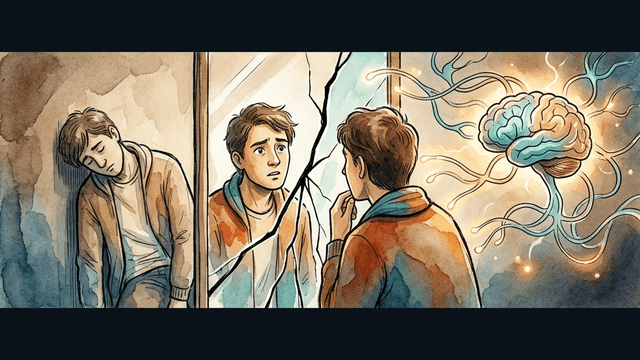
Turns out there's a word for that gap between wanting and doing. It's called executive dysfunction. And it's the core symptom of ADHD that nobody talks about in the "do I have ADHD" conversations.
What Is the Difference Between Laziness and ADHD?
This is the distinction that changes everything:
| Laziness | ADHD | |
|---|---|---|
| Desire to act | Low — you genuinely don't care about the task | High — you desperately want to act but can't |
| Emotional response | Indifference, mild guilt | Intense shame, frustration, self-hatred |
| Consistency | Selective — lazy about boring stuff, fine with fun stuff | Unpredictable — sometimes can't do things you enjoy |
| Physical sensation | Relaxed, comfortable | Tense, heavy, "frozen" |
| Pattern | Situational — certain tasks, certain moods | Pervasive — affects work, relationships, hygiene, everything |
| Self-awareness | "I know I should, I just don't want to" | "I know I should, I WANT to, and I still CAN'T" |
Read that last row again. If you consistently want to do things and can't make yourself start, that's not a character flaw. That's a neurological symptom.
What Are the Signs It's ADHD, Not Laziness?
These are the patterns that clinicians look for — the ones that separate "I don't feel like it" from "my brain won't let me."
1. You Can't Start Things You Actually Want to Do
Lazy people avoid unpleasant tasks. ADHD brains can't start anything — including hobbies, vacations, and activities they're genuinely excited about. If you've ever bought art supplies, set them out on the table with real excitement, and then... never touched them... that's not laziness. Laziness doesn't block you from doing things you want to do.
2. Your Performance Is Wildly Inconsistent
One week you're unstoppable — cleaning the entire house, crushing work deadlines, cooking actual meals. The next week you can't shower. This inconsistency is the hallmark of ADHD. It's driven by dopamine fluctuations, not effort fluctuations. Lazy would be consistently low-effort. ADHD is a rollercoaster you can't control.
3. Urgency Is the Only Thing That Works
You procrastinate for two weeks, then complete the entire project in a 3 AM panic the night before. Not because you're irresponsible, but because your brain literally cannot generate the neurochemical activation to start until the deadline creates enough adrenaline to bypass the dopamine deficit. We wrote about this exact mechanism in why you can't study until the last minute.
4. "Easy" Tasks Feel Impossibly Hard
Replying to a text. Making a phone call. Opening the mail. Filing that one form. These take 5 minutes and require no skill. But for weeks, they sit undone while you successfully complete much harder things. This is because ADHD task paralysis isn't correlated with difficulty — it's correlated with dopamine reward. A "hard" project with novelty produces more dopamine than an "easy" email with no emotional payoff.
5. You Have a Hobby Graveyard
Guitar lessons (3 weeks). Painting (2 months). Running (1 week). Journaling (4 days). Learning Japanese (2 sessions). Each one started with genuine passion. Each one was abandoned not because you lost interest in the activity, but because the hyperfocus phase ended and your brain couldn't sustain engagement without the novelty-driven dopamine spike.
6. You're Exhausted from Doing "Nothing"
Lazy people who do nothing feel rested. ADHD people who do "nothing" feel drained. Because you weren't actually doing nothing — your brain was running at full speed: calculating everything you should be doing, rehearsing conversations, replaying past failures, generating anxiety about the growing pile of undone tasks. The internal workload is enormous. The external output is zero. The exhaustion is real.
7. You've Tried Every Productivity System and None Stick
Planners, bullet journals, Todoist, Notion, Pomodoro timers, accountability partners, morning routines, habit trackers. You've tried them all. They work for 3-10 days, then stop. Not because you're undisciplined — because these tools are designed for brains with functioning executive systems. Using a planner to fix ADHD is like using a map to fix a flat tire. The tool is fine. The problem is somewhere else entirely.
(Recognizing yourself? The ADHD paralysis guide explains the neuroscience behind all of this in detail.)
Stuck on something right now?
Stop reading about it — try it. Thawly breaks your task into one tiny step you can do right now.
Free · No signup · 3 secondsIs ADHD Procrastination Different from Normal Procrastination?
The most damaging thing about the laziness narrative is that it sounds almost reasonable. Everyone procrastinates sometimes. Everyone avoids unpleasant tasks. Everyone has lazy weekends.
Here's the difference in scale:
Neurotypical procrastination: You delay doing your taxes until the last week. You feel a bit guilty. You do them in a concentrated push. Done.
ADHD procrastination: You delay doing your taxes until the last day. Then your brain physically cannot open TurboTax. You sit in front of the computer for three hours. You develop stomach pain. You file for an extension at 11:47 PM and spend the next week in a shame spiral. This happens every year.
Or:
Neurotypical "laziness": You skip the gym because you're tired. You go tomorrow.
ADHD "laziness": You skip the gym because you can't decide what to wear. Then you can't find your headphones. Then you calculate the drive time and it feels overwhelming. Then you spend 45 minutes paralyzed by the cascading decisions. Then it's too late to go. Then you feel so bad about yourself that you can't start anything else either.
The gap between these experiences is neurological, not moral.
What's Happening in Your Brain When You Can't Start?
The neuroscience is straightforward. ADHD brains have lower baseline dopamine levels in the prefrontal cortex (Volkow et al., 2009). Dopamine isn't just the "pleasure chemical" — it's the initiation chemical. It provides the neural signal that says "this action is worth beginning."
When dopamine is chronically low:
- Tasks without immediate reward feel physically impossible to start
- Your brain constantly seeks higher-dopamine activities (phone, games, snacks)
- The gap between intention and action becomes a chasm
- You develop learned helplessness: "I'm just a lazy person"
Barkley's research (2015) puts it bluntly: ADHD is not a deficit of knowledge about what to do. It's a deficit in the ability to do what you know. You know you should reply to the email. You know how to reply to the email. The knowledge is there. The activation energy isn't.
What Should You Do If You Think It's ADHD?
Step 1: Stop Punishing Yourself
Right now, before anything else. If your brain has been running on a "you're just lazy, try harder" narrative for years, that narrative is actively making things worse. Shame increases cortisol. Cortisol shuts down the prefrontal cortex. A shut-down PFC deepens the paralysis. You've been trying to fix the problem with the exact thing that's causing it.
Step 2: Get Screened
ADHD assessment isn't one test — it's a conversation. A qualified clinician (psychiatrist, psychologist, or neuropsychologist) will evaluate your history across childhood, school, work, and relationships. They're looking for a pattern — not whether you had trouble once, but whether trouble has been a consistent thread throughout your life.
(If the thought of scheduling a doctor's appointment feels paralyzing — yeah, we get it. Try the Doctor's Appointment Tool to break it into one step at a time.)
Step 3: Try One Micro-Strategy Today
You don't need a diagnosis to start working with your brain instead of against it:
- The 2-Minute Rule: If a task takes less than 2 minutes, do it the instant you think of it. Don't add it to a list. Don't plan to do it later. Your brain will lose the activation in 30 seconds.
- The Ugly First Draft: Give yourself permission to do any task badly. Write a terrible email. Clean one corner of one room. Lower the bar until your brain doesn't trigger resistance.
- External Accountability: Text someone "I'm going to do X in the next 30 minutes." The social pressure provides the dopamine your brain can't generate on its own.
FAQ
Can you be both lazy AND have ADHD?
Technically, yes — they're not mutually exclusive. But in clinical practice, what people call "laziness" in the context of ADHD is almost always executive dysfunction. Before labeling yourself lazy, rule out the neurological explanation. The odds are overwhelmingly in favor of ADHD if the pattern is pervasive, distressing, and lifelong.
I was a good student. Can I still have ADHD?
Absolutely. High intelligence can mask ADHD for years — sometimes decades. Smart students develop workarounds (last-minute cramming, charm, sheer anxiety-driven performance) that compensate for executive dysfunction until the complexity of adult life outstrips their compensation capacity. Late diagnosis in intelligent adults is extremely common.
Is there a difference between ADHD and ADD?
ADD (Attention Deficit Disorder) was the old diagnostic term for what's now called "ADHD, Predominantly Inattentive Presentation." The umbrella term is now ADHD for all presentations. Many adults who would have been diagnosed with ADD now fall under the inattentive type — the "quiet type" that doesn't look like the stereotypical hyperactive kid. Understanding which type you might have can help guide treatment.
Can ADHD develop in adulthood?
The DSM-5 requires symptoms to be present before age 12. However, many adults aren't diagnosed until their 30s, 40s, or later — not because the ADHD developed recently, but because it was masked by intelligence, structure (school/college provides external scaffolding), or coping mechanisms that eventually failed. If you "suddenly" feel like you can't function, the ADHD was likely always there. The scaffolding just collapsed.
What if I can't afford an ADHD assessment?
Community mental health centers often offer sliding-scale assessments. Some university psychology departments offer low-cost evaluations done by supervised graduate students. Online assessment platforms (like Done, Cerebral, or Ahead) offer evaluations starting around $150-200. It's not free, but it's typically less than a single therapy session.
Sources
- Volkow, N.D. et al. (2009). Evaluating dopamine reward pathway in ADHD. JAMA, 302(10), 1084-1091.
- Barkley, R.A. (2015). Attention-Deficit Hyperactivity Disorder: A Handbook for Diagnosis and Treatment (4th ed.). Guilford Press.
- Kessler, R.C. et al. (2006). The prevalence and correlates of adult ADHD in the United States. American Journal of Psychiatry, 163(4), 716-723.
- Brown, T.E. (2013). A New Understanding of ADHD in Children and Adults: Executive Function Impairments. Routledge.
- Nigg, J.T. et al. (2023). Executive function deficits and ADHD in adults: A comprehensive meta-analysis. Journal of Attention Disorders, 27(4), 375-389.

Sean Z. holds a Master's degree in Cognitive Psychology. He spent 7 years in academic research focused on human cognition, followed by 10+ years designing products and services in the applied psychology space. He built Thawly after years of firsthand experience with ADHD task paralysis — combining academic understanding of executive function with the daily reality of living with it. About the Author → LinkedIn
Looking for more specific strategies?
Explore 115+ targeted tools for specific ADHD scenarios.
Browse the ADHD Toolkit →