ADHD Freeze: Why Your Brain Shuts Down & How to Rebooting It
Disclaimer: This article is for informational and educational purposes only. It is not a substitute for professional medical advice, diagnosis, or treatment. If you suspect you have ADHD, please consult a qualified healthcare provider.
ADHD freeze is a sudden dorsal vagal shutdown — your nervous system hitting a neurological circuit breaker when overwhelm or inescapable stress exceeds your brain's processing capacity. It's driven by three converging failures: dopamine drought (no action feels worth initiating), prefrontal cortex going offline under stress hormones (Arnsten, 2009), and a shame feedback loop that deepens the paralysis. ADHD freeze is not laziness — it's a survival mechanism deployed by your autonomic nervous system.
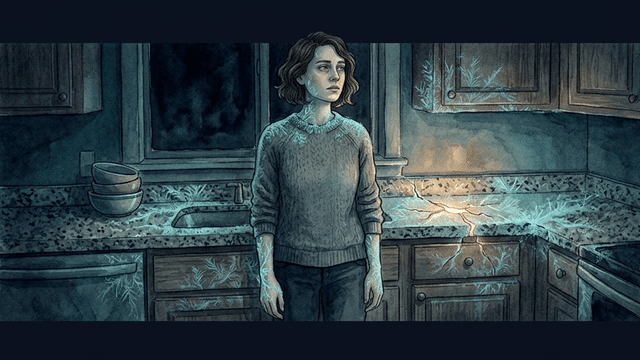
You're standing in the kitchen. Not cooking. Not cleaning. Not even looking at anything in particular. Your eyes are fixed on a spot on the counter that your brain registered as "dirty" seventeen minutes ago. The sponge is right there. The faucet is right there. You are right there.
Nothing is happening.
Your partner walks in and says, "You okay?" and for a second you genuinely don't know. Because you weren't thinking about anything. You weren't feeling anything specific. You were just... off. Like a laptop that closed its lid mid-sentence and went to sleep, except you're still standing with your eyes open.
This is what people in the ADHD community call "the freeze." And if you've landed on this page, you probably already know it's not the same thing as procrastinating, zoning out, or being lazy. It's something else entirely — something that involves your autonomic nervous system, your dopamine supply, and a survival mechanism that your brain was never supposed to deploy while standing in a kitchen at 2 PM on a Wednesday.
Is ADHD Freeze the Same as ADHD Paralysis?
They're related, but not identical. ADHD paralysis is the broader umbrella term — it includes task paralysis, decision paralysis, and overwhelm shutdown. ADHD freeze is specifically what happens when your nervous system enters a dorsal vagal shutdown — the third branch of the autonomic stress response that most people never learn about.
Here's the quick breakdown:
| Response | Triggered by | Feels like | Brain state |
|---|---|---|---|
| Fight | Perceived threat | Anger, agitation | Sympathetic activation |
| Flight | Perceived threat | Anxiety, urgency | Sympathetic activation |
| Freeze | Overwhelm or inescapable threat | Blankness, numbness, heaviness | Dorsal vagal shutdown |
Most people know about fight-or-flight. Way fewer know about freeze. But for people with ADHD, freeze is often the default stress response — not because our threats are worse, but because our nervous systems reach the overwhelm threshold faster.
Stephen Porges' Polyvagal Theory explains why. When the brain determines that neither fighting nor escaping is viable (and for many micromoments in an ADHD person's day — answering emails, making a phone call — neither feels viable), the dorsal vagal complex takes over. Your heart rate drops. Your muscles go slack. Your mind goes quiet in a way that feels profoundly wrong, because you're not resting — you're shut down.
What Happens in Your Brain During an ADHD Freeze?
Three things are happening in your brain during an ADHD freeze, and they're all feeding each other.
1. Dopamine Drought
You already know this one if you've read anything about ADHD. Adults with ADHD have lower baseline dopamine in the prefrontal cortex (Volkow et al., 2009). But here's the nuance most articles miss: dopamine doesn't just create pleasure. It creates the neurochemical signal that says "this action is worth initiating."
When dopamine is low, no action feels worth initiating. Not the important email. Not the glass of water. Not even the thing you actually want to do. The signal just... doesn't fire. Your brain doesn't label any available action as "start this," so you default to zero movement.
2. Prefrontal Cortex Goes Offline
Arnsten's research on stress and the prefrontal cortex (2009) showed something that should be printed on a card and given to every person with ADHD: stress hormones cause the PFC to shut down. Not slow down. Shut down.
The PFC is where you sequence actions, prioritize tasks, and initiate behavior. When cortisol rises — from deadline anxiety, from the accumulating guilt of not doing the thing, from the low-grade panic of watching time vaporize — the PFC hands control to the amygdala. And the amygdala only speaks three languages: fight, flight, and freeze.
3. The Shame Feedback Loop
This is the part nobody talks about enough.
You freeze. You notice you're frozen. You start calculating how much time you've wasted. You think about the last time this happened, and the time before that, and the email you still haven't sent from three weeks ago. The shame compounds. Shame is a stress signal. Stress shuts down the PFC. The PFC shutting down deepens the freeze.
I have personally spent four-hour blocks in this loop. Fully conscious. Fully aware. Unable to interrupt the cycle. It's the most maddening experience I know — not because it hurts, but because it doesn't even feel like anything. It's just absence. You're there, and you're not.
Stuck on something right now?
Stop reading about it — try it. Thawly breaks your task into one tiny step you can do right now.
Free · No signup · 3 secondsWhat Does ADHD Freeze Look Like in Real Life?
Reddit is full of people describing this with terrifying precision:
"I'll be standing in my room and suddenly 45 minutes have passed. I wasn't on my phone. I wasn't daydreaming. I just... wasn't anywhere. My wife calls it 'the stare.'"
It's not always dramatic. Sometimes freeze looks like:
- Standing in a doorway for 8 minutes because you forgot why you walked there and can't generate the activation to turn around
- Holding your toothbrush but not moving it — your arm is up, your brain is off
- Sitting in your car after arriving somewhere, unable to open the door for 15-20 minutes
- Staring at a meal you already cooked, getting cold, unable to pick up the fork
- Scrolling without reading — your thumb is moving, but your brain isn't processing anything. This is "active freeze" disguised as activity.
That last one is insidious. A lot of people think scrolling means they're not frozen. But if you've been on your phone for an hour and can't remember a single thing you saw — your body found a low-effort repetitive motion to mask a freeze state. You weren't using your phone. Your phone was using you.
(Does this sound like your mornings? The Morning Paralysis Thaw Tool was built for exactly this state.)
How Do You Break Out of an ADHD Freeze?
(Want a deeper framework? I wrote a full article on what an ADHD thaw actually is — the neuroscience of how your brain transitions from freeze back to functioning, and a 3-phase method to trigger it deliberately.)
I'm not going to tell you to "set an intention" or "practice mindfulness." When you're in dorsal vagal shutdown, your prefrontal cortex is offline. You can't "think" your way out. You need to move your way out — literally.
1. The Cold Water Reset
Splash ice-cold water on your face. Not warm. Cold.
This triggers the mammalian dive reflex — an involuntary response that stimulates the vagus nerve, slows your heart rate, and paradoxically activates the ventral vagal system (the "safe" branch of your autonomic nervous system). Porges' work shows this can interrupt a freeze state in under 30 seconds.
I keep a facecloth in the freezer. No joke. When the freeze hits, I press it against my face for 10 seconds. The shock cuts through the blankness like nothing else.
2. Sound Anchoring
Put on a song you know every word to. Not new music — your brain can't process novelty during shutdown. Something familiar. Something your body already has a motor pattern for.
Why this works: familiar music activates the basal ganglia (habit-based motor sequences) instead of the prefrontal cortex. You don't need your PFC to sing along to a song you've heard 800 times. But the act of singing or humming engages your diaphragm, which stimulates vagal tone, which nudges your nervous system out of dorsal shutdown.
Personally? Whitney Houston's "I Wanna Dance with Somebody" has pulled me out of more freezes than any therapy technique. I'm not even slightly embarrassed about this.
3. The 10-Second Physical Interrupt
Stand up. Doesn't matter where you go. Just stand up.
If you can: shake your hands for 10 seconds. Hard. Like you're flicking water off your fingers. This sends a burst of proprioceptive input to your brain that says "you are a body in space, and you are moving." That signal alone can break a mild freeze.
For worse episodes: jump. Stomp. Clap your hands three times. Anything that creates a sudden, sharp physical sensation. You're not doing "exercise" — you're sending an interrupt signal to an autonomic nervous system that's stuck in shutdown.
4. Talk First, Think Later
Open your mouth and say out loud what you need to do. Even if nobody's listening. Even if it sounds ridiculous.
"I need to stand up and walk to the kitchen."
"The next thing I'm going to do is pick up my phone and call the dentist."
This works because speaking activates Broca's area and the motor planning system simultaneously. You're converting an abstract intention into a motor sequence — and sometimes the motor planning that starts with your mouth carries over to the rest of your body.
I do this constantly. My neighbors probably think I narrate my life for an invisible podcast audience.
5. Shrink the Task Until It's Insulting
If you can identify what triggered the freeze (sometimes you can't, and that's okay), reduce the task to something absurdly small.
"Clean the kitchen" → "Put one thing in the sink." "Do my taxes" → "Find the folder with last year's returns." "Write the paper" → "Open Google Docs."
This is task initiation technique at its most extreme. You're not trying to accomplish anything — you're trying to demonstrate to your dopamine system that movement is possible and not dangerous. Once the first micro-action happens, your brain often recalibrates and releases enough dopamine for the next one.
(Can't even think of what the first step should be? That's the whole point of Thawly — it takes whatever you're stuck on and generates the smallest possible physical action to start.)
When Does ADHD Freeze Become a Bigger Problem?
Occasional freezes are part of life with ADHD. But if you're experiencing:
- Daily freeze episodes lasting 30+ minutes
- Freeze states triggered by routine tasks (not just stressful ones)
- Physical symptoms: body heaviness, facial numbness, temperature drops
- A growing avoidance of situations where freeze has happened before
- Feeling like you're "watching yourself from outside" during episodes (depersonalization)
...then this may be more than executive dysfunction. Chronic freeze responses can overlap with dissociative symptoms, C-PTSD, or autistic shutdown (which presents very similarly to ADHD freeze). A clinician who understands the intersection of ADHD and trauma can help differentiate.
This isn't about pathologizing yourself. It's about getting the right support. Medication (particularly stimulants, which directly increase prefrontal cortex dopamine) can raise the threshold at which freeze occurs. Therapy — especially somatic-based approaches like EMDR or SE — can address the nervous system dysregulation that feeds the pattern.
(There's a related state that's even harder to recognize: functional freeze — where you keep performing on the outside while being completely shut down inside. If your freeze isn't sudden but gradual and invisible to others, that piece might resonate more.)
FAQ
Is ADHD freeze the same as dissociation?
Not exactly, though they share features. ADHD freeze is a dorsal vagal shutdown — your nervous system entering conservation mode. Dissociation involves a sense of detachment from reality or your own identity. They can co-occur (many people with ADHD describe freeze episodes with dissociative qualities), but they have different neurological mechanisms and different treatment approaches. If you're experiencing depersonalization or derealization alongside freeze, mention this specifically to your clinician.
Can you have ADHD freeze without being diagnosed with ADHD?
Yes. The freeze response can occur in anyone with a dysregulated nervous system — including people with anxiety, depression, C-PTSD, autism, or chronic stress. However, the specific combination of freeze + dopamine-related task initiation failure + executive dysfunction is most characteristic of ADHD. If freeze is a regular part of your life and you haven't been evaluated, it's worth exploring.
How is ADHD freeze different from burnout?
ADHD burnout is a long-term state of exhaustion from chronically compensating for executive dysfunction. ADHD freeze is an acute episode — it has a start point and (eventually) an end point. Think of burnout as the drought and freeze as the individual power outage. Between these two extremes sits ADHD shutdown — the gradual dimming that happens over days when accumulated load exceeds your brain's capacity. Burnout can make both freeze and shutdown episodes more frequent and severe, because your baseline resources are already depleted.
Do stimulant medications help with ADHD freeze?
Yes, often significantly. Stimulant medications (methylphenidate, amphetamine salts) increase dopamine and norepinephrine availability in the prefrontal cortex, which raises the activation threshold — meaning your brain can handle more stress/overwhelm before the PFC shuts down and hands control to the freeze response. They don't eliminate freeze entirely, but they can reduce both frequency and duration. Many adults report that freeze episodes that used to last hours shrink to minutes with properly dosed medication.
Why does ADHD freeze happen more at home than at work?
External structure. The office (or school, or any environment with social accountability and scheduled demands) provides constant low-level activation — enough dopamine from social pressure and novelty to keep the PFC online. At home, especially working from home, all that external scaffolding disappears. Your brain has to generate all its own activation, which is exactly what ADHD brains struggle with most.
Sources
- Porges, S.W. (2011). The Polyvagal Theory: Neurophysiological Foundations of Emotions, Attachment, Communication, and Self-regulation. W.W. Norton.
- Volkow, N.D. et al. (2009). Evaluating dopamine reward pathway in ADHD: clinical implications. JAMA, 302(10), 1084-1091.
- Arnsten, A.F. (2009). Stress signalling pathways that impair prefrontal cortex structure and function. Nature Reviews Neuroscience, 10(6), 410-422.
- Dana, D. (2018). The Polyvagal Theory in Therapy: Engaging the Rhythm of Regulation. W.W. Norton.
- Barkley, R.A. (2015). Emotional dysregulation is a core component of ADHD. In R.A. Barkley (Ed.), Attention-Deficit Hyperactivity Disorder: A Handbook for Diagnosis and Treatment (4th ed.). Guilford Press.
- Van der Kolk, B. (2014). The Body Keeps the Score: Brain, Mind, and Body in the Healing of Trauma. Penguin Books.
- Nigg, J.T. et al. (2023). Executive function deficits and ADHD in adults: A comprehensive meta-analysis. Journal of Attention Disorders, 27(4), 375-389.

Sean Z. holds a Master's degree in Cognitive Psychology. He spent 7 years in academic research focused on human cognition, followed by 10+ years designing products and services in the applied psychology space. He built Thawly after years of firsthand experience with ADHD task paralysis — combining academic understanding of executive function with the daily reality of living with it. About the Author → LinkedIn
Looking for more specific strategies?
Explore 115+ targeted tools for specific ADHD scenarios.
Browse the ADHD Toolkit →