ADHD Outbursts: Why You Explode Over Nothing (And the Guilt That Follows)
Disclaimer: This article is for informational and educational purposes only. It is not a substitute for professional medical advice, diagnosis, or treatment. If you suspect you have ADHD, please consult a qualified healthcare provider.
ADHD emotional outbursts are not anger management problems — they are prefrontal cortex failures to inhibit amygdala responses. Research by Shaw et al. (2014) found that emotional dysregulation in ADHD is driven by the same dopamine deficits that cause cognitive symptoms. The amygdala fires a disproportionate emotional response, and the prefrontal cortex — which should apply the brakes — is too under-resourced to intervene in time. The result: an explosion over a minor trigger, followed by a shame spiral.

The thing that snapped you wasn't the thing.
Your partner left a dish in the sink. Your coworker sent a slightly passive-aggressive email. Your kid asked "why?" for the eleventh time in four minutes. Tiny provocations. Everyday friction. The kind of stuff that most people process, file away, and move on from in seconds.
You didn't file it. You detonated.
The volume went from two to ten in under a second. Words came out before your brain could approve them — sharp, mean words that didn't match the size of the problem. Maybe you slammed something. Maybe you yelled. Maybe you just went ice-cold and said something surgically designed to hurt. It lasted thirty seconds, maybe two minutes. Then the adrenaline drained, and standing in the wreckage, you thought the thing you always think:
What is wrong with me? It was just a dish.
Nothing is wrong with you. Something is wrong with the brake system between your emotional engine and your behavioral output. And that something has a name.
The Neuroscience: Why Your Emotions Arrive Before Your Judgment
ADHD emotional outbursts aren't about having too much anger. They're about having too little time between feeling and acting.
The Amygdala-PFC Timing Problem
In a neurotypical brain, here's what happens when someone says something annoying:
- Amygdala detects the emotional stimulus → generates a raw emotional response (anger, frustration, hurt) in ~200 milliseconds
- Prefrontal cortex (PFC) receives the signal → evaluates context, considers consequences, modulates the response → generates an appropriate reaction in ~500-800 milliseconds
- Behavioral output: a measured response ("That's frustrating, but it's not worth a fight")
In an ADHD brain, step 2 is delayed, weakened, or absent. Arnsten (2009) demonstrated that the ADHD prefrontal cortex operates with reduced dopamine and norepinephrine, which impairs its ability to rapidly process and modulate emotional signals. The amygdala fires at the same speed as anyone else's — but the PFC doesn't catch up in time.
The result: your emotions arrive at the output terminal before your judgment does. You're already yelling before the "is this worth yelling about?" evaluation is complete. The modulation system isn't broken — it's slow. By the time it comes online, the damage is already done.
Emotional Hyperreactivity: You Feel More, Not Less
Research by Barkley (2015) and Shaw et al. (2014) has established that ADHD involves not just attention deficits but emotional dysregulation as a core feature. This isn't a personality trait or an anger management issue. It's measurable:
- ADHD adults show heightened amygdala activation in response to emotional stimuli (Posner et al., 2011)
- The anterior cingulate cortex (ACC), which monitors for conflicts between what you're feeling and what you should be expressing, is less active in ADHD
- Emotional decay time is extended — once an emotion activates, it takes longer to return to baseline than in neurotypical peers
What this means in practice: you're not just reacting faster than other people. You're reacting more intensely to stimuli that other people barely register. The dish in the sink doesn't trigger a 3/10 annoyance for you. It triggers an 8/10 because your emotional system amplifies the signal while your regulatory system is still loading.
The Accumulation Effect
Here's the part that nobody talks about. Most ADHD outbursts don't come from a single trigger. They come from cumulative emotional load that you've been unconsciously absorbing all day.
Every minor frustration — the slow traffic, the interruption at work, the forgotten password, the grocery store being out of the thing you came for — registers in your amygdala without being fully processed by your PFC. These micro-stressors accumulate like pressure in a pipe. By evening, the pipe is at capacity. The dish in the sink isn't the cause of the explosion. It's the final drop in an already full system.
This is why ADHD outbursts feel so disproportionate — because they are disproportionate to the immediate trigger. But they're perfectly proportionate to the accumulated, unprocessed emotional load you've been carrying.
The 4 Types of ADHD Outbursts
Not all outbursts look the same. Understanding your pattern helps you build the right interventions.
1. The Volcanic Eruption
Pattern: sudden, loud, explosive. Yelling, slamming, aggressive language. Trigger: usually a perceived injustice, criticism, or being told what to do. Aftermath: intense shame and regret within minutes.
2. The Ice Storm
Pattern: sudden shutdown. Voice drops to flat monotone. Cold, cutting remarks. Emotional walls go up. Trigger: usually overwhelm, betrayal, or emotional hurt. Aftermath: isolation and difficulty reconnecting.
3. The Meltdown
Pattern: tears, frustration, feeling "broken." Not anger at someone — anger at yourself and the situation. Trigger: accumulated overwhelm, sensory overload, too many demands. Aftermath: exhaustion and emotional hangover.
4. The Delayed Bomb
Pattern: you absorb everything calmly for hours or days (functional freeze), then explode over something trivial later. Trigger: the trivial thing isn't the trigger — it's everything before it. Aftermath: confusion ("why did I blow up over that?").
(Recognize the delayed pattern? That's often linked to ADHD shutdown — where you suppress emotions until the system can't hold any more.)
Stuck on something right now?
Stop reading about it — try it. Thawly breaks your task into one tiny step you can do right now.
Free · No signup · 3 secondsThe Shame Spiral: The Outburst After the Outburst
Let me tell you about the part that hurts worse than the explosion itself.
You've calmed down. The adrenaline is gone. You see the look on your partner's face — not angry anymore, just hurt. Tired. Maybe a little afraid. And you think:
I'm a terrible person. No one should have to deal with me. I'm broken. I keep promising to change and I keep doing this.
The shame spiral after an ADHD outburst is often more destructive than the outburst itself. Research on self-referential processing in ADHD (Ramsay & Rostain, 2015) shows that ADHD adults are more likely to globalize negative events — turning "I yelled about a dish" into "I am fundamentally a bad person who can't control themselves."
This isn't just painful. It's counterproductive. Shame produces cortisol. Cortisol further impairs prefrontal cortex function (Arnsten, 2009). The worse you feel about the outburst, the less cognitive resources you have to prevent the next one. Shame is not a brake. It's an accelerator.
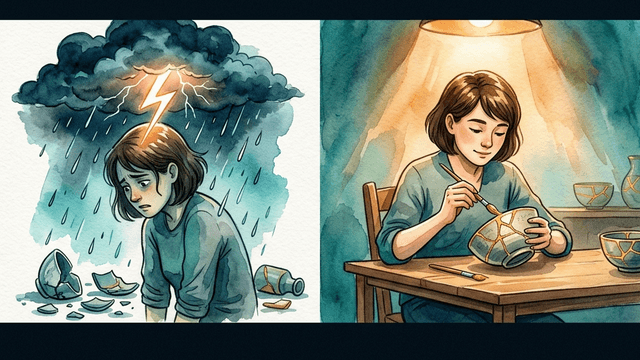
How to Build a 90-Second Buffer
You cannot eliminate ADHD outbursts through willpower. If willpower worked, you'd have fixed this years ago. What you can do is build systems that create space between the amygdala's signal and your behavioral output.
1. The 90-Second Rule
Neuroanatomist Jill Bolte Taylor documented that the chemical lifespan of an emotion in the body is approximately 90 seconds. After that, any continued emotional reaction is being generated by your thoughts about the emotion, not the emotion itself.
When you feel the surge starting:
- Name it out loud: "I notice I'm getting angry." (Lieberman et al., 2007, showed that affect labeling reduces amygdala activation by up to 30%)
- Start a 90-second timer — on your phone, on your watch, in your head
- Do nothing during those 90 seconds. Don't speak. Don't explain. Don't defend. Just ride the chemical wave
This isn't suppression. It's waiting for your PFC to come online. After 90 seconds, you still might be annoyed — but you'll have access to the modulation system that lets you choose your response instead of being hijacked by it.
2. Build an Emotional Pressure Release System
If outbursts come from accumulated emotional pressure, the solution is to create regular pressure releases throughout the day — before the system reaches capacity.
- Physical movement breaks every 90 minutes (even 5 minutes of walking)
- Transition rituals between contexts (work → home: sit in car for 5 minutes, decompress)
- Emotional check-ins 3x daily: "Where am I on a 1-10 scale right now?" If above 6, take action before it reaches 8
This is preventive maintenance. You're not fixing explosions — you're preventing the pressure buildup that causes them.
3. Create a Repair Script
You will still have outbursts. Planning the repair in advance reduces shame and speeds recovery.
A repair conversation has three parts:
- Acknowledge without excusing: "I yelled, and that wasn't okay."
- Explain the mechanism (briefly): "My brain processes emotions faster than it can moderate them. That's not an excuse — it's what I'm working on."
- State the action: "I'm going to start using the 90-second pause. Can you help me by giving me space when I say 'I need a minute'?"
Having this script ready means you don't have to construct an apology from scratch while drowning in shame. It also turns the other person into an ally rather than a victim.
4. Track Your Triggers (The Emotional ABC)
CBT practitioners use the ABC model: Antecedent → Behavior → Consequence. After each outburst (once you're calm), write down:
- A: What happened right before? (The dish. But also — what happened in the 6 hours before the dish?)
- B: What did I do? (Yelled, slammed, went cold)
- C: What happened after? (Partner withdrew, I felt shame, we didn't talk for 2 hours)
After tracking 5-10 outbursts, patterns emerge. You'll discover that 80% of your outbursts happen in the same 2-3 conditions: hungry, post-work, overstimulated, or after masking all day. That's where you intervene — at A, not at B.
(Struggling to break down what triggered you? Try the Overwhelm Bypass Tool — it can help you identify the specific emotional load that's building up.)
5. Medication Considerations
Stimulant medications directly improve prefrontal cortex function by increasing dopamine and norepinephrine availability. For many adults with ADHD, proper medication adjustment reduces the frequency and intensity of emotional outbursts — not by numbing emotions, but by giving the PFC the neurochemical resources to moderate them.
If your outbursts are a persistent pattern, a medication review with your prescriber is worth considering. Some people find that an afternoon booster dose covers the "evening meltdown" window when medication from the morning has worn off.
When Outbursts Aren't "Just ADHD"
ADHD emotional dysregulation overlaps with several other conditions. If outbursts are frequent, severe, or escalating, consider:
- Rejection Sensitive Dysphoria (RSD): If outbursts are specifically triggered by perceived criticism or rejection, RSD — a well-documented ADHD-associated phenomenon — may be the primary driver
- PTSD/Complex Trauma: Trauma responses can present similarly to ADHD outbursts. If your reactions feel survival-level ("fight mode"), a trauma-informed assessment may be valuable
- Bipolar Disorder: Extended mood episodes (days/weeks of elevated or depressed mood) are different from ADHD's rapid, situational emotional shifts
- Intermittent Explosive Disorder (IED): If outbursts involve physical aggression disproportionate to stressors, a formal evaluation for IED is important
A clinician who understands both ADHD and emotional dysregulation can help untangle these. You don't need to diagnose yourself — just describe the pattern honestly.
FAQ
Are ADHD outbursts the same as anger issues?
No. "Anger issues" implies a consistent pattern of excessive anger. ADHD outbursts are a timing and modulation problem — your emotional response arrives at full intensity before your prefrontal cortex can evaluate and moderate it. Many people with ADHD outbursts are not angry people. They're people whose braking system is 500 milliseconds too slow. The emotion itself is often normal in kind — it's the speed and intensity that are dysregulated.
Why do I only have outbursts with people I love?
Because you mask with everyone else. With strangers, coworkers, and acquaintances, you spend cognitive energy maintaining emotional composure. By the time you're with people you trust, that budget is depleted. Your loved ones don't get the worst of you because you care less — they get it because you've used all your emotional regulation resources on everyone else. It's a cruel paradox of ADHD masking.
Can I stop ADHD outbursts completely?
Realistically, no — not completely. But you can dramatically reduce their frequency and severity. The combination of medication optimization (improving PFC neurochemistry), the 90-second pause technique (creating space for modulation), and preventive pressure release (reducing accumulation) typically reduces outburst frequency by 60-80% based on clinical reports. The goal isn't perfection — it's building a system that catches most eruptions before they reach full force.
Why do ADHD outbursts happen more in the evening?
Three compounding factors: (1) medication wearing off (stimulants typically cover 8-12 hours), (2) executive function depletion from a full day of cognitive effort, and (3) accumulated emotional micro-stressors that haven't been processed. The evening brain has less dopamine, less norepinephrine, and more unprocessed emotional residue than the morning brain. This is why many ADHD adults describe the 5-8 PM window as their most volatile period.
How do I explain ADHD outbursts to my partner?
Try this: "Imagine you have a smoke detector that goes off at full volume for every kind of smoke — burned toast, a candle, an actual fire. It can't tell the difference, and it can't adjust its volume. My emotional system is like that. It fires at the same intensity for small annoyances and real problems. I'm not choosing to overreact — my brain literally can't calibrate the response in real time. I'm working on building a manual override, and I need your help with it."
Sources
- Arnsten, A.F.T. (2009). "Stress signalling pathways that impair prefrontal cortex structure and function." Nature Reviews Neuroscience, 10(6), 410-422.
- Barkley, R.A. (2015). "Emotional dysregulation is a core component of ADHD." In Attention-Deficit Hyperactivity Disorder: A Handbook for Diagnosis and Treatment (4th ed.). Guilford Press.
- Shaw, P. et al. (2014). "Emotion Dysregulation in Attention Deficit Hyperactivity Disorder." American Journal of Psychiatry, 171(3), 276-293.
- Posner, J. et al. (2011). "Abnormal amygdalar activation and connectivity in adolescents with attention-deficit/hyperactivity disorder." Journal of the American Academy of Child & Adolescent Psychiatry, 50(8), 828-837.
- Lieberman, M.D. et al. (2007). "Putting Feelings into Words: Affect Labeling Disrupts Amygdala Activity." Psychological Science, 18(5), 421-428.
- Ramsay, J.R. & Rostain, A.L. (2015). Cognitive-Behavioral Therapy for Adult ADHD. Routledge, 2nd Edition.
- Bolte Taylor, J. (2009). My Stroke of Insight: A Brain Scientist's Personal Journey. Penguin Books.
- Faraone, S.V. et al. (2021). "The World Federation of ADHD International Consensus Statement." Neuroscience & Biobehavioral Reviews, 128, 789-818.

Sean Z. holds a Master's degree in Cognitive Psychology. He spent 7 years in academic research focused on human cognition, followed by 10+ years designing products and services in the applied psychology space. He built Thawly after years of firsthand experience with ADHD task paralysis — combining academic understanding of executive function with the daily reality of living with it. About the Author → LinkedIn
Looking for more specific strategies?
Explore 115+ targeted tools for specific ADHD scenarios.
Browse the ADHD Toolkit →