ADHD Shutdown: When Your Brain Slowly Goes Dark
Disclaimer: This article is for informational and educational purposes only. It is not a substitute for professional medical advice, diagnosis, or treatment. If you suspect you have ADHD, please consult a qualified healthcare provider.
ADHD shutdown is the gradual, cumulative powering-down of your brain after days or weeks of accumulated cognitive and emotional overload. Unlike ADHD freeze (an instant circuit-breaker trip) or burnout (months of erosion), shutdown is the "brownout before the blackout" — your prefrontal cortex progressively triages functions, cutting planning, emotional processing, and working memory to conserve depleted neurotransmitter reserves. Recovery requires gentle load reduction, not pushing harder.
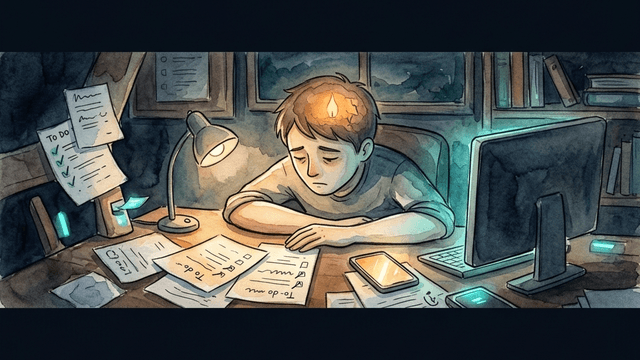
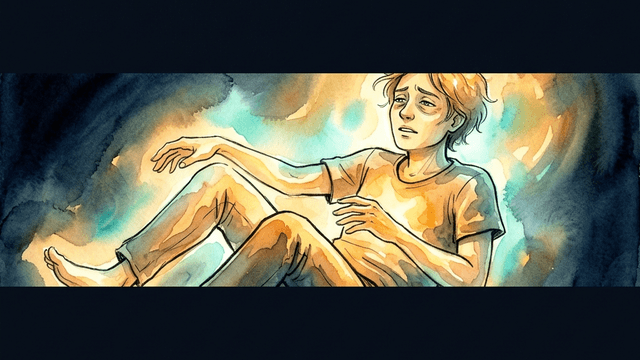
It's 6 PM. You got home from work two hours ago. You're sitting on the edge of your bed, still wearing your shoes. Your jacket is half-off — one arm out, one arm still in. You've been like this for a while. You're not sure how long.
You're not frozen. Frozen implies something sudden — a snap, a circuit breaker trip. This is different. This feels like someone is slowly turning down a dimmer switch inside your skull. The lights didn't go out all at once. They've been fading for days, maybe weeks, and now you're sitting in the near-dark wondering when exactly things went quiet.
This isn't ADHD freeze. It isn't burnout. It's something that lives in the gap between them — ADHD shutdown. The gradual, cumulative powering-down of a brain that's been running too hot for too long without anyone noticing (including you).
How Is ADHD Shutdown Different from Freeze and Burnout?
People use these terms interchangeably. They shouldn't. They describe three distinct neurological events with different mechanisms, different timelines, and crucially — different recovery strategies.
| Freeze | Shutdown | Burnout | |
|---|---|---|---|
| Onset | Seconds — an instant trip | Hours to days — gradual descent | Weeks to months — slow erosion |
| Trigger | Acute overwhelm or threat | Accumulated cognitive/emotional load | Chronic overcompensation |
| Mechanism | Dorsal vagal circuit breaker | Progressive neurotransmitter depletion | Complete executive resource exhaustion |
| Feels like | "I'm frozen in place" | "I'm slowly going offline" | "Everything I used to handle is now impossible" |
| Duration | Minutes to hours | Hours to several days | Weeks to months |
| Recovery | Physical interrupts (cold water, movement) | Load reduction + gentle reactivation | Systemic restructuring of demands |
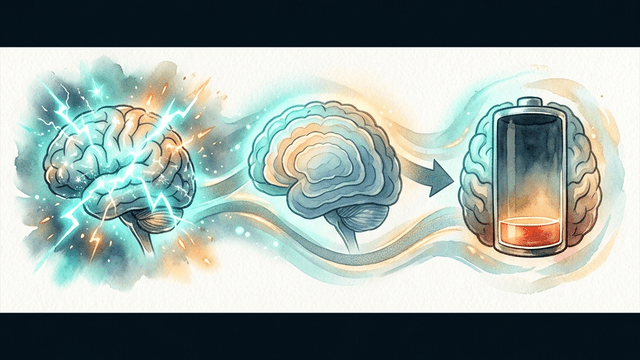
Here's the metaphor I use: ADHD freeze is a power surge that trips the breaker. ADHD burnout is running the generator dry after months of overuse. ADHD shutdown is the brownout before the blackout — the lights dimming, the screens flickering, the system still technically running but with half its functions quietly going dark.
The tricky part? You can be in shutdown for days before you realize it. Freeze is unmistakable (you literally can't move). Burnout has obvious markers (your coping strategies collapse). But shutdown slides in sideways. You just gradually become less — less responsive, less engaged, less functional — and you may not notice until your partner asks why you've been staring at the wall for forty minutes.
(There's also a fourth state that sits between shutdown and "fine": functional freeze — where you keep performing on autopilot while being emotionally offline inside. If you're still meeting deadlines but feel nothing, that might be what's happening.)
What Happens in Your Brain During ADHD Shutdown?
Shutdown isn't random. It follows a predictable neurochemical cascade that, once you understand it, explains why your brain chose this response instead of something more dramatic.
Stage 1: Dopamine Runs Low (But You Compensate)
Every cognitive task requires dopamine to initiate, sustain, and complete. ADHD brains already operate with lower baseline dopamine availability — Volkow et al. (2009) showed reduced dopamine receptor density in ADHD adults' reward pathways using PET imaging.
In the early stages, you compensate. Caffeine. Urgency. Last-minute adrenaline. Hyperfocus bursts on the interesting stuff. You're spending dopamine faster than you're making it, but the system holds — for now.
Stage 2: Cortisol Rises, Dopamine Falls Further
As the accumulated stress piles up (deadlines, social obligations, sensory overload, the forty unread emails), cortisol levels increase. Here's the brutal part: cortisol directly suppresses dopamine synthesis (Trainor, 2011). The stress that comes from not doing the thing makes it neurochemically harder to do the thing.
Arnsten (2009) demonstrated that elevated stress hormones progressively degrade prefrontal cortex function — not suddenly, but gradually. Each additional stressor reduces your executive capacity a little more. You start dropping balls. Forgetting appointments. Losing track of conversations. You're dimming.
Stage 3: The PFC Goes Into Conservation Mode
Your prefrontal cortex doesn't crash like it does during a freeze. Instead, it starts triaging. Non-essential functions get quietly deprioritized:
- Planning ahead → gone. You can only think about the current hour.
- Emotional nuance → flattened. Everything either feels like nothing or too much.
- Working memory → reduced. You re-read the same sentence five times.
- Social processing → struggling. Conversations feel like they're in a language you sort-of-speak.
This is conservation mode. Your brain is doing the neurological equivalent of closing background apps to keep the system from fully crashing. It's not dramatic. It's not even particularly noticeable from the outside. But internally, you've gone from a running at 100% to running at 30%, and the things that got cut first were the things that made you feel like you.
Stage 4: The Autonomic Shift
When the PFC's conservation efforts aren't enough, the autonomic nervous system gets involved. Porges' Polyvagal Theory (2011) describes a graduated response: first the ventral vagal system (social engagement) goes quiet. Then the sympathetic system (fight/flight) flares briefly — irritability, restlessness, that buzzing-under-the-skin feeling. Then, when even that energy is spent, the dorsal vagal system slowly takes over.
Not the sudden dorsal vagal snap that happens in freeze. A slow, heavy settling. Like your nervous system is sinking into quicksand instead of falling off a cliff. Your heart rate drops. Your muscles go slack. Your motivation evaporates. You're not paralyzed — you can technically move. You just... don't see the point.
Stuck on something right now?
Stop reading about it — try it. Thawly breaks your task into one tiny step you can do right now.
Free · No signup · 3 secondsHow Do You Know If You're in ADHD Shutdown?
1. You're Functional — But Only in the Most Basic Sense
You can still eat (sort of). You can still shower (maybe). You can still respond to texts (with one-word replies, hours late). From the outside, you look like you're having a low-energy day. From the inside, every action feels like pushing through chest-deep water.
2. Decision-Making Has Collapsed
Not the dramatic "I can't choose between two things" of decision paralysis. Something quieter. You stand in the grocery store and can't remember what you came for. You open Netflix and close it. You open the fridge and close it. Your brain has lost the ability to evaluate options — not because there are too many, but because none of them register as worth pursuing.
3. Your Internal Monologue Has Gone Quiet
This one scares people. Normally your ADHD brain is loud — racing thoughts, parallel tracks, mental tangents. During shutdown, the chatter fades. Not into peaceful silence. Into void. The absence of your own thinking is disorienting when you're used to mental noise as your baseline state.
4. Time Has Become Meaningless
ADHD time blindness is always present, but during shutdown it gets worse. You look at the clock and it says 3 PM. You look again and it says 7 PM. You didn't sleep. You didn't scroll. The time just... happened without you participating.
5. Emotions Are Delayed or Absent
Someone tells you good news. You know you should be happy. You feel nothing. Someone asks if you're angry. You're not sure. The emotional signal is taking longer to arrive, or arriving so faintly that you can't identify it. This is your limbic system on reduced power — emotional processing takes energy your brain is currently rationing.
6. You Start Avoiding Everything Preemptively
Not because you're anxious about specific tasks (that's more paralyzing anxiety). Because engaging with anything requires energy you no longer have. You cancel plans not out of dread but out of flatness. You stop opening emails not because they scare you but because you've forgotten they exist. Avoidance becomes your default setting — not a choice, but an absence of the neurological resources needed to engage.
How Do You Recover from ADHD Shutdown?
Here's what doesn't work: pushing harder. Shutdown is your brain's response to being pushed beyond its capacity. More pressure = deeper shutdown. You need the opposite — a gentle, gradual reboot.
1. Acknowledge the State (Stop Fighting It)
This is the hardest step and the most important one. Say it out loud: "I'm in shutdown. This is neurological, not moral. My brain needs recovery, not punishment."
The shame spiral — "Why can't I just function like a normal person?" — is the single biggest obstacle to recovery. Shame produces cortisol. Cortisol deepens shutdown. The fastest thing you can do for your nervous system is stop attacking yourself for being in this state.
I've started texting my close friends a code word when I'm in shutdown. Just "dim" — no explanation needed. They know it means I'm not ignoring them, I'm running on emergency power. Having that shorthand removes the guilt of unread messages, which removes a stress input, which helps recovery.
2. Reduce Sensory Load to the Minimum
Your nervous system is in conservation mode. Every sensory input is another demand on depleted resources. Go low-stimulation:
- Dim the lights or use a single warm lamp
- Noise-canceling headphones or quiet brown noise
- No news, no social media, no high-energy content
- Loose, comfortable clothing (sensory processing gets fragile during shutdown)
You're not avoiding the world. You're reducing the metabolic cost of existing in it until your system can handle more.
3. The Lowest-Possible-Energy Physical Action
During freeze, you need a sharp physical interrupt (cold water, stomping, clapping). Shutdown is different. A shock can sometimes make it worse, because your system is already depleted — a sharp input just spends more resources you don't have.
Instead, go for the smallest, gentlest physical engagement you can manage:
- Wiggle your toes. Notice the sensation.
- Roll your shoulders, slowly, three times.
- Pick up a warm mug and hold it. That's it — just hold it.
- Step outside and stand in sunlight for 90 seconds. Don't walk anywhere. Just stand.
You're not trying to "snap out of it." You're sending incredibly small signals to your nervous system that say "the body is here, the body is safe, movement is possible."
4. One Dopamine-Friendly Input (No Guilt)
Your dopamine system needs fuel. Not the kind that comes from pressuring yourself into a task — the kind that comes from something inherently rewarding with zero obligation attached.
- A song you love (not background music — acoustic attention to the actual song)
- A 5-minute comedy clip that's made you laugh before
- A warm shower (sensory reward with zero cognitive demand)
- Cooking something simple that smells good (olfactory input is one of the fastest dopamine triggers)
The goal isn't productivity. The goal is giving your reward circuitry something to work with so it can start generating the activation signal again.
(When you feel the first flicker of "maybe I could do something" — that's the moment to try Thawly. Not before. Type what you've been avoiding, and it'll give you a single step so small your shutdown brain won't reject it.)
5. Set a "Systems Check" — Not a To-Do List
Don't make a list of everything you need to do. That's a guaranteed way to re-trigger shutdown. Instead, do a simple systems check:
- Body: When did I last eat? Drink water? Sleep?
- Environment: Is this space making things better or worse?
- Social: Is anyone expecting something from me that I need to renegotiate?
Address whatever has the simplest answer. Often it's: you haven't eaten in 8 hours, which means your blood sugar is tanked, which means your already-depleted brain has been running without fuel. A meal won't cure shutdown, but hunger makes everything 40% worse.
6. Give Yourself a Recovery Timeline
In our experience observing patterns among Thawly users, ADHD shutdown typically follows this recovery arc:
- Mild shutdown (1-3 days of dimming, basic function preserved): 24-48 hours with active load reduction
- Moderate shutdown (3-7 days, significant functional impairment): 3-5 days
- Severe shutdown (1+ week, approaching burnout): Needs professional support — this may be transitioning into clinical burnout
Knowing this prevents the "it's been two days and I'm still not better, I must be broken" spiral. Your brain is rebooting. Reboots take time.
(If shutdown keeps repeating in cycles, it may be worth investigating whether your nervous system is caught in a chronic stress loop. The Executive Dysfunction Tool can help you identify and break down the specific tasks that are feeding the overwhelm.)
When Is ADHD Shutdown a Sign of Something Else?
ADHD shutdown overlaps with several other conditions, and recognizing the distinction matters because treatment approaches differ:
- Depression: Shares the flatness, withdrawal, and lack of motivation — but depression persists regardless of load changes, while ADHD shutdown improves when demands decrease
- Autistic shutdown: Very similar presentation, but often triggered more by sensory overwhelm than cognitive/emotional accumulation. If you suspect AuDHD, both mechanisms may be active simultaneously
- Dissociation: Shutdown can include dissociative features (feeling detached, time distortion), but clinical dissociation involves a more profound disconnection from self and reality
- Chronic fatigue: If shutdown symptoms persist even after significant load reduction and adequate rest, a medical evaluation for CFS, thyroid issues, or sleep disorders is warranted
A clinician who understands both ADHD and nervous system regulation (ideally polyvagal-informed) can help untangle these threads. You don't have to diagnose yourself — you just have to describe what's happening accurately.
FAQ
Is ADHD shutdown the same as ADHD freeze?
No. ADHD freeze is a sudden, acute dorsal vagal response — your nervous system hits a circuit breaker in seconds. ADHD shutdown is gradual — your cognitive and emotional systems dim over days or weeks of accumulated load. Freeze is a lightning strike; shutdown is a brownout. The recovery strategies differ: freeze responds to sharp physical interrupts, while shutdown needs gentle, sustained load reduction.
Can medication prevent ADHD shutdown?
Medication (stimulants and non-stimulants) can raise the threshold by improving baseline dopamine and norepinephrine levels, meaning your brain can handle more cognitive load before shutdown begins. But medication doesn't prevent overload — if you're still facing unsustainable demands, medication delays shutdown rather than eliminating it. Think of it as upgrading the generator without reducing the power draw.
Why does ADHD shutdown happen more in the evening?
Your brain has been spending executive resources all day — every task initiation, every social interaction, every sensory filter. By evening, the reserves are genuinely depleted. Dopamine follows a diurnal pattern (lower in the evening naturally), and for ADHD brains this combines with a full day of compensation effort. It's not that evenings are worse — it's that you've been slowly entering shutdown since mid-afternoon and only noticed once the demands dropped enough for you to feel it.
Is ADHD shutdown a sign that I need to change my life?
If it's happening regularly — weekly or more — then yes, something in your current setup is unsustainable. Recurrent shutdown means the gap between your capacity and your demands is too wide, and compensatory effort can't close it repeatedly without consequence. This doesn't necessarily mean dramatic change — sometimes it's as targeted as removing one recurring stressor, adding one external support, or adjusting medication.
How do I explain ADHD shutdown to someone who doesn't have ADHD?
Try this: "Imagine your phone at 4% battery. It's still technically on, but it's disabled most apps, dimmed the screen to minimum, and stopped processing notifications. It's not broken — it's in low-power mode because the battery is critically low. That's what my brain does when it's been running on max for too long without enough recharge. I need to plug in, not push harder."
Sources
- Volkow, N.D. et al. (2009). Evaluating dopamine reward pathway in ADHD: clinical implications. JAMA, 302(10), 1084-1091.
- Arnsten, A.F. (2009). Stress signalling pathways that impair prefrontal cortex structure and function. Nature Reviews Neuroscience, 10(6), 410-422.
- Trainor, B.C. (2011). Stress responses and the mesolimbic dopamine system: Social contexts and sex differences. Hormones and Behavior, 60(5), 457-469.
- Porges, S.W. (2011). The Polyvagal Theory: Neurophysiological Foundations of Emotions, Attachment, Communication, and Self-regulation. W.W. Norton.
- Dana, D. (2018). The Polyvagal Theory in Therapy: Engaging the Rhythm of Regulation. W.W. Norton.
- Barkley, R.A. (2015). Emotional dysregulation is a core component of ADHD. In R.A. Barkley (Ed.), Attention-Deficit Hyperactivity Disorder: A Handbook for Diagnosis and Treatment (4th ed.). Guilford Press.
- Shaw, P. et al. (2007). Attention-deficit/hyperactivity disorder is characterized by a delay in cortical maturation. Proceedings of the National Academy of Sciences, 104(49), 19649-19654.

Sean Z. holds a Master's degree in Cognitive Psychology. He spent 7 years in academic research focused on human cognition, followed by 10+ years designing products and services in the applied psychology space. He built Thawly after years of firsthand experience with ADHD task paralysis — combining academic understanding of executive function with the daily reality of living with it. About the Author → LinkedIn
Looking for more specific strategies?
Explore 115+ targeted tools for specific ADHD scenarios.
Browse the ADHD Toolkit →