Functional Freeze: When You Look Fine But Your Brain Is Frozen Solid
Disclaimer: This article is for informational and educational purposes only. It is not a substitute for professional medical advice, diagnosis, or treatment. If you suspect you have ADHD, please consult a qualified healthcare provider.
Functional freeze is a state where you continue performing daily tasks on autopilot while being emotionally and cognitively shut down inside. Unlike visible ADHD freeze (where you literally cannot move), functional freeze is invisible — you meet deadlines, answer emails, and appear competent while feeling nothing, remembering nothing, and operating on pure compensatory muscle memory. It is driven by the dorsal vagal system maintaining minimal function while the prefrontal cortex conserves depleted resources.

You're at your desk. Laptop open. Slack status is green. You responded to three emails this morning, attended the standup, even made a grocery list during lunch. From the outside, you are a functioning adult human being.
From the inside, you are a mannequin with a pulse.
There's nothing behind your eyes. No joy, no dread, no urgency — just a low-grade hum, like a refrigerator that's been running so long you forgot it was making noise. You're doing things. You're not feeling things. You could probably keep this up for weeks — months, maybe — and nobody would notice. You barely notice, honestly, until one evening you're sitting in your car in the driveway after work and realize you've been staring at your steering wheel for eleven minutes without moving, and you think: when did I become a ghost piloting a body?
That's functional freeze. And if you have ADHD, there's a very specific reason it happens to you.
What Is Functional Freeze?
Let me be clear upfront: "functional freeze" is not a clinical diagnosis. You won't find it in the DSM-5. It's a descriptive term — borrowed from polyvagal theory and somatic trauma work — for a specific nervous system state where you continue performing life's external demands while being emotionally and cognitively offline inside.
The key distinction from regular ADHD freeze:
- ADHD freeze/shutdown = you can't do anything. The system crashes. You're visibly stuck.
- Functional freeze = you can still do things. You're running on autopilot. The system hasn't crashed — it's running in safe mode.
Think of it this way: your computer has two modes when it's in trouble. It can blue-screen (crash), or it can boot into Safe Mode — where everything technically works, but you can't access half the features, everything is slow, and the colors look wrong.
Functional freeze is Safe Mode for your nervous system.
The Polyvagal Explanation
Stephen Porges' Polyvagal Theory (2011) provides the framework for understanding this. Your autonomic nervous system operates on a hierarchy:
- Ventral vagal (safe & social) — calm, connected, engaged. This is where you do your best work and enjoy your life.
- Sympathetic (fight or flight) — activated, stressed, mobilized. You're anxious but moving.
- Dorsal vagal (shutdown) — conservation mode. Energy drops, emotions flatten, you withdraw.
In a standard freeze response, you drop straight to dorsal vagal. Everything stops. But functional freeze is something more insidious — it's a blended state where your sympathetic system (which needs to keep you performing at work, meeting obligations, not getting fired) is locked in a tug-of-war with your dorsal vagal system (which is trying to shut you down to conserve energy).
The result: one foot on the gas, one foot on the brake. You're moving, but you're not alive.
Why ADHD Makes This Worse
If you have ADHD, you're especially vulnerable to functional freeze for three compounding reasons:
1. Executive Function Tax
Arnsten (2009) demonstrated that the ADHD prefrontal cortex is already operating with suboptimal dopamine and norepinephrine levels. Every task requires more cognitive overhead for you than for a neurotypical person. Simple things — remembering to eat, tracking time, switching between tasks — are not automatic. They consume executive function budget.
Over time, this constant overspending depletes the system. Your brain doesn't crash dramatically (that would be an ADHD shutdown). Instead, it starts quietly turning off non-essential systems to conserve power. Emotions? Non-essential. Joy? Non-essential. Creative thinking? Non-essential. The only thing left running is the minimum viable human: show up, complete task, respond to input.
2. Masking Exhaustion
Most adults with ADHD have spent years building elaborate masking systems — strategies to appear neurotypical in professional and social settings. Masking is cognitively expensive. You're running a real-time translation layer between your ADHD brain and the neurotypical world, every waking hour.
Research on ADHD masking in adults (Bargiela et al., 2016) — originally studied in women — shows that chronic masking correlates with higher rates of burnout, anxiety, and emotional shutdown. Functional freeze is often what happens when the masking budget runs out but the social obligations don't.
3. The "Fine" Trap
Here's the cruelest part. Because you're still functioning, nobody — including you — flags it as a problem. You're not in crisis. You're not missing deadlines. You're not crying in the bathroom (well, not often). So the functional freeze continues, sometimes for months, with this quiet internal monologue: I'm fine. I'm just tired. Everyone feels this way. I'll feel better after the weekend.
You don't feel better after the weekend. The weekend feels exactly like the weekdays, because the freeze has nothing to do with rest. It has to do with nervous system regulation.
Stuck on something right now?
Stop reading about it — try it. Thawly breaks your task into one tiny step you can do right now.
Free · No signup · 3 secondsThe 5 Signs You're in Functional Freeze (Not Just "Tired")
I spent eight months in functional freeze before I realized what was happening. Here's how to tell the difference between normal fatigue and nervous system shutdown:
1. You Can Describe Your To-Do List But Not Your Feelings
If someone asks what you need to do today, you can list seventeen items with precision. If someone asks how you feel, you get a blank screen. Not good, not bad. Just... operating.
2. Your Weekends Feel Like Weekdays
Normally, weekends bring a shift in energy — relief, relaxation, anticipation. In functional freeze, Saturday morning feels identical to Tuesday morning. The absence of external structure doesn't bring freedom. It brings a void.
3. You've Stopped Starting New Things
Not because you're lazy. Because the part of your brain that generates curiosity and enthusiasm has been shut down as a power-saving measure. You used to have hobbies. Now you have routines.
4. You Respond to Everything With "I'm Fine"
And you believe it. That's the dangerous part. The freeze has numbed your self-awareness along with everything else. You genuinely think you're okay because you've lost access to the emotional data that would tell you otherwise.
5. Physical Symptoms Without Physical Causes
Tension headaches. Jaw clenching. Stomach issues. Unexplained fatigue despite adequate sleep. Your body is carrying the freeze your mind won't acknowledge.
(Recognizing these signs in yourself? Our Overwhelm Bypass Tool can help you identify and interrupt the pattern.)
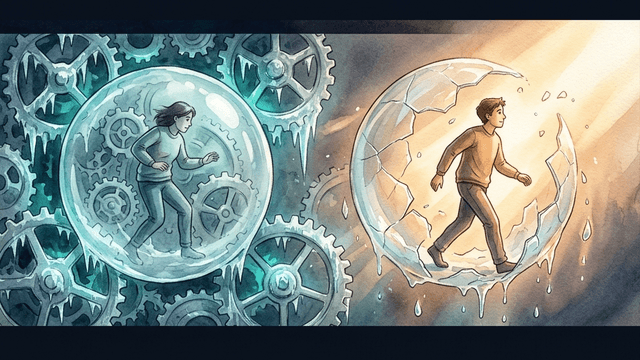
How to Thaw From Functional Freeze
Here's what I've learned, both from research and from personal experience: you cannot think your way out of functional freeze. The PFC — the part of your brain that does the thinking — is the part that's been deprioritized. Trying to logic your way out of a freeze is like trying to use the app that crashed to fix the crash.
You have to go bottom-up: body first, then emotion, then cognition.
1. The Vagal Brake Release
Your vagus nerve is the highway between your brain and your body. When it's locked in dorsal shutdown, you need to physically stimulate it back toward ventral (safe) mode.
Things that actually work:
- Cold water on face or wrists — triggers the dive reflex, activates vagal tone
- Humming or singing — vibrates the vagus nerve in your throat
- Slow exhale breathing — inhale for 4 counts, exhale for 8. The extended exhale signals safety to your autonomic system
- Gentle movement — not exercise (that requires motivation you don't have). Just standing up. Walking to another room. Stretching for 30 seconds
This isn't woo. Dana (2018) and Porges (2011) have documented these as evidence-based vagal regulation techniques.
2. Schedule One Non-Productive Activity
Functional freeze often starts as a response to chronic over-productivity — your nervous system shutting down the "extra" stuff to keep the "essential" stuff running. The antidote is deliberately doing something that has zero productivity value.
Not "self-care" in the Instagram sense. I mean something genuinely pointless. Sit outside for ten minutes without your phone. Draw something bad. Watch a specific episode of something instead of letting autoplay decide for you.
The act of choosing something unproductive tells your nervous system: "We are not in survival mode. We have bandwidth for non-essential activity." It's a signal of safety.
3. Tell One Person
Functional freeze thrives in isolation. It's invisible to others, and your numbed emotional state makes you unlikely to seek help. Break that loop by telling one person — not "I'm having a mental health crisis," just: "I think I've been running on autopilot for a while and I don't feel much of anything."
Naming the state out loud does two things. Research on affect labeling (Lieberman et al., 2007) shows that verbalizing emotional states reduces amygdala activation, creating a small crack in the freeze. And the social connection — being seen, even briefly — activates the ventral vagal pathway that functional freeze has suppressed.
4. Reduce Decision Load Ruthlessly
If your executive function is already depleted, every decision accelerates the freeze. For the next week:
- Eat the same breakfast and lunch
- Wear the same three outfits in rotation
- Say "no" to any new commitment
- Use Thawly to break your remaining obligations into micro-steps so your PFC doesn't have to do the decomposition work
This isn't giving up. It's strategic energy conservation — choosing to preserve your limited cognitive budget for the one or two things that actually matter.
(Struggling with the decision overload? Try the Decision Paralysis Bypass Tool.)
5. Address Root Cause: What Put You in Freeze?
Functional freeze doesn't appear randomly. Something triggered the nervous system to shift into conservation mode. Common triggers for ADHD adults:
- Sustained masking at a new job or in a new relationship
- Chronic overwhelm from a project, move, or life transition
- Emotional event that you "handled well" on the surface but never actually processed
- Medication changes — or the realization that your meds handle task initiation but not emotional regulation
- ADHD burnout — the end stage of running too hot for too long
Identifying the trigger doesn't instantly fix the freeze, but it tells your brain why it went into Safe Mode. And understanding the cause is the first step toward the nervous system trusting that the threat has passed.
The Uncomfortable Truth About Functional Freeze
I'll be direct about something that most articles on this topic skip.
Functional freeze is comfortable. In a terrible, soul-eroding way, it's the easiest state to stay in. You're not in pain. You're not in crisis. You're producing. Nobody is worried about you. The freeze removes the messy, chaotic, overwhelming emotional data that makes ADHD so exhausting — and in its place leaves a smooth, gray, manageable nothing.
Some days I miss it. Not the freeze itself, but the simplicity of it. Being thawed means feeling things again — including the things I was avoiding when I froze in the first place. The thaw process isn't comfortable. It's necessary.
I wrote an article about the ADHD thaw method — the specific 3-phase process of interrupt → dopamine → micro-action — that applies directly here. If you're feeling stuck in a broader sense, that piece covers the life-level stuckness that functional freeze often produces.
FAQ
What does functional freeze feel like?
Functional freeze feels like operating on autopilot. You're going through the motions — working, eating, responding to people — but there's a persistent sense of emotional numbness or disconnection. Many people describe it as watching their own life through a foggy window, or as being a "ghost piloting a body." You're not necessarily sad or anxious; you feel nothing, which is actually its own form of distress. The key distinction from depression is that you're still performing — your output hasn't dropped — but your internal experience has gone flat.
Is functional freeze the same as ADHD shutdown?
No. They're related but different nervous system states. ADHD shutdown is a full dorsal vagal collapse — you can't function, you can't move, you're visibly stuck. Functional freeze is a blended state where your sympathetic system (keep going, meet obligations) is fighting your dorsal system (shut down, conserve energy). The result is that you continue performing but lose access to emotions, creativity, and genuine engagement. Think of shutdown as a blue screen crash and functional freeze as running in Safe Mode.
How long does functional freeze last?
Without intervention, functional freeze can last weeks to months. Because you're still meeting external obligations, there's no natural trigger to break the cycle — nobody intervenes, and your own numbed self-awareness makes it hard to recognize the state. Many people I've spoken with report being in functional freeze for 3-6 months before realizing something was wrong. The earlier you identify the signs (emotional numbness, loss of interest, physical tension despite adequate rest), the shorter the thaw period.
Can medication help with functional freeze?
Partially. Stimulant medications address the dopamine deficit in the prefrontal cortex, which can improve task initiation and reduce the executive function tax that contributes to freeze. However, medication primarily addresses the cognitive layer — it helps you think and do more efficiently — but functional freeze is largely a nervous system regulation issue, not purely a cognitive one. The most effective approach combines medication with somatic techniques (vagal regulation, body-based practices) and environmental changes (reducing masking load, building in non-productive time).
What causes functional freeze in ADHD?
The primary cause is nervous system depletion from chronic executive function overuse. Adults with ADHD spend significantly more cognitive energy on daily tasks than neurotypical peers — every transition, decision, and social interaction costs more. When this spending exceeds the brain's recovery capacity, the nervous system shifts into conservation mode: still running, but with emotional and creative functions shut down. Common triggers include sustained masking at work, major life transitions, unprocessed emotional events, and the cumulative effect of ADHD burnout.
Sources
- Porges, S.W. (2011). The Polyvagal Theory: Neurophysiological Foundations of Emotions, Attachment, Communication, and Self-Regulation. W.W. Norton & Company.
- Dana, D. (2018). The Polyvagal Theory in Therapy: Engaging the Rhythm of Regulation. W.W. Norton & Company.
- Arnsten, A.F.T. (2009). "Stress signalling pathways that impair prefrontal cortex structure and function." Nature Reviews Neuroscience, 10(6), 410-422.
- Bargiela, S., Steward, R., & Mandy, W. (2016). "The Experiences of Late-Diagnosed Women with Autism Spectrum Conditions." Journal of Autism and Developmental Disorders, 46(10), 3281-3294.
- Lieberman, M.D. et al. (2007). "Putting Feelings into Words: Affect Labeling Disrupts Amygdala Activity in Response to Affective Stimuli." Psychological Science, 18(5), 421-428.
- Barkley, R.A. (2015). "Attention-Deficit Hyperactivity Disorder: A Handbook for Diagnosis and Treatment." 4th Edition, Guilford Press.
- Faraone, S.V. et al. (2021). "The World Federation of ADHD International Consensus Statement." Neuroscience & Biobehavioral Reviews, 128, 789-818.

Sean Z. holds a Master's degree in Cognitive Psychology. He spent 7 years in academic research focused on human cognition, followed by 10+ years designing products and services in the applied psychology space. He built Thawly after years of firsthand experience with ADHD task paralysis — combining academic understanding of executive function with the daily reality of living with it. About the Author → LinkedIn
Looking for more specific strategies?
Explore 115+ targeted tools for specific ADHD scenarios.
Browse the ADHD Toolkit →