What Is an ADHD Thaw? The Science of Unfreezing Your Paralyzed Brain
Disclaimer: This article is for informational and educational purposes only. It is not a substitute for professional medical advice, diagnosis, or treatment. If you suspect you have ADHD, please consult a qualified healthcare provider.
An ADHD thaw is the neurological transition from a freeze state back to functioning — the moment your prefrontal cortex comes back online and your body begins to respond to intention again. It is not a sudden snap but a gradual process driven by vagal nerve activation, dopamine micro-recovery, and the Zeigarnik Effect. You can trigger a thaw deliberately through physical interrupts, sensory anchoring, and micro-step initiation.
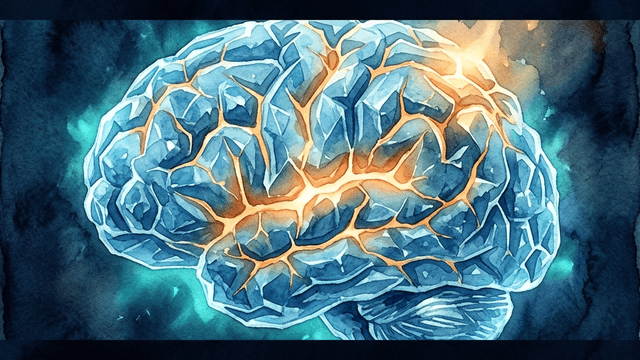
There's a moment — and you'll know it if you've felt it — where the ice cracks.
You've been staring at your laptop for 47 minutes. Not thinking about anything productive. Not scrolling. Just frozen, like someone pressed pause on you and walked away. Your jaw is tight. Your breathing is shallow. You're dimly aware of a growing knot of shame behind your sternum, and the voice in the back of your skull has been cycling through the same loop: "Why can't I just do this? What is wrong with me?"
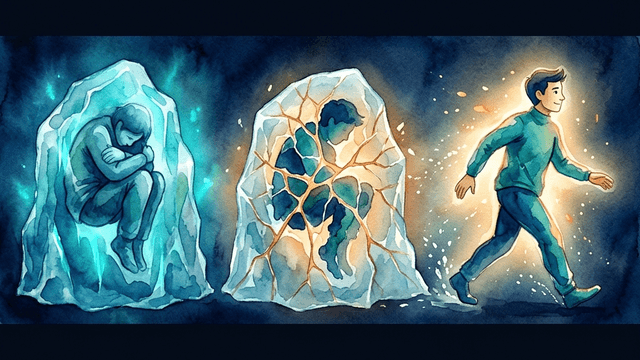
And then — sometimes for no reason you can identify — something shifts. It's not motivation. It's not willpower. It's more like a crack in a sheet of ice: small, quiet, and involuntary. Your finger moves to the trackpad. You open the email. You type one word. Then two. Then the sentence is done and you realize you're breathing normally again.
That's the thaw.
Not the dramatic, motivational-poster moment where you leap out of bed and conquer the day. Not the medication kicking in. Just a tiny neurological shift where your brain's "start" signal finally — finally — fires.
I've been thinking about this moment for years, because I experience it almost daily. And the more I learn about the neuroscience behind it, the more I realize that the thaw is not random. It follows predictable patterns. And you can learn to trigger it on purpose.
Why Your Brain Freezes in the First Place
Before we talk about thawing, we need to understand why the freeze happens. (If you've already read my articles on ADHD paralysis or ADHD freeze, you'll recognize some of this — but I want to frame it specifically through the lens of what makes the freeze end.)
Three systems fail simultaneously during an ADHD freeze:
The Dopamine Gap
Volkow et al. (2009) used PET imaging to show that adults with ADHD have measurably lower dopamine receptor density in the brain's reward pathway — specifically the nucleus accumbens and midbrain. Dopamine isn't just a "pleasure chemical." It's the neural signal that says: "This action is worth initiating."
When dopamine is insufficient, your brain can't label any available action as worth starting. Not the important one. Not the easy one. Not even the one you actually want to do. The start signal simply doesn't fire.
The PFC Shutdown
Arnsten's landmark research (2009) demonstrated that the prefrontal cortex — the brain's command center for planning, sequencing, and initiating action — is exquisitely sensitive to stress hormones. Even moderate stress causes catecholamine levels to spike beyond the PFC's optimal range, causing it to effectively go offline.
Here's the cruel irony: the guilt and shame you feel about being frozen generates exactly the kind of stress that keeps the PFC shut down. Your frustration at not starting becomes the neurochemical reason you can't start.
The Vagal Brake
Porges' Polyvagal Theory (2011) adds a third layer. When the nervous system determines that neither fighting nor fleeing is viable — and let's be honest, neither "fighting" nor "fleeing" is a reasonable response to a pile of laundry — the dorsal vagal complex pulls the emergency brake. Heart rate drops. Muscles go slack. Cognitive processing narrows to a tunnel.
This is the ADHD freeze in full neurological detail: a three-system pileup that your conscious mind is powerless to override through sheer will.
So What Actually Triggers the Thaw?
Here's what I find fascinating, and what nobody seems to write about: the freeze doesn't last forever. Something breaks it. Every time.
When I started paying close attention to my own freeze episodes — timing them, noting what I was doing when they ended — I noticed patterns. And those patterns align with what the neuroscience predicts.
What a Thaw Is, Neurologically
An ADHD thaw is the moment when your prefrontal cortex comes back online. Not fully. Not triumphantly. Just enough to execute one tiny motor plan.
Three things need to happen for a thaw to occur:
- Stress hormones drop below the PFC threshold. The cortisol needs to decrease enough for the prefrontal cortex to regain some functional control from the amygdala.
- A small dopamine signal fires. Something — a sound, a movement, a micro-thought — generates just enough dopamine to cross the activation threshold for one action.
- The vagal system shifts. The nervous system moves from dorsal vagal (shutdown) back to ventral vagal (safe engagement), even slightly.
You don't need all three to happen dramatically. You just need enough of a shift — a crack in the ice — to allow one tiny action. And that one tiny action, if it succeeds, generates a feedback loop: action → dopamine → PFC engagement → next action.
This is behavioral activation at the neurochemical level. Martell et al. (2010) demonstrated this in the context of depression, but the principle applies directly to ADHD: small actions generate neurochemical momentum.
Why Some Thaws Happen "Randomly"
They don't.
When you feel like the freeze "just ended on its own," what usually happened was one of these:
- A sensory interrupt: The doorbell rang. A car alarm went off. Your cat jumped on your keyboard. Any novel sensory input can jolt the amygdala out of its loop and create a micro-window for PFC re-engagement.
- A time-based cortisol decline: Cortisol has a natural half-life. After 20-40 minutes without a new stress trigger, levels begin to fall on their own. Sometimes the thaw is simply your stress hormones hitting a low enough point.
- An unconscious body movement: You shifted in your chair. You stretched. You stood up to pee. These proprioceptive inputs stimulate vagal tone and can push the nervous system out of dorsal shutdown.
The thaw isn't magic. It's neurochemistry. And once you understand the mechanism, you can hack it.
Stuck on something right now?
Stop reading about it — try it. Thawly breaks your task into one tiny step you can do right now.
Free · No signup · 3 secondsThe 3-Phase Thaw Method
I developed this framework for myself over two years of experimentation, and it's now built into the core logic of Thawly. It's based on a simple principle: you can't think your way out of a freeze, because the part of your brain that thinks is the part that's offline. You have to move your way out — starting from the body, working up to the brain.
Phase 1: Interrupt the Vagal Freeze (0-30 seconds)
Your first job is not to "start your task." It's to shift your autonomic nervous system out of dorsal vagal shutdown. All of these work:
- Cold water on your face. This triggers the mammalian dive reflex — an involuntary vagal reset that even overrides the freeze state. I keep a frozen facecloth for exactly this.
- Shake your hands for 10 seconds. Hard, like you're flicking water off them. Proprioceptive input tells your brain "you are a body, and you are moving."
- Hum or sing 3 bars of any song. Humming activates your diaphragm, which stimulates the ventral vagus nerve. It doesn't matter what song. (Mine is embarrassingly catchy. I'm not telling you.)
- Change your position. Stand if you're sitting. Lie down if you're standing. Any shift in gravity activates your vestibular system, which has direct connections to autonomic regulation.
You're not "getting motivated." You're sending a hardware-level interrupt to your nervous system. Motivation is a PFC function. You don't have access to the PFC yet. You're working below it.
Phase 2: Generate One Micro-Dopamine Hit (30-90 seconds)
Once the freeze breaks — and you'll feel it as a slight loosening in your chest or jaw — you need to generate a small dopamine signal. Not from the task you were avoiding. That's still too loaded. From something else.
- Text one person. Anyone. One message. "Hey what's up" counts. Sending a message creates a social micro-reward — one of the most reliable dopamine triggers in the human brain.
- Drink something cold. Temperature sensation creates a small sensory novelty signal. Your brain perks up, even slightly.
- Say out loud what you're about to do. "I'm going to open my laptop and type one word." Verbalizing an intention activates Broca's area and the motor planning system simultaneously, creating a bridge between language and movement.
The goal here is not productivity. It's priming. You're warming up the engine before putting the car in gear.
Phase 3: The Absurdly Small First Action (90 seconds - 5 minutes)
Now — and only now — you approach the task. But you do NOT approach the full task. You approach the smallest imaginable fragment of the task.
"Reply to the email" → Open the email. Don't reply yet. Just open it. "Clean the kitchen" → Pick up one item. Any item. Move it somewhere else. "Start the project" → Open a blank document and type literally one word.
(This is exactly what Thawly automates — it takes your stuck task and decomposes it into steps so small your depleted dopamine system can still execute them. Try it with whatever is freezing you right now.)
Why does this work? Because task initiation requires crossing a dopamine threshold, and smaller tasks have lower thresholds. Once you cross the first one, the success generates a small reward signal that lowers the threshold for the next step. The cascade has started.
I'm not going to pretend this works every time. Some freezes are deep — four-hour monsters that resist everything. But in my experience, this three-phase sequence breaks about 70% of my freeze episodes within 5 minutes. And for the remaining 30%, it usually shortens them significantly.
The Thaw Is Not Motivation
I want to be very clear about this, because the distinction matters.
Motivation is the experience of wanting to do something. It's a PFC-mediated state that requires baseline dopamine, clear goals, and emotional regulation. ADHD brains cannot reliably generate motivation on demand. This is not a mindset problem. It's a neurotransmitter problem.
A thaw is different. A thaw is the moment the freeze stops — the neurological transition from shutdown to minimal functioning. It doesn't feel like enthusiasm. It feels like... absence of paralysis. Neutral. Like the pain in your shoulder that you forgot was there until it stopped.
You don't need to feel motivated to thaw. You just need one tiny action to succeed. The motivation — if it comes at all — shows up later, as a side effect of momentum.
This is why most advice for ADHD paralysis fails. "Find your motivation." "Think about your goals." "Visualize the outcome." All of that requires a functioning prefrontal cortex. During a freeze, your PFC is offline. It's like telling someone whose phone battery is dead to "just check the GPS."
Start with the body. Move to the first micro-action. Let the chemistry follow.
What Makes a Thaw Stick (vs. Refreeze)
One of the most frustrating ADHD experiences is the refreeze — you thaw enough to start, do one or two things, and then lock up again 15 minutes later.
This happens because the initial thaw didn't generate enough sustained dopamine to keep the PFC online. You burned through the tiny burst from your first micro-action and didn't have enough left for the second.
The fix: chain your micro-actions with micro-rewards.
- Finish one step → Take a 60-second break to do something you like
- Finish two steps → Text a friend that you did it (social reward)
- Finish three steps → Move to a different physical location (novelty reward)
You're essentially building a dopamine breadcrumb trail, where each small reward generates enough fuel for the next action. This is the neurochemical foundation behind every timer-based productivity system — the Pomodoro technique, body doubling, even game-based task systems.
The difference is that most of those systems assume you can already start. The thaw method assumes you can't — and gives you a way to reach the starting line first.
A Personal Note
I named Thawly what I did because "thaw" is the most honest word I know for this experience. Not "overcome." Not "conquer." Not "crush." Those are neurotypical power words that imply you're defeating an enemy.
A thaw isn't a victory. It's a melting. Slow, quiet, and non-dramatic. You don't overpower the ice — you change the temperature around it until it gives way on its own.
I still freeze. Almost every day. I froze twice while writing this article, actually — once after the second heading and once during the FAQ section. Both times, I used the same method I described above: cold water, text a friend, type one garbage sentence.
That's the thing about living with ADHD: you don't get cured. You get faster at thawing.
(If your stuckness isn't about a single task — if it's the deeper, life-level kind where nothing seems to move forward — I wrote a companion piece on ADHD feeling stuck that addresses the bigger picture.)
FAQ
What exactly is an ADHD thaw?
An ADHD thaw is the neurological transition from a freeze state (dorsal vagal shutdown + prefrontal cortex offline) back to minimal executive functioning — just enough to initiate one small action. It's not motivation, it's not energy, and it's not willpower. It's the moment the ice cracks: your brain's "start" signal fires for the first time after being stuck. You can learn to trigger this transition deliberately using body-based techniques that bypass the PFC and work directly on the autonomic nervous system.
How long does it take to thaw from ADHD paralysis?
It varies. With deliberate intervention (cold water reset, physical movement, micro-step approach), many people can initiate a thaw within 2-5 minutes. Without intervention, freeze episodes can last anywhere from 20 minutes to several hours. In severe cases — especially when shame and guilt compound the freeze — episodes can last an entire day. The 3-Phase Thaw Method described in this article is designed to shorten the gap between freeze and first action.
Is an ADHD thaw the same as getting motivated?
No, and this distinction is critical. Motivation requires a functioning prefrontal cortex — the exact brain region that goes offline during a freeze. A thaw doesn't require motivation. It requires a physiological shift: your nervous system moving from shutdown (dorsal vagal) to safe engagement (ventral vagal). Motivation may emerge as a result of thawing and building momentum, but it's the effect, not the cause. Don't wait for motivation. Start with your body.
Can medication help trigger an ADHD thaw?
Yes. Stimulant medications (methylphenidate, amphetamine-based) increase dopamine and norepinephrine availability in the prefrontal cortex, which raises the threshold at which freeze occurs and makes spontaneous thawing easier. Many adults report that freeze episodes that lasted hours before medication now resolve in minutes. However, medication alone doesn't teach you the behavioral skills to actively thaw — combining medication with the body-based techniques in this article produces the best outcomes.
Why do I keep refreezing after a thaw?
Refreezing happens when the initial thaw doesn't generate enough sustained dopamine to keep the prefrontal cortex engaged. You burn through the small neurochemical burst from your first micro-action without building enough momentum for the next. The solution is chaining micro-rewards between actions: a 60-second break, a text to a friend, changing physical locations. You're building a dopamine breadcrumb trail that sustains the thaw long enough for real momentum to develop.
Sources
- Volkow, N.D. et al. (2009). "Evaluating Dopamine Reward Pathway in ADHD: Clinical Implications." JAMA, 302(10), 1084-1091.
- Volkow, N.D. et al. (2011). "Motivation deficit in ADHD is associated with dysfunction of the dopamine reward pathway." Molecular Psychiatry, 16(11), 1147-1154.
- Arnsten, A.F.T. (2009). "Stress signalling pathways that impair prefrontal cortex structure and function." Nature Reviews Neuroscience, 10(6), 410-422.
- Porges, S.W. (2011). The Polyvagal Theory: Neurophysiological Foundations of Emotions, Attachment, Communication, and Self-regulation. W.W. Norton.
- Martell, C.R. et al. (2010). Behavioral Activation for Depression: A Clinician's Guide. Guilford Press.
- Barkley, R.A. (2015). "Emotional Dysregulation Is a Core Component of ADHD." In Attention-Deficit Hyperactivity Disorder: A Handbook for Diagnosis and Treatment (4th ed.). Guilford Press.
- Dana, D. (2018). The Polyvagal Theory in Therapy: Engaging the Rhythm of Regulation. W.W. Norton.

Sean Z. holds a Master's degree in Cognitive Psychology. He spent 7 years in academic research focused on human cognition, followed by 10+ years designing products and services in the applied psychology space. He built Thawly after years of firsthand experience with ADHD task paralysis — combining academic understanding of executive function with the daily reality of living with it. About the Author → LinkedIn
Looking for more specific strategies?
Explore 115+ targeted tools for specific ADHD scenarios.
Browse the ADHD Toolkit →