ADHD Feeling Stuck? Why You're Not Lazy — You're Neurologically Trapped
Disclaimer: This article is for informational and educational purposes only. It is not a substitute for professional medical advice, diagnosis, or treatment. If you suspect you have ADHD, please consult a qualified healthcare provider.
Feeling stuck with ADHD is not a motivational failure — it is a neurological state caused by insufficient dopamine in the prefrontal cortex, which prevents your brain from generating the activation signal needed to begin any task. Research by Volkow et al. (2009) shows ADHD adults have measurably lower dopamine receptor density. The solution is not willpower — it is reducing activation energy through micro-steps, environmental design, and externalized executive function tools.
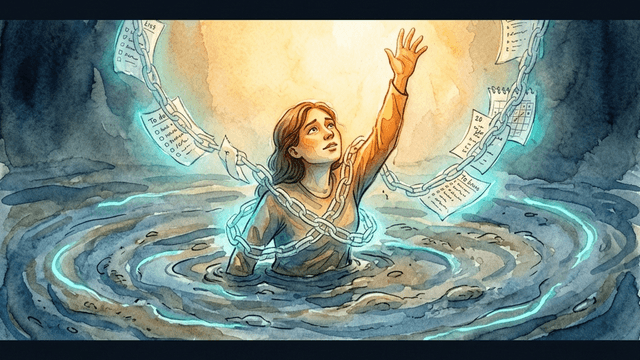
You know that feeling where you're lying on your bed at 2 PM on a Sunday, fully aware of the seventeen things you should be doing, and you can feel your life calcifying around you like concrete setting in real time?
You're not tired. You slept fine. Nobody is stopping you. The tasks aren't even hard — schedule a dentist appointment, respond to three emails, start that online course you paid $200 for six weeks ago. And yet here you are, staring at the ceiling, marinading in a cocktail of guilt and paralysis while your phone buzzes with reminders you set for yourself in a more optimistic moment.
The worst part isn't the not-doing. It's the knowing. You watch yourself not doing things. You calculate exactly how long you've been not doing them. You compose elaborate plans for how you'll definitely start tomorrow. Tomorrow comes. Same ceiling.
If this is your life — not occasionally, but structurally — you're probably not lazy. You're probably stuck. And those two things are neurologically, measurably, categorically different.
What "Stuck" Actually Means in an ADHD Brain
"Feeling stuck" is one of those phrases that sounds vague until you've lived it. For neurotypical people, "stuck" might mean "I'm in a rut" or "I need a vacation." For adults with ADHD, stuck is a specific neurological state where your executive function system has collapsed and you literally cannot translate intention into action.
Here's the brain science, stripped of jargon:
The Executive Function Gap
Your prefrontal cortex (PFC) is supposed to do five jobs: plan, prioritize, initiate, sustain effort, and regulate emotions. Research by Barkley (2012) established that adults with ADHD show 30-40% developmental delay in executive function maturation. That's not a metaphor — it means a 30-year-old with ADHD may have the executive functioning capacity of a neurotypical 20-year-old.
When your PFC can't handle the current load — and "current load" might be as simple as "choose between three tasks" — it doesn't slow down gracefully. It crashes. Like a browser with 47 tabs open. And when it crashes, you get stuck.
The Dopamine Starvation
Volkow et al. (2011) demonstrated that ADHD brains have lower dopamine receptor density in the reward pathway. Dopamine isn't just about pleasure — it's the chemical signal that says "this action has value, do it now."
When you feel stuck, what's happening neurochemically is that your brain can't assign enough "value" to any available action. Not the important thing. Not the easy thing. Not even the thing you enjoy. Every option registers as equally meh — and when everything has the same (low) priority, your brain defaults to nothing.
This is why you can spend three hours on your phone doing nothing meaningful while the thing you actually want to do sits untouched. Your phone provides just enough micro-dopamine (scroll, like, refresh) to keep you alive without ever generating the activation energy for real action.
The Borrowed Urgency Problem
Here's something that took me years to understand about my own stuckness: I'm not always stuck. I can function under pressure. Deadlines make me productive. Emergencies make me focused. Someone counting on me right now makes me move.
This is what ADHD researchers call "borrowed urgency" — the phenomenon where ADHD brains can only generate enough activation for tasks that have immediate, unavoidable consequences. The problem? Most of life isn't urgent. Career growth isn't urgent. Health isn't urgent. Personal goals aren't urgent — until they become emergencies, by which point you've already lost months or years.
This is why ADHD feeling stuck isn't the same as ADHD task paralysis. Task paralysis is about a specific task. Feeling stuck is about everything — the global, life-level sensation that you're watching time pass while your peers build careers, relationships, and futures, and you're still trying to reply to an email from three weeks ago.
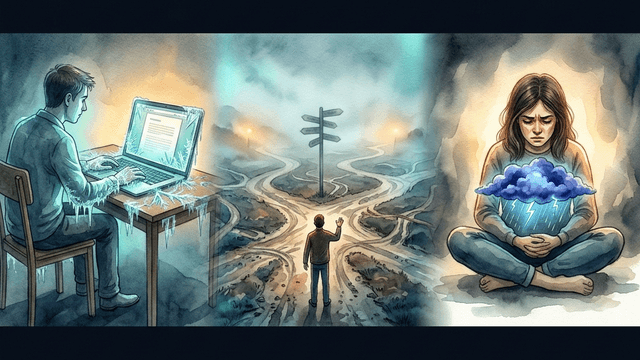
The Three Types of ADHD Stuckness
Not all stuckness is the same. I've found it helps to name the specific type, because each has different causes and different solutions.
1. Task Stuck: "I Can See What I Need to Do, I Just Can't Start"
This is the most recognizable form. You have a clear task, you understand the task, and your hands won't move. We've covered this extensively — it's driven by dopamine-dependent task initiation failure and responds well to micro-step interventions.
(Stuck on a specific task right now? Let Thawly break it into micro-steps.)
2. Life Stuck: "I Feel Like I'm Going Nowhere"
This is deeper and scarier. Life stuck isn't about any single task — it's the creeping awareness that your ADHD has created a pattern where you start things but don't finish them, make plans but don't execute them, and watch opportunities pass while you're paralyzed by the gap between who you are and who you intended to be.
Life stuck involves:
- Career stagnation: staying in the same role because switching requires sustained planning
- Relationship patterns: avoiding difficult conversations because emotional regulation is exhausting
- Goal abandonment: the graveyard of hobbies, courses, side projects, and New Year's resolutions
- Financial stuck: bills unpaid not because you're broke but because you can't initiate the payment process
A 2024 study published in the Journal of Attention Disorders found that adults with ADHD report significantly lower life satisfaction and career advancement compared to neurotypical peers — not because of intelligence or ability, but because of chronic executive dysfunction compounding over decades.
3. Emotional Stuck: "I Know What I Feel, I Just Can't Move Past It"
The third form is the one nobody talks about enough. ADHD emotional dysregulation — what Barkley calls the "hidden dimension" of ADHD — means that negative emotions hit harder, last longer, and are harder to redirect.
When something goes wrong — a rejection, a mistake, a conflict — neurotypical brains can contextualize it ("that was one bad thing in an otherwise okay day") and move on. ADHD brains often can't. The emotion floods the working memory, hijacks the PFC, and pins you in place. You know, rationally, that the thing isn't that big a deal. You feel, overwhelmingly, like it is.
This emotional stuckness often looks like:
- Replaying a conversation from two days ago on infinite loop
- Unable to work after receiving critical feedback
- Canceling plans because you feel "off" and can't shake it
- The shame spiral — where feeling bad about feeling bad creates an escalating loop
Stuck on something right now?
Stop reading about it — try it. Thawly breaks your task into one tiny step you can do right now.
Free · No signup · 3 secondsWhy "Just Try Harder" Makes It Worse
Let me say this directly to anyone who has ever been told — by a partner, a parent, a manager, or their own inner critic — that they just need to "push through it":
Pushing through a stuck state caused by executive dysfunction is like pushing through a computer crash by typing harder.
The system is offline. More input doesn't help. It makes things worse, because now you've added shame and self-blame to the existing neurochemical deficit. Arnsten's research (2009) showed that stress hormones actively degrade prefrontal cortex function. Every "why can't I just DO this" thought is literally reducing your brain's ability to do the thing.
This is the cruelest part of ADHD stuckness. The guilt you feel about being stuck is the chemical reason you stay stuck.
How to Actually Get Unstuck (Without Willpower)
I'm not going to give you a motivational pep talk. These are strategies that work because they bypass the executive function bottleneck, not through it.
1. Shrink Your World to One Room
When you're life-stuck, the scope of "everything I should be doing" is paralyzing. You're not going to fix your career, your health, your finances, and your relationships today.
Pick one room. Literally. Go to that room. Your world is now that room. What is one thing in this room that you can change in the next 3 minutes?
This works because it reduces working memory load to near zero. You don't need to plan, prioritize, or sequence. You just need to identify one object in your immediate visual field and move it.
2. The "What Would a Mediocre Person Do?" Test
Perfectionism is one of the most underdiagnosed drivers of ADHD stuckness. You're not avoiding the task because it's hard. You're avoiding it because your brain has already calculated all the ways you might do it imperfectly, and it has decided that not doing it is safer than doing it badly.
Counter this by asking: "What would a person who doesn't care about quality do right now?"
They'd send the email in two sentences. They'd apply for the job with a mediocre cover letter. They'd cook a meal from whatever's already in the fridge, even if it's weird.
Your mediocre output is still better than your perfect nothing. And here's the thing I wish someone had told me ten years ago: most of life doesn't require excellence. It requires showing up.
3. Find One External Structure
ADHD brains struggle with internal motivation but respond powerfully to external structure. This is why school was (relatively) easier — someone else set the schedule, the deadlines, and the expectations.
You need to re-create that structure artificially:
- Body doubling: work in a café, join a virtual co-working session, or simply FaceTime a friend while you both work silently
- Accountability partner: tell one person "I'm going to do X by Friday" — the social contract creates borrowed urgency
- Timer constraint: set a 15-minute timer and declare that you will work on one thing until it rings, then stop. The permission to stop is crucial — it removes the "this will go on forever" dread that prevents starting
4. Address the Emotional Layer First
If you're emotionally stuck — stuck in a shame loop, a rumination cycle, or post-conflict shutdown — no productivity hack is going to work until you address the emotion.
Two things that actually help:
- Name it out loud: "I am stuck because I feel ashamed about missing that deadline." Research on affect labeling (Lieberman et al., 2007) shows that verbalizing emotions reduces amygdala activation — literally calming the emotional hijack.
- Write a "done" list instead of a to-do list: write down everything you have done today, including "got out of bed" and "brushed teeth." This counters the ADHD tendency to discount accomplishments and amplify failures.
5. Use the Thaw Method
If you're familiar with the 3-Phase Thaw Method from my previous article, this is where it applies: interrupt the vagal freeze → generate one micro-dopamine hit → execute one absurdly small action. The thaw doesn't require motivation. It requires one crack in the ice.
A Note on the Long Game
I want to be honest about something.
I still get stuck. Regularly. I got stuck twice while writing this article — once after the section on emotional stuckness (because writing about shame activated my own shame), and once in the middle of the "how to get unstuck" section (the irony is not lost on me).
The difference between now and five years ago isn't that I don't get stuck. It's that I recognize it faster, I blame myself less, and I have a toolkit that shortens the stuck periods from days to hours.
ADHD stuckness isn't something you cure. It's something you get better at navigating. And the first step — the one that matters more than any strategy — is understanding that you're not stuck because you're broken. You're stuck because your brain has a measurable, documented, neurological difference in the system that converts intention into action.
That's not a character flaw. That's a hardware specification.
FAQ
Is feeling stuck a symptom of ADHD?
Yes. While "feeling stuck" isn't a formal diagnostic criterion, it's a direct consequence of the executive dysfunction that defines ADHD. The inability to initiate tasks, sustain effort toward goals, and manage emotional responses creates a persistent sense of stagnation. Research shows that adults with ADHD report lower life satisfaction and career progression compared to neurotypical peers — not due to lower intelligence or ability, but because executive dysfunction compounds over time. If you consistently feel stuck despite knowing what you need to do, it's worth exploring whether undiagnosed ADHD might be a factor.
How do I know if I'm lazy or if I have ADHD?
The core difference is volition. Laziness is a choice — you could do the thing, you prefer not to. ADHD stuckness is involuntary — you desperately want to do the thing but your brain's initiation system won't fire. If you feel genuine distress about your inaction, if you've tried "just trying harder" and it consistently fails, and if the pattern has been present since childhood, those are signals worth exploring with a professional. I wrote a full comparison in Do I Have ADHD or Am I Just Lazy?.
Can medication help with feeling stuck?
Often significantly, yes. Stimulant medications (methylphenidate, amphetamine-based) directly address the dopamine deficit in the prefrontal cortex, which can improve task initiation, sustained attention, and goal-directed behavior. Many adults report that medication transforms their experience from "I know what to do but can't start" to "I can actually begin when I decide to." However, medication is most effective when combined with behavioral strategies and external structures — it raises the floor, but you still need tools to build on it. Discuss options with a psychiatrist who specializes in adult ADHD.
Why do I feel stuck in life but not at work?
External structure. Work provides deadlines, meetings, supervisors, and social accountability — all of which create "borrowed urgency" that ADHD brains can use to activate. Personal life has none of that scaffolding. Your own goals, health, relationships, and long-term plans require internally generated motivation and self-directed planning — exactly the executive functions that ADHD impairs most. This is why many high-functioning adults with ADHD have successful careers but chaotic personal lives. The solution isn't to make your life more like work — it's to build external supports (accountability partners, coaching, automated systems) that provide structure without requiring a boss.
How long can ADHD stuckness last?
Individual episodes of task stuckness typically last hours. But the broader "life stuck" pattern — career stagnation, goal abandonment, relationship avoidance — can persist for years or decades if the underlying ADHD is unrecognized or unmanaged. Many adults don't realize the pattern is ADHD-related until their 30s or 40s, after years of attributing it to laziness, lack of discipline, or personal failure. The good news: identifying the neurological cause often produces immediate psychological relief ("I'm not broken — my brain works differently"), followed by gradual improvement as appropriate supports are put in place.
Sources
- Barkley, R.A. (2012). Executive Functions: What They Are, How They Work, and Why They Evolved. Guilford Press.
- Volkow, N.D. et al. (2011). "Motivation deficit in ADHD is associated with dysfunction of the dopamine reward pathway." Molecular Psychiatry, 16(11), 1147-1154.
- Arnsten, A.F.T. (2009). "Stress signalling pathways that impair prefrontal cortex structure and function." Nature Reviews Neuroscience, 10(6), 410-422.
- Nigg, J.T. et al. (2024). "Executive Function Deficits in ADHD: A Meta-Analytic Review." Psychological Bulletin.
- Lieberman, M.D. et al. (2007). "Putting Feelings into Words: Affect Labeling Disrupts Amygdala Activity in Response to Affective Stimuli." Psychological Science, 18(5), 421-428.
- Faraone, S.V. et al. (2021). "The World Federation of ADHD International Consensus Statement." Neuroscience & Biobehavioral Reviews, 128, 789-818.

Sean Z. holds a Master's degree in Cognitive Psychology. He spent 7 years in academic research focused on human cognition, followed by 10+ years designing products and services in the applied psychology space. He built Thawly after years of firsthand experience with ADHD task paralysis — combining academic understanding of executive function with the daily reality of living with it. About the Author → LinkedIn
Looking for more specific strategies?
Explore 115+ targeted tools for specific ADHD scenarios.
Browse the ADHD Toolkit →