Does ADHD Get Worse as You Get Older? The Scaffolding Theory
Disclaimer: This article is for informational and educational purposes only. It is not a substitute for professional medical advice, diagnosis, or treatment. If you suspect you have ADHD, please consult a qualified healthcare provider.
ADHD does not get worse with age — but the external scaffolding that compensated for it disappears. School provided structure, deadlines, and reminders. Parents managed your schedule. Adulthood removes all of that, exposing the full extent of your executive dysfunction for the first time. Additionally, hormonal changes (especially declining estrogen in women during perimenopause) can worsen ADHD symptoms. The solution is rebuilding external scaffolding: routines, tools, and support systems that replace what life stages removed.
When I was 12, I lost my keys maybe once a month. My mom would sigh, help me find them, and we'd move on. When I was 22, I lost my keys twice a week. There was no mom. Just me, a landlord who charged $50 per replacement, and a growing belief that I was fundamentally incapable of managing basic adult tasks.
The ADHD didn't get worse. My mom got further away.
This is the answer that nobody tells you when you Google "does ADHD get worse as you get older" — and it's both more nuanced and more painful than a simple yes or no. Your ADHD symptoms aren't escalating. The scaffolding that was holding you up is collapsing, one life transition at a time, and what's left underneath is the unmediated, unaccommodated version of your executive function. Which was always this limited. You just couldn't see it before.
What the Research Actually Says
The scientific consensus is more complicated than either "yes it gets worse" or "no you grow out of it."
A landmark longitudinal study by Biederman et al. (2010) followed ADHD children into adulthood and found that while hyperactivity often decreases with age (the stereotypical fidgety kid calms down), inattention, disorganization, and emotional dysregulation persist or worsen in the majority of cases. About 60% of children with ADHD continue to meet full diagnostic criteria as adults. The remaining 40% still have significant symptoms — they just fall slightly below the diagnostic threshold.
But here's the critical nuance: the symptoms that persist are exactly the ones that adult life punishes most severely. A kid who can't sit still in class gets a talking-to. An adult who can't organize their taxes, remember appointments, manage their finances, and maintain relationships simultaneously gets fired, divorced, or both.
The symptoms didn't change. The consequences changed.
Stuck on something right now?
Stop reading about it — try it. Thawly breaks your task into one tiny step you can do right now.
Free · No signup · 3 secondsThe Scaffolding Theory: Why Each Life Stage Feels Harder
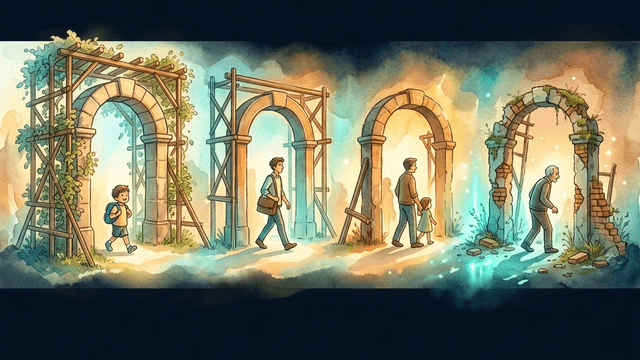
I call this the Scaffolding Theory because it explains why every major life transition feels like ADHD suddenly got worse — when really, another layer of external support just got removed.
Stage 1: Childhood — Maximum Scaffolding
- Parents manage your schedule, wake you up, remind you to do homework
- Teachers provide structured environments with clear deadlines
- Activities are time-limited and externally monitored
- Consequences for executive dysfunction are low (bad grades, not bankruptcy)
What you think: "I'm disorganized but it's manageable." What's actually happening: Other people are doing your executive function for you.
Stage 2: College — First Scaffolding Collapse
- No one wakes you up for class
- Assignments span weeks or months with no check-ins
- You manage your own food, sleep, social life, and finances for the first time
- The curriculum rewards self-directed learning
What you think: "College is harder. I'm struggling more." What's actually happening: You're doing tasks that require sustained executive function for the first time without parental scaffolding. The ADHD was always there — it just didn't have room to show its full scope.
This is where many women first notice something is wrong. Throughout school, masking and compensatory strategies may have hidden the underlying executive dysfunction. Without the school structure, the mask cracks.
Stage 3: Career — Second Collapse
- Open-ended projects with ambiguous deliverables
- Self-managed time (especially in remote work)
- Political navigation requires sustained attention to social cues
- Multiple competing priorities with no clear hierarchy
What you think: "I can't keep up with my peers. Something is wrong with me." What's actually happening: Your peers don't need external structure to initiate tasks, track deadlines, and sustain attention. You do — and the workplace doesn't provide it.
Stage 4: Family/Midlife — Final Collapse
- You're now the scaffolding for other people (children, aging parents)
- Administrative load explodes (insurance, school forms, medical appointments, bills)
- There's no downtime — the executive function demands are 24/7
- Hormonal changes (especially perimenopause) directly affect dopamine and estrogen, both of which modulate ADHD symptoms
What you think: "My ADHD is definitely getting worse." What's actually happening: You've hit maximum cognitive demand with minimum remaining support. The gap between what your executive function can handle and what life requires has never been wider.
The Hormonal Factor: Why Women Experience This Differently
This section matters enormously and is chronically underrepresented in ADHD literature.
Estrogen modulates dopamine synthesis and receptor sensitivity (Shanmugan & Epperson, 2014). When estrogen levels are stable, they partially compensate for ADHD-related dopamine deficits. When estrogen drops — during the luteal phase of the menstrual cycle, postpartum, and especially perimenopause — that compensation evaporates.
This is why many women report:
- ADHD symptoms worsening in the week before their period
- A dramatic increase in executive dysfunction postpartum
- A feeling of "losing their mind" during perimenopause — when what they're actually losing is the estrogen-mediated dopamine support that was masking their ADHD
A 2021 review in Frontiers in Psychiatry confirmed that hormone fluctuations significantly impact ADHD symptom severity in women, yet this interaction is rarely assessed in clinical settings. Many women in their 40s-50s are diagnosed with depression or early cognitive decline when the real issue is undiagnosed ADHD unmasked by hormonal changes.
(If you're recognizing these patterns in yourself, our ADHD Signs in Women guide breaks down the presentation differences that most screening tools miss.)
What to Do When It Feels Like ADHD Is Getting Worse
1. Audit Your Current Scaffolding
List every external support that helps you function — automated reminders, a partner who tracks appointments, a workplace with structure. Then identify what's changed recently. A new job? A breakup? A move? A child? Each one may have removed scaffolding you didn't realize you were relying on.
2. Rebuild Scaffolding Deliberately
The scaffolding that childhood provided naturally — you now need to build intentionally:
- Calendar systems that alert you (not ones you have to check)
- Body doubling for tasks you chronically avoid (how body doubling works)
- Automated bill pay for every possible expense
- Visible reminders (if it's not in your line of sight, it doesn't exist — out of sight, out of mind)
3. Re-evaluate Your Medication
If you were diagnosed as a child and your medication hasn't been adjusted since, it may be inadequate for adult demands. The dose that worked for a student with 4-5 classes a day may not work for an adult managing a career, family, and household simultaneously. Talk to your prescriber about coverage duration and dosing.
For women specifically: discuss with your prescriber whether hormonal changes are affecting your medication efficacy. Some clinicians adjust ADHD medication during the luteal phase or during perimenopause — this is emerging practice, not yet standard, but based on sound pharmacological reasoning.
4. Reduce the Load (Not Just Manage It Better)
Sometimes the answer isn't better coping strategies — it's fewer demands. This is hard to hear in a culture that glorifies productivity, but for ADHD brains, the gap between capacity and demand is the source of burnout, shutdown, and depression.
Look honestly at your commitments: which ones can be delegated, eliminated, or reduced? Thawly can help you break down the overwhelming audit itself — because even "figure out what to cut from my life" is a task that requires executive function you may not have right now.
5. Process the Grief
This one doesn't show up in clinical recommendations, but it matters. If you were diagnosed late, there's a legitimate grief process involved: grief for the years you spent thinking you were lazy, disorganized, or stupid. Grief for the opportunities lost. Grief for the version of yourself that might have existed with early support.
That grief is valid. Don't skip it. A therapist experienced with late-diagnosed adult ADHD can guide this process — it's not indulgence, it's essential healing.
FAQ
Does ADHD actually get worse with age biologically?
The brain changes associated with ADHD — primarily reduced dopamine availability and impaired prefrontal cortex function — don't significantly worsen in most adults. What changes is the context: adult life demands far more executive function than childhood does. However, there is one biological factor: age-related cognitive decline in the PFC can compound existing ADHD deficits, making symptoms more noticeable in adults over 50. This is an area of active research.
Can ADHD appear for the first time in adulthood?
ADHD is a neurodevelopmental condition — by definition, it's present from childhood. But it can go unrecognized until adulthood, especially in women, in people with high IQs who compensated academically, and in people whose childhood environments provided enough scaffolding to mask the symptoms. "Late-onset ADHD" is almost always "late-recognized ADHD."
Why do I feel like my ADHD medication stopped working?
Several possibilities: life demands increased (more to manage = same medication covering less territory), hormonal changes altered your neurochemistry, tolerance developed (less common with stimulants than people think), or stress raised cortisol levels that counteract the medication's dopamine boost. A medication review with your prescriber — not a dose increase by default, but an honest assessment of what's changed — is the right move.
Does having children make ADHD worse?
Having children doesn't change your neurology, but it massively increases executive function demands while simultaneously eliminating your coping strategies (sleep deprivation, loss of personal time, sensory overload from small humans). For many parents with ADHD, the postpartum period is when the condition becomes truly unmanageable — and for many women, it's when they finally get diagnosed.
Sources
- Biederman, J. et al. (2010). Adult outcome of attention-deficit/hyperactivity disorder: A controlled 16-year follow-up study. Journal of Clinical Psychiatry, 71(6), 713-726.
- Faraone, S.V. et al. (2006). The age-dependent decline of attention deficit hyperactivity disorder: A meta-analysis of follow-up studies. Psychological Medicine, 36(2), 159-165.
- Shanmugan, S. & Epperson, C.N. (2014). Estrogen and the prefrontal cortex: Towards a new understanding of estrogen's effects on executive functions in the menopause transition. Human Brain Mapping, 35(3), 847-865.
- Volkow, N.D. et al. (2009). Evaluating dopamine reward pathway in ADHD. JAMA, 302(10), 1084-1091.
- Barkley, R.A. (2015). Attention-Deficit Hyperactivity Disorder: A Handbook for Diagnosis and Treatment (4th ed.). Guilford Press.
- Hinshaw, S.P. & Ellison, K. (2015). ADHD: What Everyone Needs to Know. Oxford University Press.
- Young, S. et al. (2021). Females with ADHD: An expert consensus statement. BMC Psychiatry, 20(1), 404.

Sean Z. holds a Master's degree in Cognitive Psychology. He spent 7 years in academic research focused on human cognition, followed by 10+ years designing products and services in the applied psychology space. He built Thawly after years of firsthand experience with ADHD task paralysis — combining academic understanding of executive function with the daily reality of living with it. About the Author → LinkedIn
Looking for more specific strategies?
Explore 115+ targeted tools for specific ADHD scenarios.
Browse the ADHD Toolkit →