Emotionally Paralyzed: Why You Can't Feel, Think, or Move
Disclaimer: This article is for informational and educational purposes only. It is not a substitute for professional medical advice, diagnosis, or treatment. If you suspect you have ADHD, please consult a qualified healthcare provider.
Emotional paralysis is a dorsal vagal nervous system state where emotional overload causes your brain to enter conservation mode — you feel nothing, think nothing, and cannot initiate any action. It differs from depression (which involves persistent low mood) and anxiety (which involves excessive worry). Emotional paralysis is a protective shutdown triggered when emotional input exceeds processing capacity, driven by the same autonomic mechanisms described in Porges' Polyvagal Theory.
There's a state worse than sadness. Worse than anxiety. Worse than anger. It's the state where you feel nothing at all — and that nothing is so heavy it pins you in place.
You're lying on your bed at 2 PM on a Saturday. The blinds are closed. Your phone is somewhere under a pillow. You haven't eaten, but you're not hungry. You haven't showered, but you don't care. You had plans — you actually wanted to go — and you cancelled via text with a one-word excuse you don't even remember typing.
You're not depressed. (Or maybe you are — you can't tell anymore.) You're not panicking. You're not ruminating. You're just... blank. Like someone pulled the plug on your emotional circuitry and forgot to plug it back in.
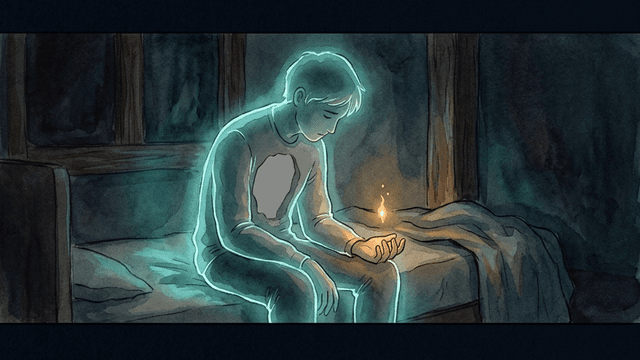
This is emotional paralysis. And if "paralysis" feels dramatic for what you're experiencing, that's exactly the problem — it doesn't feel like anything. It looks like laziness from the outside and feels like emptiness from the inside, and both descriptions are wrong.
What Emotional Paralysis Actually Is
Emotional paralysis is a state of affective shutdown where your capacity to feel, process, and respond to emotions drops to near-zero. It's not the absence of feelings — it's the suppression of feelings by a nervous system that has decided feeling things is too dangerous or too expensive.
Two primary mechanisms drive it:
The Dorsal Vagal Shutdown
Stephen Porges' Polyvagal Theory (2011) describes three states of the autonomic nervous system. When the dorsal vagal complex activates, it produces conservation behavior — low heart rate, muscle slackness, emotional blunting, cognitive fog. This is the same mechanism behind ADHD freeze, but at an emotional rather than behavioral level. Your body isn't just frozen in space — your emotional processing system is frozen too.
Emotional Overwhelm → Circuit Breaker Trip
Your brain has a finite capacity for emotional processing. When incoming emotions exceed that capacity — stacked stress, accumulated grief, chronic pressure, unresolved conflict — the limbic system doesn't crash gracefully. It trips a circuit breaker. Everything goes flat. The numbness isn't a choice. It's a protection mechanism.
For ADHD brains, this threshold is lower. Barkley (2015) identified emotional dysregulation as a core feature of ADHD — not a side effect, not a comorbidity. ADHD emotions are bigger, faster, and harder to manage. Which means the circuit breaker trips more often, at lower thresholds, and sometimes in response to things that seem "fine" from the outside.
How Emotional Paralysis Differs from Depression
This confusion causes real harm. People in emotional paralysis get told they're depressed, given SSRIs, and wonder why the medication "isn't working." Here's the distinction:
| Feature | Depression | Emotional Paralysis |
|---|---|---|
| Duration | Weeks to months (persistent) | Hours to days (episodic) |
| Trigger | Often no clear trigger | Usually follows overwhelm or emotional flooding |
| Self-talk | "Nothing matters" (hopelessness) | "I can't access how I feel" (disconnection) |
| Motivation | Don't want to do things | Want to want, but feel nothing about anything |
| Physical state | Fatigue, sleep changes | Numbness, heaviness, flat affect |
| Recovery pattern | Gradual, requires treatment | Often resolves when the emotional load decreases |
Depression can cause emotional paralysis, and emotional paralysis can trigger depression. They're interconnected but not identical. The treatment approach differs significantly.
Stuck on something right now?
Stop reading about it — try it. Thawly breaks your task into one tiny step you can do right now.
Free · No signup · 3 seconds5 Signs You're Emotionally Paralyzed (Not "Just Tired")
1. You Cancel Things You Actually Wanted to Do
Not out of laziness or anxiety — but because you can't summon any feeling about the event in either direction. The concert you were excited about last week? You feel nothing about it now. Not dread, not anticipation. Absolute neutrality. And neutrality isn't enough fuel to get dressed and leave the house.
2. Someone Asks "How Are You?" and You Genuinely Don't Know
Not in the "I'm fine" polite-deflection way. You actually can't locate an emotion to report. Your internal dashboard is dark. You search for "happy" — nothing. "Sad" — nothing. "Anxious" — sort of, but more like a memory of anxiety than actual anxiety. You say "I'm okay" because it's the closest to accurate.
3. Your Body Feels Physically Heavy
Emotional paralysis isn't just mental. The dorsal vagal activation produces real physiological changes: lowered heart rate, reduced muscle tone, slower digestion. Your body literally feels like it weighs more. Getting off the couch requires effort that seems wildly disproportionate to the physical distance involved.
4. Time Stops Making Sense
Hours pass without registration. You look at the clock and it says 5 PM and you're certain it was just noon. This isn't ADHD time blindness (though they compound). It's dissociative time distortion — your brain reduces conscious processing to conserve resources, and time perception is one of the first things to go.
5. Small Decisions Feel Impossible
What to eat. Whether to shower. Which shirt to put on. The decision itself isn't hard — your brain just can't generate the emotional signal that says "I prefer this one." Without emotional input, decisions feel like solving equations with no variables. There's nothing to calculate with.
(Stuck in the decision void right now? The Decision Paralysis Tool cuts through the noise — it doesn't need your emotions to work. Just your input.)
How to Come Back Online
These strategies are designed for the specific neurological state of emotional shutdown. They work bottom-up (body → brain), not top-down (thoughts → feelings), because your thinking brain is partially offline.
1. Temperature Change
Your nervous system responds to temperature more directly than to thoughts. Take a cold shower — or just splash cold water on your face and wrists. The mammalian dive reflex stimulates the vagus nerve and nudges the autonomic nervous system from dorsal vagal (shutdown) toward ventral vagal (engagement).
If cold is too much: hold a warm mug. The warmth activates a different vagal pathway but still sends "present moment" signals to the brain.
2. Bilateral Stimulation
Alternate tapping your left and right knees, or cross your arms and tap your shoulders alternately. Left-right-left-right, slowly, for 2 minutes.
This is the mechanism behind EMDR therapy, simplified. Bilateral stimulation activates both brain hemispheres and promotes emotional processing that got stuck in the shutdown. You don't need to be in therapy for it to work as a self-regulation tool.
3. Name One Micro-Feeling
You might not be able to identify a "big" emotion. But can you find a micro-feeling?
- "I feel a slight heaviness in my chest."
- "My hands feel cold."
- "I notice I'm a little irritated by the light in this room."
Any sensory or emotional fragment counts. Naming it activates the prefrontal cortex just enough to begin reprocessing. You're not looking for "I feel happy" — you're looking for "I feel anything."
4. One Physical Task — No Thinking Required
Don't try to do something that matters. Do something purely physical and mindless: fold one towel, wash one dish, water one plant. The movement re-engages proprioceptive circuits that feed back into emotional awakening. Your body can lead your brain out of shutdown if your brain can't lead itself.
(Need someone else to pick that first physical thing for you? Thawly generates a single, absurdly small action based on whatever you type in. Try typing "I feel stuck and can't do anything.")
5. Human Contact (Even Minimal)
Send one text. Not about how you feel — just any text. "Hey." "What's up." "Did you see that thing about [topic]."
Co-regulation — the process of one nervous system calming another — is Polyvagal Theory's most powerful intervention. You don't need a deep conversation. The act of connecting to another person's nervous system through language sends a ventral vagal safety signal that your own system can't generate alone.
When Emotional Paralysis Needs Professional Help
Episodic emotional paralysis that resolves within hours and happens occasionally? That's within the normal range for ADHD and high-sensitivity nervous systems.
But seek help if:
- Episodes last multiple days and you can't break out
- You're dissociating — feeling detached from your own body or reality
- The numbness is replacing all emotions, including positive ones, for extended periods
- You're using substances to break the paralysis (alcohol, drugs to "feel something")
- You're having thoughts of self-harm as a way to break the numbness
A therapist trained in somatic experiencing, EMDR, or polyvagal-informed therapy can address the nervous system dysregulation directly. If ADHD is in the picture, coordinating with a psychiatrist to ensure your medication adequately supports emotional regulation is also important.
FAQ
Is emotional paralysis the same as emotional numbness?
They overlap heavily. Emotional numbness is the subjective experience ("I can't feel anything"). Emotional paralysis includes the behavioral component — you can't feel, AND you can't act, decide, or engage. Numbness is the inner experience; paralysis is what it does to your outer functioning.
Can emotional paralysis happen in relationships?
Very commonly. Emotional flooding during conflict (ADHD's emotional dysregulation + relationship stress) can trigger immediate shutdown. Your partner is expressing something important, and you go completely blank — not because you don't care, but because your nervous system has been overwhelmed. This gets misread as stonewalling or indifference, which escalates the conflict, which deepens the shutdown. It's one of the most damaging ADHD-relationship patterns.
Why does emotional paralysis feel worse than sadness?
Because sadness is a signal — it tells you what you've lost, what matters, what needs grieving. Emotional paralysis removes the signal entirely. You're left with no compass, no direction, no framework for understanding what's happening to you. Sadness connects you to your values. Numbness disconnects you from everything.
Is emotional paralysis related to burnout?
Often, yes. ADHD burnout is chronic nervous system depletion from years of overcompensating for executive dysfunction. Emotional paralysis is frequently one of burnout's final stages — your system has been running on empty for so long that it stops producing emotional responses altogether. The gradual process of getting there — the slow dimming before the full blackout — is what's called ADHD shutdown. If your emotional paralysis co-occurs with exhaustion, cynicism, and reduced performance, burnout is the likely context.
Sources
- Porges, S.W. (2011). The Polyvagal Theory. W.W. Norton.
- Barkley, R.A. (2015). Attention-Deficit Hyperactivity Disorder: A Handbook for Diagnosis and Treatment (4th ed.). Guilford Press.
- Dana, D. (2018). The Polyvagal Theory in Therapy. W.W. Norton.
- Van der Kolk, B. (2014). The Body Keeps the Score. Penguin Books.
- Shapiro, F. (2017). Eye Movement Desensitization and Reprocessing (EMDR) Therapy. Guilford Press.

Sean Z. holds a Master's degree in Cognitive Psychology. He spent 7 years in academic research focused on human cognition, followed by 10+ years designing products and services in the applied psychology space. He built Thawly after years of firsthand experience with ADHD task paralysis — combining academic understanding of executive function with the daily reality of living with it. About the Author → LinkedIn
Looking for more specific strategies?
Explore 115+ targeted tools for specific ADHD scenarios.
Browse the ADHD Toolkit →