Stress Paralysis: Why Your Brain Shuts Down Under Pressure
Disclaimer: This article is for informational and educational purposes only. It is not a substitute for professional medical advice, diagnosis, or treatment. If you suspect you have ADHD, please consult a qualified healthcare provider.
Stress paralysis occurs when elevated cortisol from high-stakes situations shuts down the prefrontal cortex, leaving you unable to think clearly, prioritize, or take action. Arnsten (2009) showed that even moderate stress causes the PFC to go offline, handing control to the amygdala. For ADHD brains, which already operate with reduced PFC capacity, the threshold for stress-induced shutdown is significantly lower — meaning deadlines and pressure often trigger paralysis rather than motivation.
The presentation is in four hours. I've known about it for two weeks. I have twelve slides to build. I've built zero.
I'm not watching Netflix. I'm not scrolling. I'm sitting at my desk, staring at PowerPoint's blank white rectangle, while my heart rate does something uncomfortable and my stomach produces a sensation I can only describe as "internal screaming."
I know what I need to do. Open the slide. Type a title. Find the data. I've made hundreds of presentations. This isn't new. This isn't hard.
But pressure has a way of turning "not hard" into "absolutely impossible." Because pressure doesn't help your brain work better. Past a certain point, it makes your brain stop working altogether.
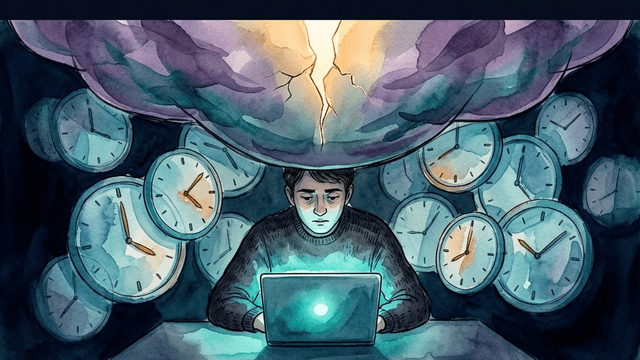
This is stress paralysis. And if you've ADHD, you probably know it intimately.
What Happens in Your Brain During Stress Paralysis
The relationship between stress and performance follows what psychologists call the Yerkes-Dodson curve — an inverted U. A little stress improves performance (you're alert, focused, energized). Too much stress tanks it. And for ADHD brains, the "too much" threshold is set dramatically lower than average.
Here's the neurochemical sequence:
Step 1: A stressor arrives (deadline, confrontation, high-stakes task). Your amygdala detects it and triggers the hypothalamic-pituitary-adrenal (HPA) axis.
Step 2: Cortisol floods the system. In moderate amounts, cortisol sharpens attention. In excess, it does the opposite — Arnsten (2009) showed that high cortisol levels cause the prefrontal cortex to essentially go offline. The PFC is where you plan, prioritize, sequence, and initiate. When it shuts down, those capacities go with it.
Step 3: With the PFC offline, the amygdala takes over. The amygdala only has three modes: fight, flight, or freeze. For most people with stress paralysis, the answer is freeze. You sit at your desk, fully aware of what's needed, completely unable to begin.
Step 4: The paralysis itself becomes a stressor. You notice you're frozen. You calculate the shrinking time window. This adds more cortisol. The PFC goes further offline. The freeze deepens.
This is why "just push through" doesn't work. You're not fighting laziness. You're fighting a cortisol-mediated neurological shutdown.
Why ADHD Makes Stress Paralysis Worse
ADHD brains are particularly vulnerable to stress paralysis for three compounding reasons:
1. Lower Baseline PFC Function
The ADHD prefrontal cortex already operates with reduced dopamine (Volkow et al., 2009). It requires less cortisol to push it past the shutdown threshold. Where a neurotypical brain might handle a tight deadline with heightened focus, an ADHD brain hits the cortisol ceiling faster and crashes harder.
2. Emotional Dysregulation Amplifies the Stress Signal
Barkley (2015) identified emotional dysregulation as a core — not secondary — feature of ADHD. This means the emotional response to a stressor is disproportionate to the stressor itself. A tight deadline doesn't just feel stressful. It feels catastrophic. And a catastrophic emotional signal produces a catastrophic cortisol response.
3. The Accumulated Wall of Awful
Every past deadline you missed, every project that fell apart, every time someone expressed disappointment in your reliability — those memories don't fade. They stack into what ADHD educator Brendan Mahan calls the Wall of Awful. When a new stressor arrives, you're not just facing the current pressure. You're facing current pressure + the accumulated emotional weight of every similar past failure.
Stuck on something right now?
Stop reading about it — try it. Thawly breaks your task into one tiny step you can do right now.
Free · No signup · 3 seconds5 Strategies to Break Stress Paralysis
These are designed to work during the shutdown, when your PFC is offline and willpower is unavailable.
1. The Physiological Sigh
This is the single fastest scientifically-validated way to reduce cortisol in the moment. Take two sharp inhales through the nose (fill your lungs, then top them off with a second sniff), followed by one long exhale through the mouth.
Huberman Lab's research (2023) showed that this specific breathing pattern — called a "physiological sigh" — activates the parasympathetic nervous system more rapidly than any other breathing technique. One cycle takes 5 seconds. Do 2-3 rounds. You should feel your heart rate drop within 30 seconds.
2. Shrink the Time Horizon
Your brain is paralyzed because it's looking at the entire task + the deadline + the consequences. Collapse the time horizon to the next 5 minutes. Not "finish the presentation by 3 PM." Just: "For the next 5 minutes, write anything on Slide 1."
This works because the PFC can sometimes handle micro-planning even when it can't handle macro-planning. Five minutes of imperfect action creates momentum, and momentum is its own dopamine source.
(Can't even figure out what the 5-minute action should be? That's the point of Thawly — it generates the smallest possible starting action for you.)
3. Change Your Physical State
Stress paralysis lives in your body, not just your brain. The freeze response is a physiological state — your muscles tighten, your breathing shallows, your digestion slows. Override it physically:
- Stand up and stretch for 60 seconds
- Splash cold water on your face
- Go outside for 2 minutes (literally just step outside and come back)
- Clench your fists hard for 10 seconds, then release
You're not doing exercise. You're sending counter-signals to the autonomic nervous system that break the freeze pattern. The more sudden and physical the interruption, the more effective it is.
4. Narrate Out Loud
Open your mouth and say exactly what's happening:
"I'm stressed about the presentation. My brain is frozen. The next thing I'm going to do is open PowerPoint and type a title."
Speaking activates Broca's area (speech production) and the motor planning system simultaneously. It converts an abstract intention into a physical motor sequence. Sometimes the motor sequence that starts with your mouth carries over to your hands.
(This technique is also powerful for ADHD freeze states — it bypasses the PFC entirely.)
5. Body Double — Immediately
Call someone. Not to talk about the task. Just to exist on the line while you work. "Hey, can you stay on the phone while I start this thing? You don't have to say anything."
Co-regulation — the process of one calm nervous system calming another — is one of the most underrated anti-paralysis tools. Porges' Polyvagal Theory (2011) shows that the human voice activates the ventral vagal system, signaling safety to your nervous system. You borrow their regulation while yours is offline.
The Paradox of Urgency
Here's the cruelest thing about stress paralysis with ADHD:
ADHD brains often need urgency to function. The adrenaline spike of a looming deadline is sometimes the only thing that can override the dopamine deficit and force the PFC online. Many adults with ADHD report that they do their best work "under the gun."
But there's a threshold. Below it, urgency is activating. Above it, urgency is paralyzing. And you don't know where the line is until you've crossed it.
The goal isn't to eliminate stress (impossible and counterproductive). It's to keep stress below the paralysis threshold while still harnessing its activating properties. That's what the micro-strategies above are doing — they're not removing the pressure, they're lowering the cortisol enough for your PFC to come back online and actually use the urgency as fuel.
FAQ
Is stress paralysis the same as burnout?
No. Stress paralysis is an acute response — it has a beginning and an end, usually tied to a specific stressor. ADHD burnout is a chronic state of depletion from sustained overcompensation. Think of stress paralysis as a circuit breaker tripping and burnout as the entire electrical system wearing out. Burnout can make stress paralysis happen more frequently and at lower stress levels because your reserves are already depleted.
Can stress paralysis happen with positive events?
Yes — and this confuses people. Planning a wedding, starting a dream job, moving to a city you love. Positive events can produce the same cortisol-mediated PFC shutdown because the overwhelm isn't about whether the event is "good" or "bad" — it's about the number of decisions, changes, and executive function demands it creates. Many people experience severe paralysis during objectively exciting life changes.
Does medication help with stress paralysis?
Stimulant medication raises baseline PFC function, which means it takes more cortisol to push the PFC past the shutdown threshold. Many adults report that medication doesn't eliminate stress paralysis but raises the ceiling significantly — they can handle more pressure before crashing. For anxiety-driven stress paralysis, a combination approach may be more effective.
Why do I perform well in crises but freeze over small deadlines?
Because different stress levels hit different neurochemical systems. A true crisis (car accident, medical emergency) produces adrenaline — which bypasses dopamine requirements entirely and activates the PFC through a different pathway. A small deadline produces cortisol without sufficient adrenaline, meaning your PFC gets shut down without the emergency override. It's actually the medium-stakes situations that are hardest for ADHD brains, not the high-stakes ones.
Sources
- Arnsten, A.F. (2009). Stress signalling pathways that impair prefrontal cortex structure and function. Nature Reviews Neuroscience, 10(6), 410-422.
- Volkow, N.D. et al. (2009). Evaluating dopamine reward pathway in ADHD. JAMA, 302(10), 1084-1091.
- Barkley, R.A. (2015). Attention-Deficit Hyperactivity Disorder: A Handbook for Diagnosis and Treatment (4th ed.). Guilford Press.
- Porges, S.W. (2011). The Polyvagal Theory. W.W. Norton.
- Huberman, A.D. et al. (2023). Brief structured respiration practices enhance mood and reduce physiological arousal. Cell Reports Medicine, 4(1), 100895.
- Yerkes, R.M. & Dodson, J.D. (1908). The relation of strength of stimulus to rapidity of habit-formation. Journal of Comparative Neurology and Psychology, 18(5), 459-482.
Try These Targeted Tools
If you're struggling right now, these scenario-specific tools can help you take the first step:
- ADHD Deadline Panic at Work — Get instant micro-steps tailored to this specific situation.
- ADHD Burnout Recovery Tool — Get instant micro-steps tailored to this specific situation.
- ADHD Anxiety Loop Breaker — Get instant micro-steps tailored to this specific situation.

Sean Z. holds a Master's degree in Cognitive Psychology. He spent 7 years in academic research focused on human cognition, followed by 10+ years designing products and services in the applied psychology space. He built Thawly after years of firsthand experience with ADHD task paralysis — combining academic understanding of executive function with the daily reality of living with it. About the Author → LinkedIn
Looking for more specific strategies?
Explore 115+ targeted tools for specific ADHD scenarios.
Browse the ADHD Toolkit →