Why Is Task Initiation So Hard? The 4 Hidden Barriers Your Brain Won't Tell You About
Disclaimer: This article is for informational and educational purposes only. It is not a substitute for professional medical advice, diagnosis, or treatment. If you suspect you have ADHD, please consult a qualified healthcare provider.
You've been sitting here for — you check the clock — forty-seven minutes. The task is clear. You wrote it on a sticky note this morning. You even circled it. Twice.
It's not complicated. Fifteen minutes of work, tops. You've done harder things before breakfast. But your body won't move. Your cursor blinks. The room is silent and the silence is deafening because somewhere in the back of your skull, a voice is screaming "WHY WON'T YOU JUST START?"
If you've never experienced this, you probably think it sounds dramatic. If you have experienced this, you probably teared up a little reading it.
Task initiation is hard. Not "kind of challenging" hard — neurologically, structurally, devastatingly hard for certain brains. And the cruelest part is that nobody can see it. You look fine. You look like someone choosing not to work. But inside, you're clawing at a wall that shouldn't exist.
Here's why that wall exists — and what it's actually made of.
Barrier 1: The Dopamine Prediction Error
Your brain runs a prediction engine. Before you start any action, your prefrontal cortex estimates: "How much reward will this produce? Is it worth the energy cost?"
For neurotypical brains, this calculation completes in milliseconds. "Email = boring but necessary = mild satisfaction when done = worth starting." The "go" signal fires. Task begins.
For ADHD brains, this calculation stalls. Volkow et al. (2009) demonstrated that adults with ADHD have significantly lower dopamine receptor availability in the brain's reward circuits. The prediction engine runs — but the estimated reward is too low. The "go" signal never reaches threshold.
This is not a choice. This is a neurochemical computation that returns "insufficient justification to begin" — and your motor system obeys the result.
Think of it this way: your brain is running a cost-benefit analysis on every task, and the "benefit" column is systematically undervalued due to hardware limitations. The task isn't different. The evaluation system is.
This is why you can't start the email but you can start the video game. The game produces immediate, high-certainty dopamine. The email produces delayed, uncertain, low-magnitude reward. Same brain, radically different dopamine predictions.
Barrier 2: The Decision Stack
Here's something most people — including most clinicians — don't recognize: "starting a task" isn't one action. It's a stack of micro-decisions, each requiring executive processing.
When you say "I need to start the report," your brain actually needs to:
- Select the task from competing priorities
- Locate the relevant materials
- Plan the first section
- Determine the first sentence
- Initiate the motor sequence (typing, writing, clicking)
Each of these is a separate executive function demand. And here's the killer: they must execute sequentially — you can't do step 5 without completing steps 1-4 first.
For someone with intact executive function, this stack resolves automatically and below conscious awareness. For someone with executive dysfunction, each step requires deliberate, effortful processing. By the time you've made it through steps 1-3, you've exhausted the cognitive resources needed for step 5.
The solution isn't "start" — it's "pre-resolve the decision stack."
Pre-select the task. Pre-locate the materials. Pre-plan the opening. Pre-determine the first sentence. Write it all down the night before. Tomorrow, the only thing left is step 5 — pure motor initiation — which has the lowest cognitive demand.
Gollwitzer and Sheeran (2006) demonstrated that pre-loading decisions increases follow-through by 65%. For ADHD adults, I'd argue it's even more than that — because the baseline decision-processing capacity is lower, eliminating decisions produces a proportionally larger benefit. (This is the core principle behind implementation intentions — and it's built into every Thawly interaction.)
Stuck on something right now?
Stop reading about it — try it. Thawly breaks your task into one tiny step you can do right now.
Free · No signup · 3 secondsBarrier 3: The Emotional Moat
This is the barrier nobody talks about in productivity content — and it might be the biggest one.
Every task you've previously failed to start doesn't just disappear from memory. It leaves emotional residue. An email isn't just an email — it's the email you were supposed to send last Tuesday, plus the one from three weeks ago you never replied to, plus the slowly accumulating evidence that you're the kind of person who can't handle basic communication.
Brown (2013) identified emotional regulation as a core ADHD deficit — not a secondary symptom. This means the emotional loading on tasks isn't just "feelings" — it's a neurological barrier that's as real as the dopamine deficit.
The emotional moat works like this:
- You failed to start a task previously → shame accumulates
- You encounter the same type of task → shame activates as anticipatory anxiety
- The anxiety raises the activation threshold → you now need more dopamine to start than you would have needed without the emotional loading
- You fail again → more shame → higher threshold next time
- Cycle repeats → eventually, certain task categories become essentially impossible to initiate
This is why some people can run a business but can't open their mail. The type of task triggers specific emotional associations that create category-specific initiation barriers.
Breaking the moat:
- Name the emotion, not the task: "I'm feeling shame about past emails" is more actionable than "I can't do emails"
- Separate the task from its history: This specific email has never been failed before. It's new. Treat it as new.
- Start with the smallest possible action: Not "reply to the email" — "open the email and read it." Reading isn't failing. Reading is neutral. Once you've read it, reply becomes easier.
(Stuck in this cycle? Our Task Avoidance Bypass is specifically designed for emotionally loaded tasks.)
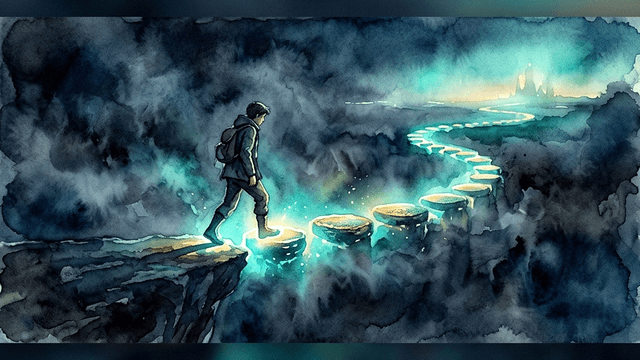
Barrier 4: The Transition Cost
Your brain doesn't switch between activities for free. Every context switch — from scrolling to working, from resting to doing, from one task to a different one — incurs a cognitive toll.
Monsell (2003) documented what researchers call "switch costs": measurable increases in reaction time and error rates that occur after task switches. These costs exist for everyone, but they're amplified in ADHD brains because the executive system responsible for managing transitions is the same one that's already impaired.
The practical impact:
- Switching from "sitting on the couch" to "working at the desk" isn't just a physical move — it's a complete cognitive context switch that requires loading new goals, new rules, new expectations into working memory
- The switch itself is an initiation event — and it's happening before the actual task initiation
- You're essentially paying the initiation cost twice: once to switch contexts, and once to start the task
This is why people with ADHD can work for hours once they're going but can't restart after a break. The transition cost of returning to work is another initiation barrier — and after a break, the task context has been flushed from working memory, requiring a complete reload.
Minimizing transition costs:
- Don't take breaks between tasks — take breaks after completing a task block. The break-and-return cycle doubles your initiation costs.
- Use transition rituals: A 2-3 minute routine (make tea → headphones → open file) that bridges "not working" and "working" without requiring cold initiation
- Batch similar tasks: Email-email-email is one context. Email-report-email is three contexts and two costly switches.
- Never close what you'll need tomorrow: Leave the document open. Leave the tab loaded. Reduce the reload cost to zero.
Why Understanding This Matters
Knowing why task initiation is hard doesn't automatically make it easier. I'm living proof of that — I can cite every paper in this article and I still spend some mornings frozen at my desk.
But understanding replaces shame with accuracy.
"I'm lazy" is shame. "My dopamine prediction system is undervaluing this task's reward signal" is accuracy. The second version doesn't feel great either — but it points toward solutions instead of character assassination.
And the solutions exist. Micro-steps bypass the dopamine threshold. Implementation intentions pre-resolve the decision stack. Emotional naming loosens the moat. Transition rituals reduce switch costs.
None of them work every time. All of them work more often than "just try harder."
That's the whole game, really. Not fixing the brain. Not eliminating the barriers. Just finding enough tools to get past them often enough to build a life that works — imperfectly, inconsistently, but genuinely.
What Actually Gets Me Moving
I'll be honest: my answer changes week to week. The ADHD brain loves novelty, which means any strategy that works brilliantly for two weeks might stop working on day fifteen.
Right now, my most reliable combination is:
- Night before: Write tomorrow's first action on a sticky note (pre-resolve decision stack). Leave the relevant document open (minimize transition cost).
- Morning: Coffee. This is my transition ritual — I don't work without it, and I don't drink it without working. They're paired.
- Micro-step: Hands on keyboard. Type one sentence. That's the entire commitment.
- Thawly fallback: On days when even the sticky note doesn't work, I open Thawly and let it give me the first micro-step. Outsourcing the initiation decision to an external system removes the last barrier.
This works about 4 out of 5 mornings. The fifth morning, I let go. One failed morning in five isn't a pattern — it's a bad brain day. They happen. They pass.
FAQ
Why is task initiation so hard even for simple tasks?
Because task complexity isn't what determines initiation difficulty — dopamine prediction is. A simple task with low reward salience (sending a boring email) can be harder to start than a complex task with high reward salience (building something new). Your brain doesn't evaluate difficulty; it evaluates reward. Low-reward tasks are hardest to start regardless of their actual complexity.
Is difficulty with task initiation always ADHD?
No. Depression, anxiety, chronic fatigue, autism, and even severe stress can impair task initiation. However, ADHD is the most common cause of chronic, pervasive task initiation difficulty in otherwise healthy adults. If this is a consistent pattern across multiple life domains, a professional evaluation is worthwhile.
Why can I start tasks at the last minute but not before?
Because deadline proximity creates urgency, which floods your system with norepinephrine — temporarily compensating for the dopamine deficit. Your brain's emergency response system does what your normal activation system can't. This isn't a strategy; it's your brain treating every deadline as a crisis. And it has a cost: burnout, chronic stress, and the accumulated damage of living in perpetual crisis mode.
Does task initiation get easier with practice?
The underlying neurological barrier doesn't change with practice — but your compensatory strategies become more automatic over time. You'll still need external scaffolding, but you'll deploy it faster and with less conscious effort. The goal isn't to fix the brain; it's to build a personal system that compensates for its specific weak points.
What should I do RIGHT NOW if I can't start a task?
Stand up. Walk to the location where the task happens. Touch the first object you'd need to use. That's it — three physical movements. Don't commit to the task. Just commit to the movements. Your brain will close the open loop about 80% of the time. If it doesn't — that's a zero day. Drink water. Try again tomorrow.
Sources
- Brown, T.E. (2013). A New Understanding of ADHD in Children, Adolescents, and Adults: Executive Function Impairments. Routledge.
- Fogg, B.J. (2019). Tiny Habits: The Small Changes That Change Everything. Houghton Mifflin Harcourt.
- Gollwitzer, P.M. & Sheeran, P. (2006). Implementation intentions and goal achievement: A meta-analysis. Advances in Experimental Social Psychology, 38, 69-119.
- Monsell, S. (2003). Task switching. Trends in Cognitive Sciences, 7(3), 134-140.
- Volkow, N.D. et al. (2009). Evaluating dopamine reward pathway in ADHD. JAMA, 302(10), 1084-1091.

Sean Z. holds a Master's degree in Cognitive Psychology. He spent 7 years in academic research focused on human cognition, followed by 10+ years designing products and services in the applied psychology space. He built Thawly after years of firsthand experience with ADHD task paralysis — combining academic understanding of executive function with the daily reality of living with it. About the Author → LinkedIn
Looking for more specific strategies?
Explore 115+ targeted tools for specific ADHD scenarios.
Browse the ADHD Toolkit →