ADHD or Depression? How to Tell Which One Is Draining You
Disclaimer: This article is for informational and educational purposes only. It is not a substitute for professional medical advice, diagnosis, or treatment. If you suspect you have ADHD, please consult a qualified healthcare provider.
You haven't gotten out of bed for three hours. Not because you're tired — you slept nine hours. Not because you're sad — you don't feel much of anything. You just... can't start. The day feels like a wall and you're staring at it from under the covers.
Is this ADHD paralysis? Or depression?
The honest answer is that these two conditions share so much symptom overlap that even clinicians get it wrong. Kessler et al. (2006) found that 18.6% of adults with ADHD also meet criteria for major depressive disorder. And Biederman et al. (2008) showed that having ADHD triples your lifetime risk of developing depression.
But here's the part nobody talks about: ADHD and depression drain you through completely different mechanisms. Mixing up the cause means getting the wrong treatment — and the wrong treatment can make the other condition worse.
The Overlap Problem: Why It's So Confusing
Here's a side-by-side that makes therapists nervous:
| Symptom | ADHD | Depression |
|---|---|---|
| Can't start tasks | ✅ | ✅ |
| Low motivation | ✅ | ✅ |
| Brain fog | ✅ | ✅ |
| Sleep problems | ✅ | ✅ |
| Difficulty concentrating | ✅ | ✅ |
| Forgetfulness | ✅ | ✅ |
| Irritability | ✅ | ✅ |
Seven core symptoms. Shared by both. No wonder people spend years being treated for the wrong one.
But the mechanism underneath each symptom is completely different. And that's where the real diagnostic clues hide.
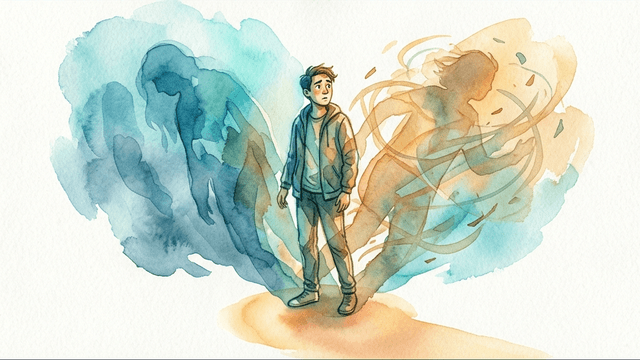
The Core Difference: Want-To vs Can-Do
The simplest way I've found to separate these two:
Depression kills the want-to. You don't care about the task. Nothing sounds appealing. The thing you used to love doing? You'd rather stare at a wall. Anhedonia — the inability to experience pleasure — is the defining feature. Your dopamine reward system isn't just low; it's flatlined (Treadway & Zald, 2011).
ADHD kills the can-do. You want to do the task. Maybe you're even excited about it. But the bridge between wanting and starting is broken. Your prefrontal cortex can't fire the go signal. The task sits there, mocking you, and you feel increasingly terrible about your inability to just do the thing (Barkley, 2015).
Here's the test I run on myself when I'm stuck:
Do I want to do this but physically can't start? → Probably ADHD. Do I not care whether I do this or not? → Possibly depression. Both? → Welcome to the comorbidity club. Membership is involuntary.
Stuck on something right now?
Stop reading about it — try it. Thawly breaks your task into one tiny step you can do right now.
Free · No signup · 3 seconds6 Diagnostic Clues That Separate Them
1. The Interest Test
ADHD: You can hyperfocus on something interesting for six hours straight while ignoring three urgent deadlines. Your attention isn't absent — it's unregulated.
Depression: Nothing sounds interesting. Not even the thing that consumed you last month. The entire reward system has gone quiet.
2. The Energy Pattern
ADHD: Your energy is chaotic — bursts of productivity at 11 PM, completely useless at 2 PM. The pattern is irregular, not consistently low.
Depression: Your energy is consistently low. Morning to night, Tuesday to Saturday. It doesn't spike at random — it just stays flat.
3. The Self-Talk
ADHD self-talk: "Why can't I just DO this? I'm so frustrated with myself. I know exactly what I need to do."
Depression self-talk: "What's the point? Nothing I do matters anyway. I'm not worth the effort."
The ADHD version has urgency and frustration. The depression version has resignation and emptiness.
4. The Onset Story
ADHD: You've always been like this. "I was the kid who lost every permission slip." "I've never been able to sit through a meeting." Symptoms started in childhood — even if nobody noticed at the time (APA, DSM-5, 2013).
Depression: There's usually a before and after. "I used to be able to do this." "Things changed after I lost my job." The onset is often linked to a life event or period of sustained stress.
5. The Movement Response
ADHD: Physical movement helps. Going for a walk, fidgeting, changing locations — these actually improve your ability to think and start tasks. Movement increases dopamine and norepinephrine (Ratey, 2008).
Depression: Movement feels like lifting concrete. The thought of exercise is exhausting, not energizing. Even though it helps clinically, the activation energy required feels insurmountable.
6. The Social Battery
ADHD: You might avoid social situations because of rejection sensitivity or overstimulation — but once you're there, you often enjoy it. Sometimes too much.
Depression: Social withdrawal comes from genuine disinterest. You don't want to be around people. Not because it's overwhelming — because nothing seems worth the effort.
When It's Both: The Comorbidity Trap
Here's the scenario I see most often — and the one I lived through:
- You have undiagnosed ADHD.
- You spend years failing at things neurotypical people do easily.
- The repeated failure creates a narrative: "I'm lazy. I'm broken. I can't do anything right."
- That narrative becomes depression.
This isn't depression or ADHD. It's depression because of ADHD. Biederman et al. (2008) called this "demoralization syndrome" — a secondary depression that develops specifically from the chronic frustration of living with untreated executive dysfunction.
The cruel irony? If you treat the depression alone — antidepressants, therapy focused on mood — the ADHD remains untreated, the failures continue, and the depression keeps coming back. You're treating the symptom while ignoring the engine that produces it.
(Feeling stuck in this loop right now? Our Brain Fog Bypass Tool can help you take the first step — even when everything feels impossible.)
I know this cycle personally. I spent two years in therapy for "depression" before anyone thought to screen me for ADHD. The depression was real — but it was a downstream effect, not the primary problem. Once the ADHD was addressed, the depression didn't vanish, but it stopped regenerating itself every time I missed a deadline.
What Actually Helps (Depending on What You Have)
If It's Primarily ADHD:
- Externalize your executive function: Use tools that break tasks into micro-steps and remove decision points. Thawly does this automatically — you type the task, it generates the "how."
- Implementation intentions: Pre-commit to specific If-Then plans so your brain doesn't have to generate the go signal.
- Body doubling: Work alongside someone else, even silently. The social accountability bypasses the initiation deficit.
- Movement before tasks: 10 minutes of walking before sitting down to work. Not negotiable.
If It's Primarily Depression:
- Behavioral activation: Start with absurdly small actions. Not "exercise for 30 minutes" but "put on shoes." The behavioral activation model (Martell et al., 2010) works by breaking the inertia loop.
- Professional support: SSRIs, therapy (particularly CBT or behavioral activation therapy), or both. Depression often has a biological component that self-help alone can't address.
- Social reconnection: Even brief, low-effort social contact. Text a friend. Sit in a coffee shop. Isolation feeds the cycle.
If It's Both:
- Address the ADHD first — or simultaneously. Safren et al. (2005) demonstrated that combining medication with cognitive-behavioral strategies produces significantly better outcomes than either alone.
- Get a comprehensive evaluation. Not a 15-minute screening. A proper neuropsychological evaluation that considers both conditions.
(Not sure which pattern fits you? Try our ADHD Task Paralysis Tool — it's designed for the executive function side, regardless of what's causing it.)
FAQ
Can ADHD cause depression?
Yes. Multiple longitudinal studies confirm that untreated ADHD significantly increases the risk of developing depression (Biederman et al., 2008). The mechanism is usually "demoralization" — chronic failure and frustration eroding self-worth over time.
Can depression look like ADHD?
Absolutely. Depression causes concentration problems, forgetfulness, low motivation, and difficulty starting tasks — all symptoms that overlap with ADHD. This is why proper differential diagnosis matters. The key distinction: ADHD symptoms are lifelong; depression symptoms typically have a more recent onset.
Should I treat ADHD or depression first?
If both are present, the current clinical consensus (supported by Safren et al., 2005) is to stabilize the depression if it's severe, then address the ADHD. If the depression is mild-to-moderate and likely secondary to ADHD, treating the ADHD often improves the depression simultaneously.
Can ADHD medication help with depression?
Some ADHD medications (particularly stimulants) can improve mood by increasing dopamine availability. However, they're not antidepressants and shouldn't be used as such. Some people with comorbid ADHD and depression benefit from both a stimulant and an SSRI (Biederman et al., 2008).
Why do so many people with ADHD get misdiagnosed with depression?
Because the symptom overlap is massive, and depression screening tools (like the PHQ-9) don't differentiate between "I can't start tasks because I don't care" and "I can't start tasks because my executive function won't fire." If a clinician only screens for depression, they'll find it — and miss the ADHD underneath.
Sources
- American Psychiatric Association (2013). Diagnostic and statistical manual of mental disorders (5th ed.). APA Publishing.
- Barkley, R.A. (2015). Attention-Deficit Hyperactivity Disorder: A Handbook for Diagnosis and Treatment (4th ed.). Guilford Press.
- Biederman, J. et al. (2008). New insights into the comorbidity between ADHD and major depression in adolescent and young adult females. Journal of the American Academy of Child & Adolescent Psychiatry, 47(4), 426-434.
- Kessler, R.C. et al. (2006). The prevalence and correlates of adult ADHD in the United States. American Journal of Psychiatry, 163(4), 716-723.
- Martell, C.R. et al. (2010). Behavioral Activation for Depression: A Clinician's Guide. Guilford Press.
- Ratey, J.J. (2008). Spark: The Revolutionary New Science of Exercise and the Brain. Little, Brown and Company.
- Safren, S.A. et al. (2005). Cognitive-behavioral therapy for ADHD in medication-treated adults. Behaviour Research and Therapy, 43(7), 831-842.
- Treadway, M.T. & Zald, D.H. (2011). Reconsidering anhedonia in depression: Lessons from translational neuroscience. Neuroscience & Biobehavioral Reviews, 35(3), 537-555.
Related Reading

Sean Z. holds a Master's degree in Cognitive Psychology. He spent 7 years in academic research focused on human cognition, followed by 10+ years designing products and services in the applied psychology space. He built Thawly after years of firsthand experience with ADHD task paralysis — combining academic understanding of executive function with the daily reality of living with it. About the Author → LinkedIn
Looking for more specific strategies?
Explore 115+ targeted tools for specific ADHD scenarios.
Browse the ADHD Toolkit →