ADHD Organization: Why Every System You Try Falls Apart
Disclaimer: This article is for informational and educational purposes only. It is not a substitute for professional medical advice, diagnosis, or treatment. If you suspect you have ADHD, please consult a qualified healthcare provider.
I once spent an entire Sunday building the perfect Notion workspace. Color-coded databases. Linked calendars. A daily review template that would make a productivity YouTuber weep with joy.
I used it for three days.
By Wednesday, the system felt like a chore. By Friday, I'd downloaded a different app. By the following Monday, I had four organizational systems, all half-filled, none functional, and a creeping sense that something was fundamentally wrong with me.
Sound familiar? You're not bad at organization. Your brain just has a fundamentally different relationship with systems — and until you build for that brain, every system will collapse.
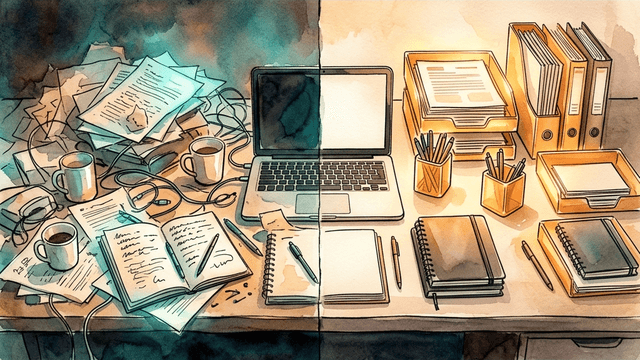
Why Your Brain Fights Organizational Systems
The Maintenance Cost Problem
Every organizational system has a maintenance cost — the ongoing effort required to keep it functional. Filing papers, updating task lists, processing inboxes, reviewing calendars.
Neurotypical brains handle maintenance costs automatically. It becomes routine. For ADHD brains, maintenance costs compete with every other demand on your already-depleted executive function resources (Barkley, 2012).
Here's the math that nobody does:
- Pretty Notion workspace: maintenance cost = high (daily reviews, page updates, property tagging)
- Simple sticky note on monitor: maintenance cost = near zero (write, look, throw away)
Guess which one actually works for ADHD?
The best organizational system isn't the most comprehensive. It's the one with the lowest maintenance cost your brain will actually sustain.
The Novelty Trap
Your dopamine system craves novelty (Volkow et al., 2009). New app? Dopamine spike. New organizational method? Exciting for 72 hours. The system itself becomes a hyperfocus target — and then, like all hyperfocus targets, it gets abandoned when the novelty wears off.
This is why you have seven productivity apps on your phone and use none of them.
The Perfectionism Spiral
ADHD perfectionism (yes, it's a thing) means your organizational system needs to be perfect before you start using it. You spend hours designing the system instead of doing the work the system was supposed to organize. The system becomes the procrastination.
The 4 Principles of ADHD-Proof Organization
After years of failed systems and researching what actually works for executive dysfunction, I've landed on four non-negotiable principles. Every system that survives in my life follows all four.
Principle 1: Make It Visible
"Out of sight, out of mind" isn't just a saying for ADHD — it's a neurological fact.
ADHD impairs object permanence for tasks. If a task isn't physically visible, your brain treats it as nonexistent. This is why digital task managers fail for many ADHD brains — the tasks disappear behind app icons.
What this means in practice:
- Physical whiteboards beat digital task lists
- Sticky notes on your monitor beat buried Notion pages
- A single visible pile beats a perfectly labeled filing cabinet you'll never open
- Transparent containers beat opaque drawers
Principle 2: Reduce to One Step
Every organizational action should require exactly one physical step to complete.
- Bad: Pick up mail → walk to office → open filing cabinet → find correct folder → file
- Good: Pick up mail → drop in the "deal with it" basket on the counter
Dr. Ari Tuckman (2012) calls this "lowering the activation energy." The more steps between you and the organized state, the less likely it happens. One step is the maximum. Zero steps is ideal.
Principle 3: Build for Failure
Your system will break. You will skip three days. The question isn't whether it'll happen — it's how easy it is to recover.
The best ADHD systems have:
- No streak dependency: Missing a day doesn't ruin the system
- Quick restart: You can resume in under 2 minutes
- No guilt architecture: There's no visual "failure log" showing you all the days you missed
This is why bullet journals with pre-printed daily pages don't work — every blank page is a monument to your failure. Use a system where yesterday simply doesn't exist.
Principle 4: Externalize Everything
Your working memory holds approximately 4 items (Cowan, 2010). Your brain is not a storage device — stop treating it like one.
Everything — appointments, tasks, ideas, grocery lists — must live outside your head. Not "most things." Everything. The moment you think "I'll remember that," you've already lost it.
Thawly was built on this principle. You dump your mental chaos into the AI, and it externalizes the entire execution plan — every decision, every step, every sequence — so your working memory can focus on doing, not remembering.
Stuck on something right now?
Stop reading about it — try it. Thawly breaks your task into one tiny step you can do right now.
Free · No signup · 3 seconds3 Systems That Actually Survive ADHD
These aren't the sexiest systems. They won't get Instagram likes. But they're still running in my life after months — which is more than I can say for any Notion template.
1. The Launch Pad
One specific spot near your door. Everything you need when leaving the house goes there: keys, wallet, phone, bag. Nothing else. No decoration, no other purpose.
Why it works: One location, one purpose, zero decisions. You don't organize — you just dump things in the same spot. Maintenance cost: zero.
2. The Doom Box (Legitimized)
You already have doom piles — those mysterious accumulations of papers, mail, and random objects that grow on every flat surface. Instead of fighting them, give them a box.
One box per room. Everything goes in it. Once a week (or month, honestly), you spend 15 minutes going through it. Most of it is trash. The rest gets dealt with.
Why it works: It works with your natural behavior instead of against it. (This is exactly the approach behind our Mail Pile Tool — acknowledging the pile instead of pretending it won't happen.)
3. The Digital Brain Dump
One single app. Not three. One. Use it exclusively for capturing — not organizing. Every thought, task, idea, or reminder gets typed in with zero formatting.
I use Apple Notes. Not because it's the best — because it opens in one second and requires zero decisions about where to put things. Capture now. Organize never. Or maybe later. Probably never.
The Systems Graveyard: What to Stop Trying
After eight years of ADHD and probably 40+ failed organizational attempts, I can confidently tell you what doesn't work for most ADHD brains:
- Color-coded filing systems: Too many categories = too many decisions = paralysis
- Daily planning rituals: Anything requiring daily setup at the same time will be abandoned within a week
- Complex digital dashboards: The more features, the higher the maintenance cost, the faster the collapse
- Systems that require consistency: If the system breaks when you skip a day, it's not built for your brain
I still struggle with this. Not every week is organized. Some weeks, the doom box overflows and the launch pad becomes a doom pad. That's fine. The system recovers because it was built to fail.
(Feeling overwhelmed just reading this? Start with one change. Our Decluttering Tool breaks the process into micro-steps so small they feel ridiculous.)
FAQ
Why can't I stay organized even when I try really hard?
Organization requires sustained executive function — specifically working memory, task monitoring, and impulse control. These are exactly the functions impaired by ADHD (Barkley, 2012). It's not about effort; it's about neurological capacity. The solution isn't trying harder — it's building systems with lower executive function demands.
What's the best organizational app for ADHD?
The one with the fewest features that you'll actually open. Seriously. A simple checklist app beats a complex project manager every time. If you need recommendations, check our Best ADHD Apps comparison — we tested seven over six months.
Should I hire a professional organizer?
If you can afford it, professional organizers who specialize in ADHD can be transformative — not because they organize for you, but because they build systems calibrated to your specific executive function profile. Look for organizers certified by ICD or NAPO with ADHD specialization.
How do I organize when I have too much stuff?
Don't start with "organize." Start with "reduce." For every item, ask: "Does keeping this require ongoing maintenance?" If yes, it needs to earn its place. Fewer possessions = fewer things to organize = lower cognitive load.
Why do I get hyperfocused on organizing instead of doing the actual work?
Because organizing feels productive without the emotional risk of the actual task. It's a form of productive procrastination — your brain gets the dopamine hit of "doing something" while avoiding the harder, scarier work. Recognize the pattern and set a timer: 15 minutes max for organizing, then switch to the real task.
Sources
- Barkley, R.A. (2012). Executive functions: What they are, how they work, and why they evolved. Guilford Press.
- Cowan, N. (2010). The magical mystery four: How is working memory capacity limited, and why? Current Directions in Psychological Science, 19(1), 51-57.
- Tuckman, A. (2012). Understand Your Brain, Get More Done: The ADHD Executive Functions Workbook. Specialty Press.
- Volkow, N.D. et al. (2009). Evaluating dopamine reward pathway in ADHD. JAMA, 302(10), 1084-1091.
Related Reading

Sean Z. holds a Master's degree in Cognitive Psychology. He spent 7 years in academic research focused on human cognition, followed by 10+ years designing products and services in the applied psychology space. He built Thawly after years of firsthand experience with ADHD task paralysis — combining academic understanding of executive function with the daily reality of living with it. About the Author → LinkedIn
Looking for more specific strategies?
Explore 115+ targeted tools for specific ADHD scenarios.
Browse the ADHD Toolkit →