Is Procrastination a Sign of ADHD? 5 Ways to Tell
Disclaimer: This article is for informational and educational purposes only. It is not a substitute for professional medical advice, diagnosis, or treatment. If you suspect you have ADHD, please consult a qualified healthcare provider.
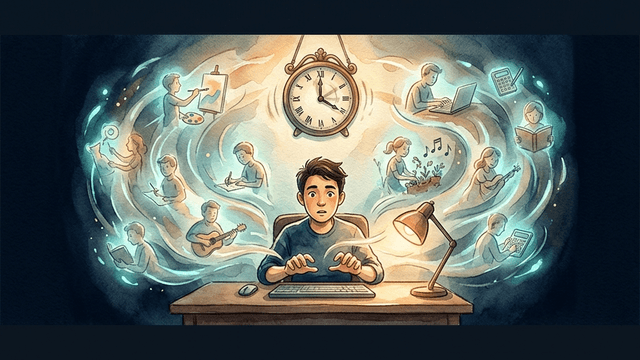
You've missed the deadline by four days. Not because you didn't know about it — you've been thinking about it nonstop since last week. Not because the task was hard — it's a 20-minute email. You've just been... not doing it. While simultaneously feeling terrible about not doing it.
Your friend tells you to "just start." Your therapist asks what you're avoiding. Your boss assumes you don't care.
But here's what none of them understand: you're not avoiding the task. Your brain is failing to initiate it. And that distinction might point to something more specific than garden-variety procrastination.
Regular Procrastination vs ADHD Procrastination
Everyone procrastinates. That's normal human behavior. Steel (2007) found that approximately 20% of adults identify as chronic procrastinators.
But ADHD procrastination operates through a fundamentally different mechanism:
Regular procrastination is typically an emotion regulation problem. You avoid the task because it triggers anxiety, boredom, or fear of failure. The avoidance is strategic — your brain is protecting you from an uncomfortable feeling (Sirois & Pychyl, 2013).
ADHD procrastination is an executive function failure. Your brain's prefrontal cortex cannot generate the activation signal needed to convert intention into action (Barkley, 2012). You want to do the task. You might even be excited about it. The bridge between wanting and doing is simply broken.
The practical difference? Regular procrastinators can usually start once the anxiety passes or the deadline creates enough pressure. ADHD procrastinators might not be able to start even with a gun to their head — and the deadline pressure often triggers paralysis instead of action.
5 Signs Your Procrastination Might Be ADHD
1. You Procrastinate on Things You Actually Want to Do
This is the biggest red flag.
Normal procrastination targets unpleasant tasks — taxes, awkward emails, dentist appointments. Makes sense. Your brain avoids pain.
ADHD procrastination doesn't discriminate. You'll procrastinate on the vacation you've been excited about for months. You'll delay starting the creative project you love. You'll put off calling your best friend — not because you don't want to talk to them, but because picking up the phone requires a task initiation sequence your brain can't execute.
If you regularly delay things that bring you genuine joy, that's not an emotion regulation problem. That's an executive function problem.
2. You Feel Physical Resistance, Not Just Mental
Normal procrastination feels like "I don't want to." It's a preference, a feeling, a choice (even if a bad one).
ADHD procrastination feels like "I can't." Not "I won't" — "I literally cannot make my body move toward this task." There's a physical heaviness, a wall between intention and action that no amount of willpower can penetrate.
I've described it as trying to push yourself through invisible concrete. Your mind is screaming "START" and your body is... just sitting there. That's not lack of motivation. That's executive dysfunction.
3. The Deadline Doesn't Help — It Makes Things Worse
For most procrastinators, deadlines eventually force action. The anxiety of missing the deadline overwhelms the anxiety of doing the task. Action happens.
For many ADHD brains, deadline proximity triggers the opposite: shutdown. The approaching deadline creates panic, the panic overwhelms the executive system, and the system freezes completely. You end up paralyzed AND panicking — the worst of both worlds.
(Stuck in that panic-freeze loop right now? Our Deadline Panic Tool breaks the task into steps small enough to bypass the freeze.)
4. You've Been Like This Since Childhood
Regular procrastination often develops in response to life circumstances — a stressful job, a toxic relationship, burnout from overwork. There's a "before" when you were productive.
ADHD procrastination has always been there. You were the kid who couldn't start homework until 10 PM. The teenager who had the cleanest room right before exam season (procrasticleaning). The college student who wrote every paper the night before.
The DSM-5 requires ADHD symptoms to be present before age 12 (APA, 2013). If your procrastination pattern has a clear starting point in adulthood, it's less likely ADHD. If you honestly can't remember a time when starting tasks was easy — that's a signal.
5. You Procrastinate Differently Throughout the Day
Normal procrastination is relatively consistent. If you're avoiding a task at 9 AM, you're still avoiding it at 3 PM. The avoidance is about the task, not the time.
ADHD procrastination fluctuates with your neurochemistry. You might be completely paralyzed at 2 PM and hyperfocused on the same task at 11 PM. Or functional on Monday and frozen on Wednesday — with no change in circumstances.
This inconsistency drives people crazy ("But you did it fine LAST week!"). It also points squarely at a neurological rather than motivational origin. Your dopamine availability fluctuates, and your executive function fluctuates with it (Volkow et al., 2009).
Stuck on something right now?
Stop reading about it — try it. Thawly breaks your task into one tiny step you can do right now.
Free · No signup · 3 secondsWhat the Research Actually Says
Nigg et al. (2005) found that procrastination in adults with ADHD correlates directly with deficits in behavioral inhibition and executive function — not with emotional avoidance. This is a critical distinction because it changes the treatment approach entirely.
If procrastination is emotional avoidance → CBT focusing on the avoided emotion is effective.
If procrastination is executive dysfunction → CBT alone often isn't enough. You need strategies that externalize executive function — implementation intentions, environmental restructuring, body doubling, and tools that remove decision points from the initiation sequence.
In our testing with Thawly, we've observed that users who receive AI-generated micro-step breakdowns start the first action within an average of 90 seconds — compared to the hours (or days) they reported spending paralyzed before. The micro-steps bypass the initiation barrier by making the first action so small it doesn't trigger the executive system's resistance.
So You Think It's ADHD. Now What?
I'm not going to tell you to "get evaluated" and leave it at that. Here's what actually helps:
1. Track the pattern. For two weeks, note every time you procrastinate. Write down: What task? What time? Did you want to do it? Could you do other things? This data is gold for a clinician.
2. Try executive function strategies first. If If-Then plans, body doubling, and task breakdown tools dramatically help, that's diagnostic information. These strategies target the executive function pathway — if they work, that's where your bottleneck is.
3. Get a proper evaluation. Not a 15-minute screening. A comprehensive ADHD assessment that includes childhood history, executive function testing, and differential diagnosis for depression and anxiety (which look very similar).
4. Don't wait for diagnosis to act. Executive function strategies help everyone — ADHD or not. Start using them now. The diagnosis can catch up later.
(Want to test whether task breakdown bypasses your procrastination? Try Thawly — type in the task you've been avoiding and see if micro-steps change anything. No signup required.)
FAQ
Can procrastination be the only symptom of ADHD?
Technically, no — ADHD requires multiple symptoms across domains (inattention, hyperactivity/impulsivity). But procrastination driven by executive dysfunction is often the most noticeable symptom, especially in adults with predominantly inattentive ADHD. Other symptoms may be present but masked by compensation strategies.
Is chronic procrastination always ADHD?
No. Chronic procrastination can result from depression, anxiety disorders, perfectionism, or simply learned behavioral patterns. The differentiator is whether the procrastination stems from emotional avoidance (not ADHD) or executive initiation failure (possibly ADHD). Both can coexist.
Does ADHD medication help with procrastination?
For ADHD-related procrastination, stimulant medication can significantly improve task initiation by increasing dopamine availability in the prefrontal cortex (Volkow et al., 2009). However, medication alone is rarely sufficient — combining it with behavioral strategies produces the best outcomes (Safren et al., 2005).
Why can I do some things immediately but procrastinate on others?
Because ADHD executive function is interest-dependent. Tasks that are novel, urgent, interesting, or competitive generate enough dopamine to bypass the initiation deficit. Boring, important-but-not-urgent tasks don't. This is why you can hyperfocus on a video game but can't open your email.
Sources
- American Psychiatric Association (2013). Diagnostic and statistical manual of mental disorders (5th ed.). APA Publishing.
- Barkley, R.A. (2012). Executive functions: What they are, how they work, and why they evolved. Guilford Press.
- Nigg, J.T. et al. (2005). Causal heterogeneity in attention-deficit/hyperactivity disorder. Biological Psychiatry, 57(11), 1224-1230.
- Safren, S.A. et al. (2005). Cognitive-behavioral therapy for ADHD in medication-treated adults. Behaviour Research and Therapy, 43(7), 831-842.
- Sirois, F.M. & Pychyl, T.A. (2013). Procrastination and the priority of short-term mood regulation. Social and Personality Psychology Compass, 7(2), 115-127.
- Steel, P. (2007). The nature of procrastination. Psychological Bulletin, 133(1), 65-94.
- Volkow, N.D. et al. (2009). Evaluating dopamine reward pathway in ADHD. JAMA, 302(10), 1084-1091.
Related Reading

Sean Z. holds a Master's degree in Cognitive Psychology. He spent 7 years in academic research focused on human cognition, followed by 10+ years designing products and services in the applied psychology space. He built Thawly after years of firsthand experience with ADHD task paralysis — combining academic understanding of executive function with the daily reality of living with it. About the Author → LinkedIn
Looking for more specific strategies?
Explore 115+ targeted tools for specific ADHD scenarios.
Browse the ADHD Toolkit →