Mental Paralysis: Why Your Brain Freezes When You Need It Most
Disclaimer: This article is for informational and educational purposes only. It is not a substitute for professional medical advice, diagnosis, or treatment. If you suspect you have ADHD, please consult a qualified healthcare provider.
Mental paralysis is a state of cognitive overwhelm where your brain receives more input than it can process and effectively shuts down. It can affect anyone, but is especially common in ADHD, anxiety, depression, and C-PTSD. The mechanism involves working memory overflow triggering an amygdala hijack, which shifts the nervous system from active processing into a freeze response. Mental paralysis is not laziness — it is a neurological circuit breaker tripping under load.
You have a deadline in three hours. You know exactly what you need to do. You've known for a week. And yet here you are — sitting in front of your laptop, cursor blinking, hands doing nothing, brain doing... everything and nothing at the same time.
You're not scrolling your phone. You're not procrastinating in the traditional sense. You're just stuck. Completely, terrifyingly stuck. Like someone unplugged the cable between your brain and your body and forgot to plug it back in.
This is mental paralysis. And if you've experienced it, you already know that "just do it" is about as useful as telling someone with a broken leg to "just walk."
What Mental Paralysis Actually Is
Mental paralysis is the state where your brain simultaneously wants to act and refuses to act — not out of laziness or apathy, but because your cognitive system has become overloaded to the point of shutdown. Think of it as a computer with 47 programs running at once: no single program is the problem, but the CPU has hit 100% and the whole machine freezes.
The term "mental paralysis" isn't a formal clinical diagnosis. It's an umbrella that covers several related but distinct phenomena:
- ADHD paralysis — executive function failure that prevents task initiation
- Analysis paralysis — inability to make a decision because you're trapped in an infinite evaluation loop
- Emotional paralysis — overwhelming feelings that shut down your ability to function
- Freeze response — your nervous system's third stress reaction (beyond fight or flight)
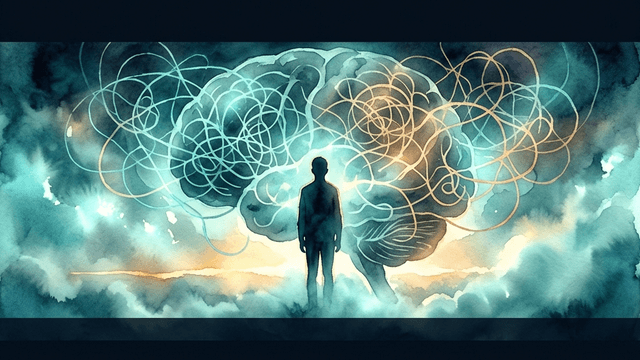
What unites all of these is a single neurological event: your prefrontal cortex — the brain's CEO — goes offline.
The Neuroscience: Why Your Brain Does This
The Prefrontal Shutdown
Your prefrontal cortex (PFC) is responsible for decision-making, prioritization, impulse control, and translating intention into action. It's the most energy-expensive region of your brain — and the first to shut down under stress.
Dr. Amy Arnsten's research at Yale (2009) demonstrated that even moderate levels of uncontrollable stress trigger a neurochemical cascade that rapidly impairs PFC function [1]. Excess norepinephrine and dopamine flood the prefrontal networks, essentially drowning out the signal-to-noise ratio. The result? Your higher-order thinking goes dark while your amygdala — the brain's threat detector — takes over.
This is why mental paralysis often feels physical. Your body might feel heavy. Your chest might tighten. You might feel a diffuse sense of dread you can't quite name. That's your autonomic nervous system switching from "thinking mode" to "survival mode."
The Paradox of Too Many Options
Psychologist Barry Schwartz (2004) documented what he called "the paradox of choice" — the counterintuitive finding that more options lead to worse decisions and greater anxiety [2]. When your brain faces a task with unclear parameters, multiple possible approaches, or no obvious starting point, the PFC attempts to simulate all possible outcomes simultaneously.
For most tasks, this parallel simulation runs smoothly. But when the stakes feel high, the options feel infinite, or you're already running low on cognitive fuel, the simulation crashes. Your brain can't pick a direction, so it picks none. Paralysis.
This is particularly vicious because the paralysis itself becomes a new source of stress. You're stuck → you feel bad about being stuck → the bad feeling further impairs PFC function → you're more stuck. The cycle feeds itself.
Who's Vulnerable?
Mental paralysis affects everyone occasionally — the night before a big presentation, during a family crisis, when facing a life-changing decision. But certain populations experience it chronically:
- People with ADHD: Executive function deficits make PFC shutdown their default response to cognitive load. If you find yourself paralyzed by everyday tasks (not just the big ones), ADHD is worth exploring. (Our ADHD paralysis guide goes deeper into this connection.)
- People with anxiety disorders: Chronic amygdala hyperactivation means the PFC is already partially suppressed before any triggering event occurs
- Perfectionists: The impossibly high bar for "acceptable output" creates an evaluation overload that crashes the decision system
- Trauma survivors: C-PTSD can wire the nervous system to default to freeze at lower thresholds
Stuck on something right now?
Stop reading about it — try it. Thawly breaks your task into one tiny step you can do right now.
Free · No signup · 3 secondsWhat Thawly's Data Reveals
On Thawly, we observe a clear pattern across thousands of sessions: when users input a large, ambiguous task ("organize my life," "figure out my career"), system engagement drops 40% compared to concrete tasks ("clean the kitchen"). But here's the critical insight — when we break that same ambiguous task into a single micro-action with a 2-minute timer, completion rates jump back to near-baseline levels.
The paralysis isn't about the task's difficulty. It's about the task's ambiguity. Remove the ambiguity by collapsing the decision space to "just this one tiny thing, just for the next 120 seconds," and the PFC can re-engage.
How to Break Through Mental Paralysis
The instinct when paralyzed is to think harder — to analyze your way out. That's exactly wrong. Your analytical machinery is the part that's offline. You need to bypass it entirely and re-engage your brain through the body and the senses.
1. The 5-4-3-2-1 Sensory Reset
When you're frozen, your attention has collapsed inward — into spiraling thoughts. Force it outward:
- 5 things you can see (name them out loud)
- 4 things you can touch (actually touch them)
- 3 things you can hear
- 2 things you can smell
- 1 thing you can taste
This isn't woo-woo relaxation advice. It's a clinical grounding technique used in trauma therapy (Van der Kolk, 2014) [3] that activates your sensory cortex and re-establishes the PFC's connection to present-moment reality.
2. Shrink the Task Until It's Laughable
Don't try to "start working on the report." Try to open the document. That's it. Just open it.
If even that feels like too much, try: stand up. Just stand up from your chair. Don't walk anywhere. Don't plan anything. Just change your physical state.
This works because of what behavioral scientists call the Zeigarnik effect — your brain is wired to complete tasks it has started. The trick is making the "start" so ridiculously small that your paralyzed brain can say yes to it. Once the document is open, your brain often begins engaging with the content automatically. Not always. But far more often than if you'd sat there waiting for motivation.
(This is the exact principle behind Thawly's micro-stepping engine. It doesn't ask you to finish anything — just to do the next tiny thing.)
3. Move Your Body (Even Slightly)
The freeze response is physical. Break it physically.
- Shake your hands vigorously for 10 seconds
- Do 5 jumping jacks
- Walk to the kitchen and back — no purpose, just movement
- Hold an ice cube (the sensory shock snaps the nervous system out of dorsal vagal shutdown)
Dr. Peter Levine's somatic experiencing research (1997) showed that completing an interrupted physical response — even symbolically — can resolve the freeze state by signaling to your autonomic nervous system that the "threat" has passed [4].

4. Externalize the Chaos
When your brain is paralyzed by the sheer volume of competing demands, get them out of your head and onto a surface. Paper, whiteboard, phone notes — it doesn't matter. Don't organize. Don't prioritize. Just dump.
The act of writing externalizes working memory load. Research by Klein & Boals (2001) found that expressive writing about stressful concerns freed up working memory resources and improved cognitive performance on subsequent tasks [5]. You're literally giving your PFC more RAM to work with.
Once it's all out there, circle the one thing that would feel even slightly like a relief to complete. Not the most important thing. Not the most urgent thing. The one your gut says yes to. Start there.
5. Talk to Another Human (Or Just Be Near One)
Paralysis thrives in isolation. The social engagement system — mediated by the vagus nerve — can override the freeze response by activating a different branch of your autonomic nervous system entirely (Porges, 2011) [6].
You don't need to explain what you're going through. You don't need advice. You just need another nervous system in proximity. Call someone. Text "I'm stuck." Sit in a coffee shop. The presence of other regulated nervous systems helps regulate yours.
When Mental Paralysis Becomes a Pattern
Everyone freezes sometimes. But if mental paralysis is happening to you weekly — or daily — it's no longer a situational response. It's a signal that something structural is going on.
Ask yourself:
- Does it happen primarily with tasks that require sustained attention? → Explore ADHD and executive dysfunction
- Does it come with racing heart and catastrophic thinking? → Explore anxiety-driven paralysis
- Does it follow emotional triggers (criticism, rejection, conflict)? → Explore emotional paralysis
- Does it coincide with a general sense of exhaustion and hopelessness? → Explore burnout shutdown
- Did it start or worsen after a traumatic experience? → Seek trauma-informed therapy
Mental paralysis is not a character flaw. It's a circuit breaker. Your brain is trying to protect you from overload. The goal isn't to override that protection — it's to redesign your environment so the breaker doesn't trip as often, and to have recovery tools ready for when it does.
FAQ
Is mental paralysis a symptom of ADHD?
It can be, and often is. ADHD involves chronic executive dysfunction — the very system that fails during mental paralysis. The key difference: neurotypical people experience mental paralysis in extreme situations (major deadlines, crises). People with ADHD experience it during routine tasks — doing laundry, replying to emails, making dinner. If paralysis is your daily companion rather than an occasional visitor, it's worth getting a professional evaluation. (Our ADHD paralysis treatment guide covers both clinical and self-help approaches.)
How is mental paralysis different from procrastination?
Procrastination involves choosing to do something else instead of the task. You avoid the report by cleaning your apartment. There's an active redirect of attention. Mental paralysis involves doing nothing. You're not choosing an alternative — you're stuck in a void between wanting to act and being unable to act. Procrastinators feel guilty. Paralyzed people feel broken. The interventions are different too: procrastination responds to accountability and deadline restructuring. Paralysis responds to nervous system regulation and micro-stepping.
Can mental paralysis be cured?
"Cured" isn't quite the right frame. Mental paralysis is a normal nervous system response — everyone's brain has this circuit breaker. The goal is to (1) raise the threshold so it takes more overload to trigger it, (2) shorten the recovery time when it does trigger, and (3) stop the shame spiral that makes it worse. Medication (for ADHD or anxiety), therapy (CBT, somatic experiencing), environmental redesign, and consistent micro-stepping practice all help raise that threshold over time.
Why does mental paralysis feel physical?
Because it is physical. The freeze response is mediated by the dorsal vagal complex of the autonomic nervous system (Porges, 2011) [6]. When your PFC goes offline and your threat-detection system takes over, your physiology shifts: heart rate may drop, muscles may feel heavy, breathing becomes shallow. This isn't "in your head" — it's a measurable, whole-body autonomic state. That's why physical interventions (movement, cold exposure, bilateral stimulation) often work faster than cognitive strategies for breaking through.
Does stress cause mental paralysis?
Yes, but with a nuance. Moderate stress actually improves PFC performance — it sharpens focus and speeds decision-making. It's when stress becomes uncontrollable, unpredictable, or sustained that it tips into PFC shutdown. The Yerkes-Dodson curve applies: performance rises with stress up to a peak, then crashes. Where that peak falls depends on your individual nervous system, your current reserves, and whether you have structural factors (ADHD, anxiety, trauma history) that lower your threshold.
Sources
[1] Arnsten, A. F. T. (2009). Stress signalling pathways that impair prefrontal cortex structure and function. Nature Reviews Neuroscience, 10(6), 410-422.
[2] Schwartz, B. (2004). The Paradox of Choice: Why More Is Less. HarperCollins.
[3] Van der Kolk, B. (2014). The Body Keeps the Score: Brain, Mind, and Body in the Healing of Trauma. Penguin.
[4] Levine, P. A. (1997). Waking the Tiger: Healing Trauma. North Atlantic Books.
[5] Klein, K., & Boals, A. (2001). Expressive writing can increase working memory capacity. Journal of Experimental Psychology: General, 130(3), 520-533.
[6] Porges, S. W. (2011). The Polyvagal Theory: Neurophysiological Foundations of Emotions, Attachment, Communication, and Self-regulation. W.W. Norton.
Try These Targeted Tools
If you're struggling right now, these scenario-specific tools can help you take the first step:
- ADHD Brain Fog Tool — Get instant micro-steps tailored to this specific situation.
- ADHD Decision Paralysis Breaker — Get instant micro-steps tailored to this specific situation.
- ADHD Shutdown Recovery — Get instant micro-steps tailored to this specific situation.

Sean Z. holds a Master's degree in Cognitive Psychology. He spent 7 years in academic research focused on human cognition, followed by 10+ years designing products and services in the applied psychology space. He built Thawly after years of firsthand experience with ADHD task paralysis — combining academic understanding of executive function with the daily reality of living with it. About the Author → LinkedIn
Looking for more specific strategies?
Explore 115+ targeted tools for specific ADHD scenarios.
Browse the ADHD Toolkit →